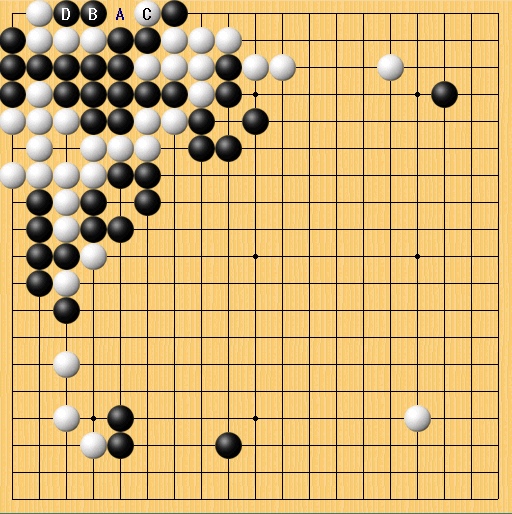
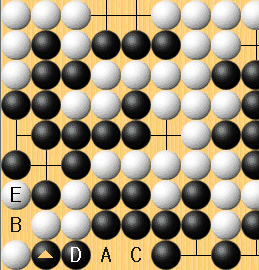
This is repeating itself forever. So if this decide outcome of game, then whole game is tie.
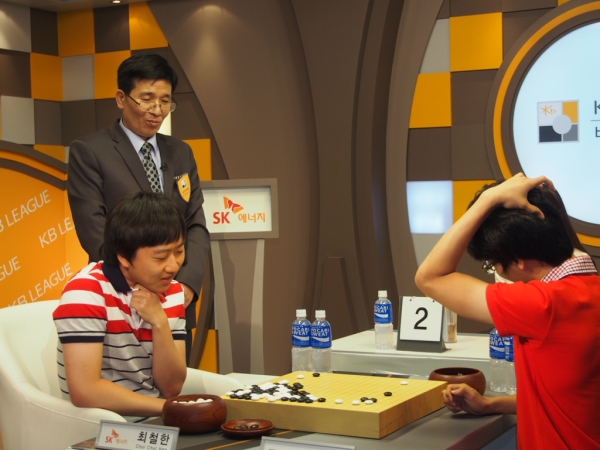
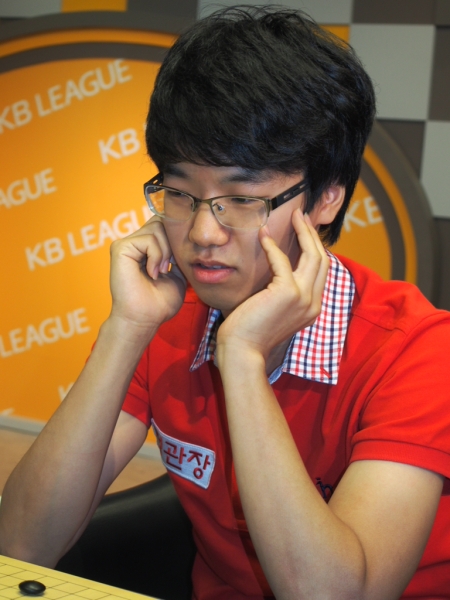
Game between Choi Cheolhan vs Ahn Seongjoon created this.
Another one created by Rin vs Komatsu.
This form of co-alive is very rare. This is the third one happend in official game. The first one was by Rin vs Komatsu. The second one was by O Mien vs Uchida Shuhei.
Last edited by trout on Sun Jun 30, 2013 8:10 am, edited 1 time in total.
trout wrote:if this decide outcome of game, then whole game is tie.
It depends on the rules.
This form of co-alive is very rare. This is the third one happend in official game. The first one was by Rin vs Komatsu. The second one was by O Mien vs Uchida Shuhei.
Please clarify the count of the games including the Rin vs Komatsu shape (with its global ko intersections)! Was there only this one game or were there three such games? (To be sure, I do NOT mean ordinary Eternal Life (the shape in the Choi Cheolhan vs Ahn Seongjoon game.)
I always thought the ko rule prevents board positions from repeating themselves, but I assuem this holds true only until after the next stone is played?
paK0 wrote:I always thought the ko rule prevents board positions from repeating themselves, but I assuem this holds true only until after the next stone is played?
Well, this depends on what ko rule you use. In the case of strict positional super ko where the board must never look the same twice, then such positions will end eventually. Chinese rules call for this. However, most rule sets use looser ko rules, like situational super ko (the board cannot repeat a position if you created it on your turn previously) used by AGA and New Zeeland. Some ko rules are only for one stone taking another back and forth. And Japanese and Korean rules say that a repeated board position mean "no result" and the game must be replayed.
"You have to walk before you can run. Black 1 was a walking move.
I blushed inwardly to recall the ignorant thoughts that had gone through
my mind before, when I had not realized the true worth of Black 1."
-Kageyama Toshiro on proper moves
Though known for centuries from problems, it seems that the first example of eternal life (chosei) in an actual game is as recent as 1989-01-28 when Kono Mitsuki and Kurotaki Masanori, a pair of 1-kyus, produced one in the Nihon Ki-in's insei tournament.
The first ever chosei in official pro games was on 1993-09-02, in the 49th Honinbo League between Komatsu Hideki and Rin Kaiho. Probably because it was a league, the game was, most unusually, not replayed, and both players were given half a point. This result was even more dramatic than this bare description betrays. The players were fighting over the last a half-point ko, the result of which would decide the game. Komatsu had just taken the ko and Rin appeared to be out of ko threats, but he found one which threatened the chosei. At first, Komatsu, goggle-eyed, thought this was a mistake, but then he realised what it threatened. He could not afford to lose the half-point ko, but all was not lost. He went ahead and connected the half-point ko. Although Rin could then set up what looked like a huge new ko, Komatsu had one last internal threat whereas Rin had no threats at all.
GoGoD also has an example from an amateur game, 2003-09-28c, in the Kanto final of the 2nd Students' Oza in Japan. The game was declared void and the players shared the title.
John Fairbairn wrote:Though known for centuries from problems, it seems that the first example of eternal life (chosei) in an actual game is as recent as 1989-01-28 when Kono Mitsuki and Kurotaki Masanori, a pair of 1-kyus, produced one in the Nihon Ki-in's insei tournament.