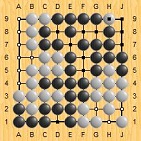
The move 1 is the next "idea" I would have in mind in this setup. It would kind of work together with 5 and threaten a big moyo anyway. Is this still as bad as the previous idea in your mind?
Pippen wrote:The move 1 is the next "idea" I would have in mind in this setup. It would kind of work together with 5 and threaten a big moyo anyway. Is this still as bad as the previous idea in your mind?
Uberdude wrote:
Pippen, I prefer that jump to f17, but still I would rather not make the exchange
Can u try to explain why? Because the more I look at it the more I like the jump to F5. It more or less forces White to enclose the corner and thus keeps sente while the split stone gets some distant help.
Pippen wrote:
Ah, ok. Is tewari commonly accepted as an analyzing tool or are there discussions about its validity?
Both! It's reasonable that anything you are going to accept as a common tool has a discussion about its validity. In this case, I think one discussion you may find interesting is "How to lie with Tewari".
In both cases I see Black at least even with White. I begin to think that move 1 (F5) is better than the previous idea of jumping at the upper shimari, because F17 leaves three singled + isolated black stones back while 1 (F5) works better together with 5 and the lower hoshi. Let's see if moyoaji destroys this idea with tewari as well^^.
Black now has ideal moves in the 'a' or 'b' region to expand his own framework and limit white's shimaris. White would like to get in the move at , but there is not time. This result looks bad for white. Instead, white will approach one of black's corners.
I also don't see what you have against your own stones. In your second diagram forces white to remove your group's base. You are actively pushing your opponent into hurting your stones. Why?
Why not play this? Why not help your weak group? White pincered very loosely, so make the base he offered. Then, after white approaches, he forces you to take profit in the corner. Isn't this the kind of result you should want?
Does black now continue to run with a move around 'a'? Giving white the possibility of a splitting attack at 'b'?
Does black tenuki to attempt to build the right? Only to be put behind enemy lines when white continues to advance outward while preparing to reduce the very framework black just tried to build?
Your large enclosure is not that solid, and because of the position of it can be invaded. If white gets another move on the right your own corner could become a weak group since it cannot expand more on the bottom. Instead, if approached on the right, it must make it's base in the corner. White's corner, on the other hand, can still expand to either 'e' or 'f' to make it more secure.
Looking at this board, I see white has one weak group, with a base, which he just helped. Black, on the other hand, has a baseless weak group and a weak stone. And can black claim to have more on this board than white? White has two enclosures to black's one and while black may have more potential he also has the only thing on the board that can be attacked.
Perhaps this is even on the board, but considering white has komi I'm not so sure.
EDIT: I decided to look for some splitting fuseki where the player ignores the splitting stone in professional games. I looked at every 2014 game on Go4Go and found exactly 3 games with an early splitting stone that was ignored. All were Orthodox fuseki games. In no case did the professional pressure their opponent into harming the stone. Here are the examples:
Responding to a threat of removing the base is far more common in professional games. And also more common than a player ignoring their own splitting stone when threatened was both players ignoring the splitting stone. So in your game, going back to the very start, white could play like this:
"You have to walk before you can run. Black 1 was a walking move.
I blushed inwardly to recall the ignorant thoughts that had gone through
my mind before, when I had not realized the true worth of Black 1."
-Kageyama Toshiro on proper moves
If you have certain emotions when playing big moyo games, work on that instead of trying to find openings that strive to avoid moyos. We are not strong enough to claim any kind of style except 'amateurish'. We should play as the situation demands and not according to our illusional go-personality. In this example, the situation demands to build the right side as Black, not to split the left side, especially not if we're going to build the top and bottom sides afterwards. It's inconsistent and negative in a misguided way. I would describe Black's play as 'thin' rather than 'light'.
Also, I'd be interested to see if this is an example where tewari doesn't work, because it seems if you reorder moves black and white play decent moves and the white's split move ends up being very bad which he wasn't in the original game:
I think tewari requires a sane move order, not an arbitrary move order. In your second diagram 3-5-7 are kind of "what". In the game black answered the white stone three times : The cost was that that white stone became a terrible move.
Edit: Because 3 would be played at 8 in your crazy move order.
Loons wrote:I think tewari requires a sane move order, not an arbitrary move order. In your second diagram 3-5-7 are kind of "what". In the game black answered the white stone three times : The cost was that that white stone became a terrible move.
Edit: Because 3 would be played at 8 in your crazy move order.
+10086
You need to make sure the order being used for tewari is reasonable for at least one side, otherwise you just have a bunch of bad moves in a way that does not allow for you to conclude what the net result is. Moves 5, 7, and 8 are all ridiculous. If white had 8 somewhere else (e.g. something on the top or right side) then you can conclude that black played badly (since the only ridiculous moves were all from black).
IMO 5 and 7 are normal moves for black creating his own moyo and bribing white to invade somewhere, just 8 would be a (very) bad move (we talk about the tewari-scenario here). That would show that tewari doesn't work, because 8 was certainly not a bad move in the original game unlike in the tewari analysis. So it would follow that moves that seem bad in tewari are not necessarily bad....
Pippen wrote:IMO 5 and 7 are normal moves for black creating his own moyo and bribing white to invade somewhere, just 8 would be a (very) bad move (we talk about the tewari-scenario here). That would show that tewari doesn't work, because 8 was certainly not a bad move in the original game unlike in the tewari analysis. So it would follow that moves that seem bad in tewari are not necessarily bad....
5 and 7 are... normal moves... I think it more shows that your judgement doesn't work. If 5 and 7 are normal moves, then it should mean that the below result should be even. What do you think?
illluck wrote:5 and 7 are... normal moves... I think it more shows that your judgement doesn't work. If 5 and 7 are normal moves, then it should mean that the below result should be even. What do you think?
Considering that Black has sente, yes, I think it's even, maybe even favourable for Black. But that doesn't say much for I am too weak to give a judgement here, maybe some high dan can tell....


 exchange
 stone like this, but now it is very easy for Black to sacrifice.
 , but there is not time. This result looks bad for white. Instead, white will approach one of black's corners.
 forces white to remove your group's base. You are actively pushing your opponent into hurting your stones. Why?