Page 12 of 18
Re: Why do some people never reach shodan
Posted: Fri Sep 30, 2016 10:10 am
by John Fairbairn
Why invest your time studying if you don't enjoy it and probably won't become shodan anyway? Or why invest your time studying if you don't enjoy it, and don't want to become shodan anyway?
I wouldn't have disagreed with this until today. It just so happens I have just started reading a book by a Chinese martial arts grandmaster, and he addresses this problem. He says that it is normal for everyone to reach stages (plural, i.e. several times) when they feel practice is boring or is just not leading anywhere. The reason is that, especially in the early stages, you don't follow a straight path to your goal. You make mistakes and so make detours. Instead of going North you go roughly North-west or North-east, but sometimes you lose your bearings so much you go due West or East. He claims the trick then is to get a teacher to make a correction for you. This still won't guarantee you go true North, but you will at least resume a roughly northward path.
He says these detours, which can all be predicted accurately by an experienced teacher, are biggest at the beginning but reduce in amplitude as you improve. You gradually learn the art of self-correction.
He divides the path of learning a martial art up into five levels. What I found especially interesting is that once you move onto Level 4 you don't really need a teacher any more. I found this interesting because I've often wondered about go pros who reach 1-dan (which seems like having completed Level 3) and then are expected to do without a teacher, beyond the occasional Shuko Seminar or the like. This seems rather different from chess (especially the Soviet School style of chess) where even world champions have trainers (e.g. Carlsen hired Kasparov).
Following the martial arts model, it seems as if daal is still on Level 1 or 2. At Level 1 you would still be learning the form (the moves) and basics such as standing up straight. In Level 2 you would be able to move on to facing a partner and acquiring the first notions of self defence, while refining your posture.
From my experience it seems true that the scope your mistakes and lack of improvement is huge in Level 1. I have watched a lot of taiji beginners, and they certainly can't stand up straight. When the teacher says take a step to the right, the first thing most of them do is look down to where their foot is going to go. The head tilts (the brain is rather heavy) and they are straightaway off-balance and so the whole foot goes down in a flat thump, instead of heel first, with head erect. It also does seem true that people are generally incapable of correcting this for themselves, and do need a teacher.
I'm surmising that daal's call to the forum is tantamount to asking for the advice of a teacher, which he has now had and accepted, so he should (according to the model) start moving up again. But he needs to accept that he will detour again before too long. However, he should then know how to handle it (ask the forum again) but will be able to correct himself a little bit more each time, i.e. the detours will gradually get shorter.
Re: Why do some people never reach shodan
Posted: Fri Sep 30, 2016 11:26 am
by Kirby
I agree that the path is not always easy, and motivation may be hard at first. But given the limited time we have on Earth, if you don't really want to become shodan, and if you don't enjoy studying... Seems somewhat of a poor choice to spend your time.
Maybe John's argument is that it may be difficult to accurately gauge your desire and/or chance of reaching a given milestone. If that's the argument, I agree. Or maybe the argument is that the chances of becoming shodan are probably higher than one might think, since things get easier over time. I agree with that, too.
Otherwise, I don't follow the logic.
Re: Why do some people never reach shodan
Posted: Fri Sep 30, 2016 3:46 pm
by John Fairbairn
Otherwise, I don't follow the logic
Seems pretty clear to me: (a) when a person feels depressed or frustrated and can't see a way forward, someone of more experience in the same field can show there is actually light at the end of the tunnel; (b) when a person has already invested a lot of time and effort into something (and emits a cry for help, to boot) it is rather unfeeling to tell him to throw the baby out with the bathwater - especially if (a) applies. Glass half full may be a better message than glass half empty.
But do try not to overanalyse this and remember the context. It's all about a chap who needs some gentle encouragement. It's not about you or forensic science.
Re: Why do some people never reach shodan
Posted: Fri Sep 30, 2016 8:00 pm
by Kirby
Thanks for clarifying, John. I agree with (a), and hopefully the responses in this thread have helped in that front. I don't agree with (b), necessarily. It might seem like a pity that you've invested time into something and don't continue with it, but if it's not bringing you happiness, it seems more of a pity to waste your time on it. This is not just with go, but with anything. I've worked where I am now for almost 4 years now, and it would be a pity in some ways to move to a different team and "waste" the experience I've gotten so far. But if the job isn't making me happy, why not make a move if I have the means? The life experience acquired from the job is not wasted.
I don't see this as a glass-half-empty approach. I think it's logical.
I am not telling daal to quit go study. I am telling him to make decisions to lead to a happy life. He knows best if that means studying go.
I am not trying to do forensic science or make this about me, either. I genuinely think my illustration is a logical model that can simplify the decision making process. The model I gave allows for outcomes that result in sticking with go, too. You seem focused only on the non-go outcomes.
Re: Why do some people never reach shodan
Posted: Sat Oct 01, 2016 1:02 am
by John Fairbairn
daal: I've read a lot more of the book The Rookie, which you will recall is about a chess weakie simply trying to become less of a weakie - nothing to do with becoming a grandmaster or pro.
It seems pretty clear now that the immediate answer does not lie in more chess/go knowledge, but almost entirely in self knowledge. Most games, which in amateur chess tournaments are against people of roughly the same grade (same as go?), and almost by definition you can expect to score 50%. Most games, on both sides, are lost by whoever makes the last big mistake, and the mistakes are made for reasons such as lack of concentration, tiredness, impatience (e.g. in winning a won game), greed, showing off, fear, drunkenness, etc, etc. Superior or inferior technical knowledge has next to nothing to do with it, within a given grade band (fairly wide - seems to be about 4-5 kyus). If you can get the mental discipline right, you can convert your score from 50% to nearly 100% - four kyu improvement!
I've mention before on this forum that one of the commonest words used by Japanese pros giving advice and not often picked up by western readers is taido - attitude. Coincidentally, I've noticed lately a significant increase in mention of the word yakimochi (jealousy or greed, in the sense of trying to deny the opponent any territory at all). There are a couple of recent books about it, one almost exclusively on the topic (I think it was in the title).
So mental discipline during play may be the area to focus on. I haven't got far enough into the book to be able to tell you whether the chess quest was successful, or what measures are needed (though having a pre-game strategy has been mentioned, and it seems important to avoid blitz games). But when I used to play a little, one trick I used was to put, say, three stones in front of my side of the board to force me to remember three attitudinal things. Others do things like forcing themselves to play their moves left handed so as to slow down. You can of course also sit on your hands. Not just avoiding blitz games but avoiding mice and click-happiness may be wise (unplug your mouse while playing online or reviewing pro games?).
Maybe others can contribute their attitude-boosting tricks.
Re: Why do some people never reach shodan
Posted: Sat Oct 01, 2016 4:08 am
by daal
Although I can't really relate to Kirby's chart, I do get the gist of it. I agree that it is worth thinking about how much you want something and what you are willing to do to get it, and I also agree that it is important to consider what one enjoys about an activity, and what one wants to get out of it.
It has been pointed out before in other discussions that banking one's pleasure on improvement is a dead-end street, and partly for that reason, I have stopped stressing out about studying to improve and have spent most of my go time over the last few years just playing, which I enjoy. I do also happen to enjoy studying, but feel irritated if it is not producing any tangible results. I do however know that improving is fun, and that if it is possible, it is worth a good amount of effort.
When I started this thread, I took it as a given that for some people, studying is no longer effective, that no matter what they study, they won't become stronger go players. This is probably disappointing to anyone who is at this stage, but it seems a bit bitterer if it happens when you still play at kyu level.
What I've seen in this thread is that people don't see my assumption as proven, and this raises contrary emotions. On the one hand, I feel compelled to search for and offer evidence that there is good reason some people are stuck at kyu level, and on the other hand, I am boistered by the thought that if I can't prove it, why should I accept it? I guess I remain skeptical. Just because you can't prove something is not a reason to ignore the evidence. Nonetheless, this thread has also helped me see that there are indeed aspects of go that are within my power to improve.
Of these, the most compelling are not the hard factors such as being able to do harder problems and remember more josekis, but rather the soft factors: the attitude that John talks about, the fighting spirit and time management that Knotwilg mentions. I imagine that I can indeed improve my hard skills, though perhaps not dramatically, but more than this, to improve my soft skills, I need to break out of my routine, and I think by shifting my emphasis for a while towards studying and away from playing for fun I'll have the opportunity to distance myself from a few bad habits.
Re: Why do some people never reach shodan
Posted: Sat Oct 01, 2016 5:17 am
by HKA
I really like Kirby's chart. Perhaps someone better at maths than I can suggest a small refinement. We need another axis to account for what I would call the "go equipment variance" While this factor tends to mirror enthusiasm in early days, it ultimately has an inverse relationship to strength - better the player, more pedestrian the go set.
BTW - I just got a cool new go table from China!
Re: Why do some people never reach shodan
Posted: Sat Oct 01, 2016 6:05 am
by daal
HKA wrote:I really like Kirby's chart. Perhaps someone better at maths than I can suggest a small refinement. We need another axis to account for what I would call the "go equipment variance" While this factor tends to mirror enthusiasm in early days, it ultimately has an inverse relationship to strength - better the player, more pedestrian the go set.
BTW - I just got a cool new go table from China!
Congratulations?
Your axis unfortunately doesn't have a place in Kirby's chart. Kirby's chart is prescriptive - it tells you what you should do, whereas your axis is descriptive ... unless of course you mean that playing with cheaper materials will make you better, in which case you'd be wrong - I've tried that.
Re: Why do some people never reach shodan
Posted: Sat Oct 01, 2016 9:32 am
by Kirby
Good luck, daal

Re: Why do some people never reach shodan
Posted: Mon Oct 03, 2016 8:09 am
by hyperpape
One question I never saw asked or answered: how long have you been stuck?
Re: Why do some people never reach shodan
Posted: Mon Oct 03, 2016 10:50 am
by daal
I missed it being asked. I've been stuck at 5k, with an occasional foray into 4k territory, for about three years. I'd also be curious to know if anyone who has been stuck this long has managed to get the improvement ball rolling again.
Re: Why do some people never reach shodan
Posted: Mon Oct 03, 2016 12:55 pm
by Ember
daal wrote:I'd also be curious to know if anyone who has been stuck this long has managed to get the improvement ball rolling again.
I've been stuck at 6k for about 4 years. I was quite active playing tournaments, intermitted with some self-study for a few weeks here and there, solving tsumego, getting my games commented and taking lessons from Guo Juan from time to time and it was SO frustrating. Nothing I did seemed to help. Everybody said I was playing too slow, timid moves and I was struggling very hard to overcome this for quite some time (I might have overcome this if I had played more, but, well...

). However, since I started to play more actively, I was finally progressing again and I was able to go up a rank or two. And I discovered after many years that I could enjoy fighting hard on the board and that I could progress again. I'm now playing as a 4k and right now I'm swinging into the more aggressive direction - a touch too much, maybe - and I hope to some day be able to balance my game more. This is kind of my most important goal at the moment and I guess it will keep me busy for many, many, many years to come since it isn't only a matter of technique but of thinking and self-control, too. ^^;
Re: Why do some people never reach shodan
Posted: Mon Oct 03, 2016 3:25 pm
by Uberdude
daal wrote:I've been stuck at 5k, with an occasional foray into 4k territory, for about three years. I'd also be curious to know if anyone who has been stuck this long has managed to get the improvement ball rolling again.
A few years ago I had a student in the BGA's teaching program (Ludan Fang) who had plateaued at 5k for about a year (actually gone down a bit from a brief earlier peak). After a year of my teaching (shaded area below) she had gained 155 GoR or about one and a half stones to a good 4k.
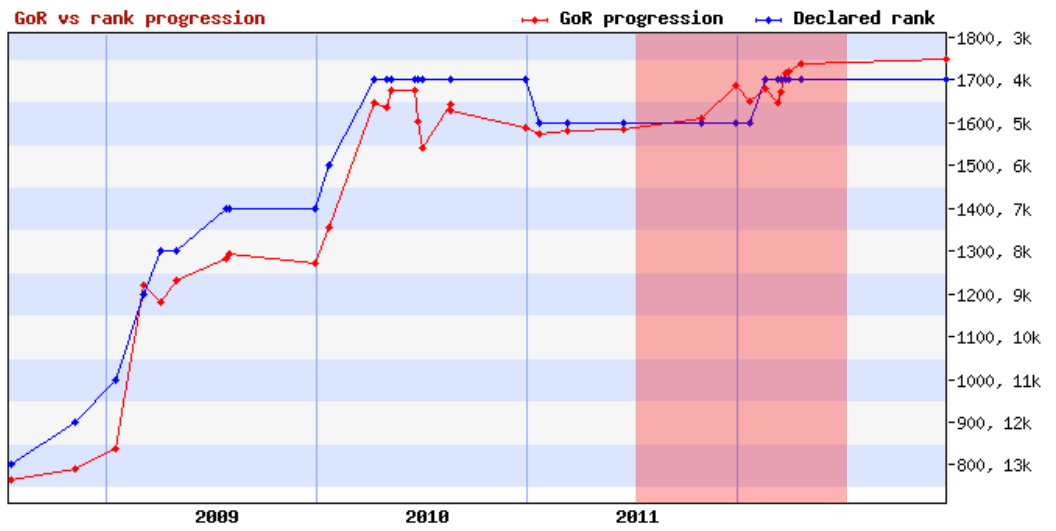
- LudanChart.PNG (67.08 KiB) Viewed 10346 times
P.S. funnily enough my other student at the time also gained exactly 155 points (2k to 1k)!
Re: Why do some people never reach shodan
Posted: Mon Oct 03, 2016 4:02 pm
by Fedya
I've been stuck at KGS 6k for almost six years now.
Re: Why do some people never reach shodan
Posted: Mon Oct 03, 2016 6:42 pm
by hyperpape
I think I first started feeling stuck sometime in late 2007 or maybe in 2008. I can't remember all the details, but I entered Congress at 6 kyu in 2007, and didn't gain much strength for a few years after that. I subsequently improved a bit, though quite slowly.
http://agagd.usgo.org/player/13891/