Page 3 of 4
Re: What went wrong with AlphaGo ?
Posted: Wed Jul 18, 2018 4:42 am
by Elom
I cannot remember whether these were my initial thoughts on Alphago, but, and I simplify for brevity although have touched on sister subjects in more detail elsewhere, it
appears that out of what seems to be the main groups most focusing on the Alphago revolution, mathematical or tech-savvy souls and journalists:
Many who already play go are of the first group, as they are least likely to be frightened by 'the worlds most complex board game'. And many have already come across go in their line of work, meaning we are much closer to the 'critical mass', if you will, of those in this group who might possibly be interested, at least compared to other groups of people (I am simplifying here).
Journalists and news channels most likely increased base awareness, and slightly change some negative go preconceptions borrowed from board games in general (making it seem a little, 'cool', 'futuristic' or similar), yet Alphago will likely get lost among the other stories over time, not necessarily drawing in people excepting great manual effort and strain on resources on go associations' part.
In other words, at least in the west, it increased the size of the pool and, minimally, the quality of the bait, but not the number of fishing rods available.
So we could only capitalise so much, and even then, finding the optimum strategy was a delicate balance.
Well, at least that's my current model of events.

Re: What went wrong with AlphaGo ?
Posted: Wed Jul 18, 2018 4:45 am
by jlt
Uberdude wrote:
Indeed; in fact what about the players weaker than 20k? I've heard some criticism of the EGF rating system for not allowing ranks weaker than 20k (presumably because such player have large variances so the idea is the ratings won't be high quality) for excluding weaker players and making them feel like they are not proper players involved in the community. A 10 year old 27k could still find making 26k motivating, even if there are big error bars.
Some countries such as France allow ranks as weak as 30k. While this can be a factor of motivation, I don't think it's a crucial point. Children who practice judo are ready to wait for 1 year before they earn a yellow belt, so why not wait for 1 year before you earn a 19k rank? There are more important reasons why children tournaments are useful:
- In regular tournaments, very few players are weaker than 15k, and it's not fun for a beginner to lose badly every game.
- Children (let's say under 11 years old) play much faster than adults, and it's not fun to keep waiting for your opponent to move.
- In regular tournaments, more than 90% of the players are adults, have adult conversations, drink beer (I am exaggerating a bit but not so much)...
To come back to the original question ("What went wrong with AlphaGo ?"), certainly thanks to AlphaGo many people
heard about the game, but this didn't make people
like the game. While you can like a game just by playing online, I suspect that what makes the game attractive for most people is human interaction, having a stronger player explain concepts, and having conversations that go beyond "Hi! (...clicks...) Thank you for the game."
Re: What went wrong with AlphaGo ?
Posted: Wed Jul 18, 2018 4:56 am
by dfan
JF: Have you tried watched any live internet chess commentary on top tournaments? It might not be your thing for other reasons, but if you want to see strong players demonstrate how they think, there is nothing better. Peter Svidler and Jan Gustafsson are particularly good (and often work as a team). This is one of the things I think of when I compare the chess scene today positively to that of 20 years ago. I also play chess and go more for the joy of mastery and understanding and less for the competition so these sorts of resources appeal to be particularly.
I may be an outlier (I often am

) but one of the reasons go has stuck for me so far this time around is the social aspect involving real people. When I reëntered the go scene it turned out that the Boston area was full of very friendly and fun people who also are passionate about go. Without that human connection my interest would probably have flagged a bit.
Re: What went wrong with AlphaGo ?
Posted: Wed Jul 18, 2018 5:01 am
by HermanHiddema
Uberdude wrote:
Indeed; in fact what about the players weaker than 20k? I've heard some criticism of the EGF rating system for not allowing ranks weaker than 20k (presumably because such player have large variances so the idea is the ratings won't be high quality) for excluding weaker players and making them feel like they are not proper players involved in the community. A 10 year old 27k could still find making 26k motivating, even if there are big error bars.
Ranks weaker than 20k are not excluded, but are all converted to 20k (rating 100). So those players are in the system, they just don't have proper ratings. It would be nice to get rid of the artificial bottom bar, but Ales Cieply felt it would destabilize the current system if it was removed.
Re: What went wrong with AlphaGo ?
Posted: Wed Jul 18, 2018 5:09 am
by Schachus
Lets be honest here: Below 15k the rating system is very destabilized anyway. If a 15k wins with 9 stones against 30k (which happens quite a lot in kids handicaps tourneys), he probably didnt even have to put in too much effort, yet he still gets a rating boost, as if he had beaten an 11k even. I dont see how much worse this could get by removing the bottom bar.
Re: What went wrong with AlphaGo ?
Posted: Wed Jul 18, 2018 6:47 am
by Javaness2
Schachus wrote:Lets be honest here: Below 15k the rating system is very destabilized anyway. If a 15k wins with 9 stones against 30k (which happens quite a lot in kids handicaps tourneys), he probably didnt even have to put in too much effort, yet he still gets a rating boost, as if he had beaten an 11k even. I dont see how much worse this could get by removing the bottom bar.
It's another subject. 15k beats 30k in a 9 stone game. Do you want the rating gap to be about 1500-850 or 500-850? I prefer the former. Having an adaptive enough rating system is a difficult problem of course. Probably the real danger of extending down to 30kyu is that rating resets will not be done in a controlled manner, because the community is not capable of organising that, and thus mass deflation will happen. I quite liked the look of what gennan was doing with regard to GoR, but his work appears to have been parked.
Re: What went wrong with AlphaGo ?
Posted: Wed Jul 18, 2018 8:22 am
by bernds
dfan wrote:JF: Have you tried watched any live internet chess commentary on top tournaments? It might not be your thing for other reasons, but if you want to see strong players demonstrate how they think, there is nothing better. Peter Svidler and Jan Gustafsson are particularly good (and often work as a team). This is one of the things I think of when I compare the chess scene today positively to that of 20 years ago. I also play chess and go more for the joy of mastery and understanding and less for the competition so these sorts of resources appeal to be particularly.
I was going to mention those two after reading JF's post. They are a pleasure to watch, and they do mostly keep the engines off in order to discuss what the humans likely to be thinking. 25 years ago there was one annual chess game broadcast on German TV, with occasional smaller shows with brief discussions of tournament games. Back in the day I thought that was great, but it's really no contest between what's available now and back then. I'd say Svidler/Gusti are the best commentary team, but just today there was an announcement on reddit about coverage of a tournament next week with Seirawan/Hansen/Hambleton, and I'm looking forward to that as well. Hansen is a pretty good example of a young chess GM being able to make money, just by playing for an audience on Twitch. The sources of income change over time and always have.
As for the original question of this thread, I think it's just the wrong thing to ask. Nothing went wrong with AlphaGo, it's just really hard to make people interested in Go. I know that I've occasionally done events where Go players were part of a larger festival and we brought out the 9x9 boards and taught anyone who'd sit down with us. We'd be busy on the day but it never translated into any new players coming to club meetings, as far as I know.
For me personally, AlphaGo was fascinating both from a technical viewpoint and for the new ideas it brought to the game, mixed with some disappointment when Zero came along and opening play seemed to become more narrow. And I enjoy being able to ask a computer what went wrong in my games, it's a new opportunity for study. I may not understand what Leela Zero is trying to tell me (many of the variations it gives are of the kind where I just shake my head and admit I can't evaluate the position), but there are aspects where I think I'm learning new things.
Re: What went wrong with AlphaGo ?
Posted: Wed Jul 18, 2018 10:12 am
by John Fairbairn
JF: Have you tried watched any live internet chess commentary on top tournaments? It might not be your thing for other reasons, but if you want to see strong players demonstrate how they think, there is nothing better. Peter Svidler and Jan Gustafsson are particularly good (and often work as a team).
I've admired Svidler in interviews but I've never seen him do commentaries (and I confess to never having heard of Gustafsson but I'll watch out for him now). I've come across quite a few enjoyable commentators - Seirawan is one I like because he's likewise great at team work.
We are quite lucky with presenters in go, too. I think Michael Redmond excels, and there are of course quite a few superb presenters in the Oriental languages (though that obligatory man-woman format where the woman has to pretend to be the dumb one really grates on me).
But I don't watch videos much, because I'm deaf and most days I struggle to hear them even at 100% volume. And with most commentators not being native English speakers, lip reading doesn't work too well.
Re: What went wrong with AlphaGo ?
Posted: Wed Jul 18, 2018 10:53 am
by bernds
John Fairbairn wrote:We are quite lucky with presenters in go, too. I think Michael Redmond excels, and there are of course quite a few superb presenters in the Oriental languages (though that obligatory man-woman format where the woman has to pretend to be the dumb one really grates on me).
Very much agreed on Redmond, and I count that as one of the major positives to come out of the AlphaGo events. I'd known of him from old Go World magazines, and I have one of his books that I quite like, but seeing him do commentaries and reviews in videos regularly is something quite different.
Re: What went wrong with AlphaGo ?
Posted: Wed Jul 18, 2018 12:16 pm
by Knotwilg
For sure there's a different effect to be expected from an anime featuring a young Japanese kid inhabited by a ghost of times long past, propelling him into the highest spheres quite effortlessly, or a piece of software assembled by a rather anonymous team destroying any hopes for a human being to ever be the strongest in this area.
How inspirational did anyone expect an AI landslide to be for Go? Perhaps for AI it did inspire young programmers. As for Go, everybody now knows it's a mission accomplished.
Re: What went wrong with AlphaGo ?
Posted: Wed Jul 18, 2018 2:29 pm
by sybob
Informative, yes.
But I feel sad and left out.
I know, The Netherlands is only a small country, but we do have a fairly active go community over here and over 30 clubs around this small country. Amsterdam hosts one of the largest tournaments in Europe and several strong players are from The Netherlands.
I probably also speak for other nationalities (Belgium, Spain, to name a few).
(I understand this was not intentional)
Re: What went wrong with AlphaGo ?
Posted: Wed Jul 18, 2018 3:34 pm
by sybob
I concur with many observations already made above.
Perhaps I can contribute a little bit to the discussion.
Maybe go players could learn from marketing/sales/promotion.
E.g. the AIDA model of awareness (or attention), interest, desire, action (I know, this model is old, but still reasonably valid, I think).
Action I would describe as joining a club or association.
AlphaGo raised awareness, but failed to raise interest.
Why?
As someone said already: it did not raise appeal (read: interest, desire).
Why?
I think because for (most, new) people to become interested, the main appeal is the social aspect (already mentioned before).
We have not been very good to convert the AlphaGo technological appeal to the social appeal.
AlphaGo is too far of kids and newcomers to raise interest. They don't care about computers, AI, $600m investment, pro games, win rate probabilities, neural networks (what's that?), etc. They just want to have some fun time and enjoy people's company. Go players generally do not tend to be very outspoken or charismatic.
If we want to broaden the base in terms of number of players (I understand this post is about that, not about higher levels, learning, teaching), we perhaps should try to be more extravert, less nerdy, more social, more outgoing. Just mingle (in business terms: do some networking), visit schools, go to public events, etc.
Re: What went wrong with AlphaGo ?
Posted: Wed Jul 18, 2018 11:54 pm
by jlt
sybob wrote:
I know, The Netherlands is only a small country, but we do have a fairly active go community over here and over 30 clubs around this small country. Amsterdam hosts one of the largest tournaments in Europe and several strong players are from The Netherlands.
I probably also speak for other nationalities (Belgium, Spain, to name a few).
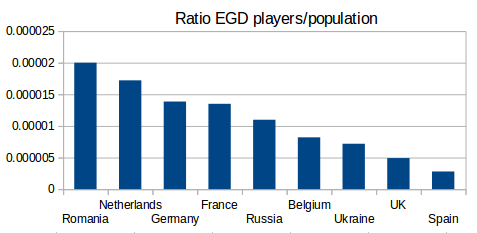
I have to admit that I chose to compare a few European countries with "large" go playing populations (+UK since this is a thread about Alphago) but I wasn't aware that The Netherlands has one of the highest ratios (EGD registered players)/(total population) in Europe:
- ratio.png (12.64 KiB) Viewed 8697 times
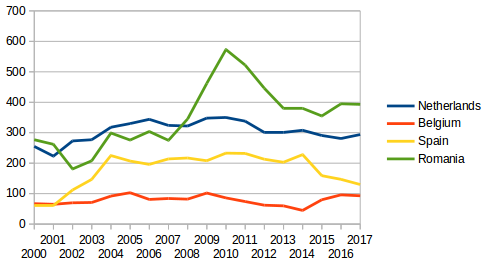
Unfortunately, as in most other countries except Russia, the number of go players has been declining since 2010:
- EGDplayers.png (25.9 KiB) Viewed 8697 times
I may have forgotten a few other very active countries. My point was not to be exhaustive, but to stress the fact that it is still possible to make progress, although
Hikaru no Go no longer has any effect, but it is not so surprising that AlphaGo didn't help to reverse the post-2010 decline. That an AI can play better than humans is not enough to convince you that a game is interesting, you need an experienced player to talk about the game and explain you why it is interesting. Perhaps most people who heard about go game after the AlphaGo events weren't even aware they would be welcome at a go club, so maybe they tried a few games on the internet and didn't find a reason to continue.
Re: What went wrong with AlphaGo ?
Posted: Thu Jul 19, 2018 1:52 am
by Uberdude
Would be interesting to compare Go player / population ratios and Chess player / population ratios to see if those countries with higher ones also tend to be more into board games generally as part of their culture. Maybe International Maths Olympiad medals / population too?
Re: What went wrong with AlphaGo ?
Posted: Thu Jul 19, 2018 3:40 am
by jlt
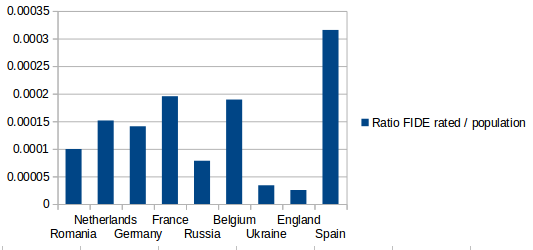
The ratio EGF rated/population is poorly correlated with the ratio FIDE rated/population:
- fide.png (13.03 KiB) Viewed 8643 times
(But maybe the number of FIDE rated players does not reflect accurately chess activity, so it's hard to tell whether popularity of go is related or not to popularity of chess in Europe.)
Comparison with IMO medals is irrelevant, as the number of IMO medals depends heavily on
- the number of students who prepare specifically to that competition;
- the quality of the preparation.
Moreover, there is no reason why go game should attract essentially scientific minds. In Asia, children are exposed to go much earlier than in western countries, before showing any inclination towards science or literature.