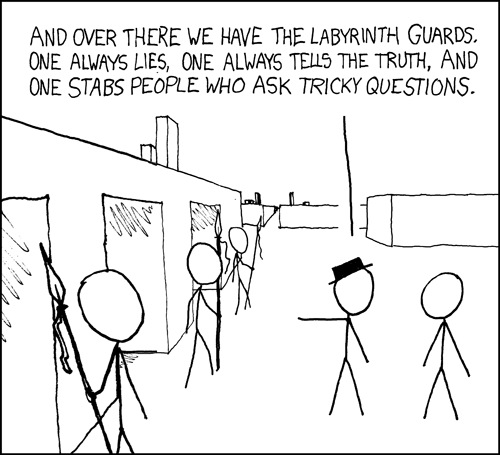
Alright, next one. It might be already known to some of you, but still:
You are in a prision with two doors. One leads to freedom and one to death.
There is a guard before each door. You know that one always tells the truth and the other always lies and they both know it about each other, but you do not know which one is which.
You can adress one question to one of the guards. What do you ask to find out about the way to freedom?
Re: Logical puzzles
Posted: Mon Nov 29, 2010 2:32 am
by entropi
Redundant wrote:Spot
I think that a good way to characterize the new information is "If there were only one person with a red spot, that person would know that they had a red spot". Knowing this conditional is sufficient for the induction, and lacking without the proclamation of the visitor.
But for starting the induction you need more. It is ok with one red spot but why should it also work when you add more red spots?
While I think SpongeBobs logic is correct, it should be possible to explain in a simpler way. Otherwise you should also have to show the same thing for 4 red spots, 5 red spots, ....
Here is my try using induction:
If there is just one red spot, it obviously works.
If there are two red spots, everyone already knows that there is at least one red spot.
But the next level of information comes from the observer (tourist), in the form of making each one of red spots expect the other to leave the next morning. Since the other one doesn't leave, he learns that there is one more red spot except that one.
So, every day he learns that there must be one more, and this information comes from the "expectation" (expectation that other red spots should leave) created by the observer.
So for creating the induction: When you add one more red spot, you delay the expectation of leaving one more day.
Without the observer, this expectation would never be created because there is no reason for any of the red spots to expect anyone to leave. Even if a red spot knows that N other red spots exist, there is still no information relating to the color of his own spot.
What the observer does is turning the rule of leaving next morning into information related to the number of red spots via the expectation.
Re: Logical puzzles
Posted: Mon Nov 29, 2010 8:00 am
by Redundant
entropi wrote:
But for starting the induction you need more.
No. You don't. If there were one person, and this was known, he'd leave. If there were two, then after one day, the two people will know. It goes on. The knowledge of the conditional is sufficient.
Note that this is a conditional. The new knowledge isn't that there is at least one person with a spot, but that if there were only one that person would know.
Re: Logical puzzles
Posted: Mon Nov 29, 2010 8:45 am
by entropi
Redundant wrote:
entropi wrote:
But for starting the induction you need more.
No. You don't. If there were one person, and this was known, he'd leave. If there were two, then after one day, the two people will know. It goes on. The knowledge of the conditional is sufficient.
Note that this is a conditional. The new knowledge isn't that there is at least one person with a spot, but that if there were only one that person would know.
Maybe it is just a matter of definition, but for calling a proof "induction", you would need to prove (at least) two things:
1-It is true for x=1
2-If it is true for x=N, it is also true for x=N+1
In this case what you say is that the solution of the puzzle is true for 1 red spot. But it is not immediately apparent that if N red spots leave after N days, N+1 red spots would leave after N+1 days. Probably that is what you call "conditional". If it is, then we are saying the same thing.
I formulate it as "independently of the initial number of red spots, adding one more red spot would cause one more day of delay of the expected leaving day, because each additional red spot would add one more day of uncertainty (whether he would know or not) for all the rest of the red spots".
Anyway, the more I think about it the more I appreciate the puzzle, indeed wonderful.
Re: Logical puzzles
Posted: Mon Nov 29, 2010 11:14 am
by Redundant
If we know that N red spots leave after N days, and we have N+1 spots.
Each of the people with red spots will see N people with red spots. If those N people don't leave after N days, on the (N+1)th day, each of these people will know they have red spots, and leave. As I'd say in about any homework assignment, "the induction is trivial".
I'm really not sure what we're disagreeing on here, now that I think about it.
Re: Logical puzzles
Posted: Mon Nov 29, 2010 11:48 am
by Dusk Eagle
SpongeBob wrote:Alright, next one. It might be already known to some of you, but still:
You are in a prision with two doors. One leads to freedom and one to death.
There is a guard before each door. You know that one always tells the truth and the other always lies and they both know it about each other, but you do not know which one is which.
You can adress one question to one of the guards. What do you ask to find out about the way to freedom?
I'm sure some of us have seen this before, but it's obligatory anyway:
Re: Logical puzzles
Posted: Mon Nov 29, 2010 12:09 pm
by SpongeBob
entropi wrote:
If there are two red spots, everyone already knows that there is at least one red spot.
But the next level of information comes from the observer (tourist), in the form of making each one of red spots expect the other to leave the next morning. Since the other one doesn't leave, he learns that there is one more red spot except that one.
Expecting the other to leave the next morning already involves logical reasoning by the islander based on the information given by the tourist.
Re: Logical puzzles
Posted: Mon Nov 29, 2010 10:54 pm
by ethanb
cyclops wrote:
hyperpape wrote:@cyclops
cyclops wrote:Ask A whether B wouldth confirm that C wouldth confirm that he is God.
If you get an answer then A is Random.
If he's not Random ask the similar question to B.
Now we know Random. The Others we call P and Q for God's sake.
Ask P if He confirms that da is Goddish for true. If He answers da he is True.
I believe your first question doesn't quite work, but it's on a useful track.
If A is false, B is true and C is random, A will say 'yes'. B will remain silent, because he cannot say whether C will answer, so A will be speaking falsely.
P.S. Adding to the confusingness of the puzzle, if he uses weak negation, True can say
Not(random would confirm that he is a God)
I think we're better off assuming that the Gods just fall silent when they can't answer.
Ok, I'll hide as you prefer.
Alternative first question(s): Ask A whether Random would give the same answer as A would give if asked whether he is God. If A answers he is Random himself. The last question as before.
Hmm, interesting that you guys think the logical dead-ends are the way to solve it. I posted my "solution" as a joke because I assumed that falling into one of those unanswerable positions meant you failed (hence the "struck by lightning" bit.) Haven't had time to think about it any more, but maybe that is the solution.
I kind of don't think so though, since it seems like ANY question that you pose involving Random causes the same problem, so there wouldn't be a single correct answer if that's the case. Then again, I guess nobody said there had to be.
Re: Logical puzzles
Posted: Tue Nov 30, 2010 2:35 am
by entropi
Redundant wrote:
I'm really not sure what we're disagreeing on here, now that I think about it.
Nothing It is just that something is trivial to you but not to me. But apart from that the reasoning is absolutely the same.
Maybe it's a professional deformation of mine. My daily job is questioning whether an idea, a concept, etc is trivial or not (in order to issue or reject a patent)
SpongeBob wrote:
Expecting the other to leave the next morning already involves logical reasoning by the islander based on the information given by the tourist.
Yes, the amazing thing about that puzzle is, in case there are more than one red spots, what the tourist says seems to be nothing new, but still gives information indirectly. Incredibly beautiful way of giving information. It's entropy must be approaching infinity
Re: Logical puzzles
Posted: Tue Nov 30, 2010 9:09 am
by hyperpape
@ethanb
There are solutions that do not involve stumping the gods. The range of solutions is extremely wide--there are many logically equivalent ways to phrase the same question, and there are many distinct questions.
Re: Logical puzzles
Posted: Tue Nov 30, 2010 5:36 pm
by Magicwand
i dont get this puzzle answer.
dont they already have that same info by looking at other's red spot?
Re: Logical puzzles
Posted: Tue Nov 30, 2010 11:09 pm
by Redundant
Magicwand
You can see that there is new information by looking at whether everyone knows the statement "If there were only one person with a red spot, would he know".
Without the visitor, they don't know this statement, but with the visitor's statement they do.
Re: Logical puzzles
Posted: Wed Dec 01, 2010 12:03 am
by HermanHiddema
Redundant wrote:Magicwand
You can see that there is new information by looking at whether everyone knows the statement "If there were only one person with a red spot, would he know".
Without the visitor, they don't know this statement, but with the visitor's statement they do.
Another important aspect is that the tourist provides an element of timing. He synchronizes the islanders, so to speak. Suppose that the tourist had, instead of speaking, simply left a sign on the island saying "There is at least one person with a red spot on the island". And over the course of a few days or weeks, all islanders come upon this sign and read it. Then the puzzle wouldn't work anymore...
Re: Logical puzzles
Posted: Wed Dec 01, 2010 6:08 am
by Magicwand
Redundant wrote:Magicwand
You can see that there is new information by looking at whether everyone knows the statement "If there were only one person with a red spot, would he know".
Without the visitor, they don't know this statement, but with the visitor's statement they do.
yes..only time the info is useful is when there is only 1 person.
but if more than 1 person then it is same info as tourist's info everyone are aware of the fact that there are at least one red spot.
if that is the case then there is only 1 possiblity for that island. there was only 1 red spot when tourist announce the info.
what am i missing?
Re: Logical puzzles
Posted: Wed Dec 01, 2010 6:30 am
by flOvermind
Magicwand wrote:what am i missing?
Let's assume there are 10 people with a red spot, and let's assume you are one of them.
You see 9 people with a red spot. That is, you know there are either 9 or 10 people with a red spot, since you don't know whether you have a red spot or not.
Now if I ask you "How many red spots are there?" you'll answer "9 or 10". Let's call that question A.
But what if I ask you "What would this other person with a red spot answer to question A?" (let's call that question B)? For all you know, this person might only see 8 red spots (you don't know that you have one yourself). And the person doesn't know either, so the answer has to be "either '8 or 9', or '9 or 10'". Of course, if you'd actually ask that person, the answer would be "9 or 10". But you can't know that, since you don't know you have a spot yourself.
Now what if I ask you "What would this other person with a red spot answer to question B?". And by the same reasoning, you'll have to answer "7,8,9 or 10". And again you can call that question C, and if I ask you what someone else would answer to question C, the answer will be "6,7,8,9 or 10".
You can play that game until you're down at an answer containing 0. But with comment of the tourist, everyone will know there is "at least 1" red spot, and everyone knows that everyone knows there is "at least 1" red spot, and everyone knows that everyone knows that, and so on... So before the tourist, while everyone might have known that there is at least 1 red spot, and also that everyone knew that there is at least one red spot, and so on, nobody could say whether (everyone knew that (everyone knew that (everyone knew that *repeat 10 times* (there is at least 1 red spot)))))))))). That's the additional information provided.