Page 4 of 4
Re: Points at the end of a game
Posted: Tue Feb 19, 2013 8:40 am
by PeterPeter
I was thinking more about the uncertainty that beginners might feel, rather than those more familiar with the game. A beginner reading the above about numerous rulesets could easily be put off, if they just want to know how to finish the game.
Re: Points at the end of a game
Posted: Tue Feb 19, 2013 8:48 am
by amnal
PeterPeter wrote:I was thinking more about the uncertainty that beginners might feel, rather than those more familiar with the game. A beginner reading the above about numerous rulesets could easily be put off, if they just want to know how to finish the game.
I'd hope that a beginner might read the first few posts and find that they clearly answer the question.
In practice, few if any beginners learn in a total vacuum, there's just too much passed on knowledge and I think the initial learning curve is potentially steeper than is often noted. A beginner playing a more experienced (even if only slightly) player avoids not only this problem but all other potential confusions, like problems with suicide and stones being captured without them noticing. As long as we can quickly impart a reasonable basic understanding when actually teaching a beginner in a short time, I don't think the existence of internet rules debates is worrying.
Maybe that's unclear...what I'm trying to say is, even with a well set out AGA ruleset, I think a beginner would struggle to properly answer this question, because the whole game is quite a lot to take in. It's like a ddk looking at a high dan tsumego...it's easy knowing what to do, but with so much to remember and so many choices to make it's very hard to actually follow through the logic process to pick the correct move even if you're allowed to actually play it out. To a beginner trying to grasp the rules, even a position like your first one is quite unclear because there are several possible places for both players to play (plus passing) and it's hard to see ahead to know what move will actually be best. As such, I think it's more important to encourage interaction and to provide basic explanations (like those early in this thread) where necessary.
Re: Points at the end of a game
Posted: Tue Feb 19, 2013 9:05 am
by msgreg
PeterPeter wrote:At the risk of straying into politics, has there ever been an attempt to set up an International Go Association? This could standardise the rules, as well as coordinate and promote the game internationally, as FIDE does for chess. I don't think it does the game much good if there can be so much uncertainty over the ending of a game.
The role of the International Go Federation (
wikipedia) is to promote the sport of Go throughout the world, promote amicable relations among members and improve world go organization
Re: Points at the end of a game
Posted: Tue Feb 19, 2013 9:10 am
by Dusk Eagle
PeterPeter wrote:At the risk of straying into politics, has there ever been an attempt to set up an International Go Association? This could standardise the rules, as well as coordinate and promote the game internationally, as FIDE does for chess. I don't think it does the game much good if there can be so much uncertainty over the ending of a game.
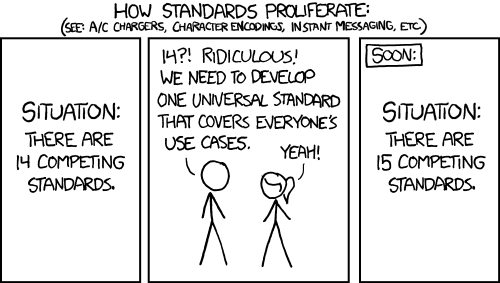
For example, the Ing ruleset or AGA rules.
Re: Points at the end of a game
Posted: Tue Feb 19, 2013 9:16 am
by Tim C Koppang
Nice. There's an XKCD for everything!
Re: Points at the end of a game
Posted: Tue Feb 19, 2013 9:54 am
by Bill Spight
PeterPeter wrote:I was thinking more about the uncertainty that beginners might feel, rather than those more familiar with the game. A beginner reading the above about numerous rulesets could easily be put off, if they just want to know how to finish the game.
Which is why, for the most part, area scoring has been adopted by go associations in the West.
When in doubt, play it out. 
Re: Points at the end of a game
Posted: Tue Feb 19, 2013 2:13 pm
by skydyr
To chime in too late, I too have moved to teaching area scoring to beginners for the simplicity of finding the end. At its most basic, you have them fill everything in and then count stones, making it very easy to explain that they're trying to control more than half of the board.
Re: Points at the end of a game
Posted: Tue Feb 19, 2013 2:32 pm
by palapiku
There's also the reality that adopting a universal worldwide ruleset based on area scoring simply won't happen, no matter how beneficial you think it could be. This suggestion is similar to proposals such as completely changing the English orthography, to make it easier for foreigners to learn. Which will not happen because nobody cares about foreigners that much.
And just like English orthography is completely manageable for native English speakers, go rules (including territory scoring) are simple and natural to people who are not learning in a vacuum. If you have friends who already play go, they will probably be able to resolve all your difficulties in ten minutes. The rules of go really are full of deep theoretical difficulties, but it's quite amazing how little any of them matter in practice.
Re: Points at the end of a game
Posted: Tue Feb 19, 2013 2:43 pm
by PeterPeter
palapiku wrote:And just like English orthography is completely manageable for native English speakers, go rules (including territory scoring) are simple and natural to people who are not learning in a vacuum. If you have friends who already play go, they will probably be able to resolve all your difficulties in ten minutes. The rules of go really are full of deep theoretical difficulties, but it's quite amazing how little any of them matter in practice.
I don't know a single other person who plays. It sometimes makes it hard to get things into proper perspective. Fortunately the good people on here help a lot.
Re: Points at the end of a game
Posted: Tue Feb 19, 2013 6:58 pm
by Phelan
PeterPeter wrote:palapiku wrote:And just like English orthography is completely manageable for native English speakers, go rules (including territory scoring) are simple and natural to people who are not learning in a vacuum. If you have friends who already play go, they will probably be able to resolve all your difficulties in ten minutes. The rules of go really are full of deep theoretical difficulties, but it's quite amazing how little any of them matter in practice.
I don't know a single other person who plays. It sometimes makes it hard to get things into proper perspective. Fortunately the good people on here help a lot.
I didn't know anyone who played when I started too. I taught most of the go players around me, then.
I later found a group of players around here, but in the beginning, I almost only played with people I had taught the game too.
One of them has surpassed me, and can now give me about 5-6 stones handicap.
So don't discount trying to make your own Go community.
Even if you don't, keep a positive attitude. I like seeing you around here, since you usually have a lot of good questions.

Re: Points at the end of a game
Posted: Wed Feb 20, 2013 2:41 am
by Koroviev
palapiku wrote:And just like English orthography is completely manageable for native English speakers...
I wouldn't go that far!
Re: Points at the end of a game
Posted: Thu Feb 21, 2013 1:29 pm
by PaperTiger
amnal wrote:PeterPeter wrote:I don't think it does the game much good if there can be so much uncertainty over the ending of a game.
This might be a legitimate point when it comes to teaching beginners, but part of the reason it remains so debatable is that it honestly practically never comes up in anything other than beginner games, and to experienced players there really isn't any uncertainty.
For some definition of "beginner" and "practically never". A beginner for me is somebody who has recently learned the rules of the game and doesn't have basic skills. Yet I have personally played many games where the opponent was stronger than 15k but uncertainty arose over life and death. I'm not saying this happens
often, but it happens more than people claim.
I've detailed the games
here. Except for the first game, these are games that I have
personally played, not just a few examples picked from all existing game records.
Re: Points at the end of a game
Posted: Fri Feb 22, 2013 10:09 am
by SmoothOper
xed_over wrote:
Area Scoring
- Black = 8 + 4 = 12
- White = 8 + 4 = 12
result: 12 - 12 = 0 / Jigo (tie)
This is wrong because in Chinese scoring the players fill in the dame because there are points IE.
$$Bc 5x5 board
$$ -------------
$$ | . . . . X |
$$ | X X X X X |
$$ | O X 1 O X |
$$ | O O O O O |
$$ | O . . . . |
$$ -------------
- Click Here To Show Diagram Code
[go]$$Bc 5x5 board

$$ -------------

$$ | . . . . X |

$$ | X X X X X |

$$ | O X 1 O X |

$$ | O O O O O |

$$ | O . . . . |

$$ -------------[/go]
Black has 13 and white has 12, this came up at a friendship tournament where an AGA club was playing a Chinese club. In Chinese they always play out all the dame, and sometimes it matters. IE if is sente, it may get played before other point plays.
Re: Points at the end of a game
Posted: Fri Feb 22, 2013 12:02 pm
by xed_over
SmoothOper wrote:xed_over wrote:
Area Scoring
- Black = 8 + 4 = 12
- White = 8 + 4 = 12
result: 12 - 12 = 0 / Jigo (tie)
This is wrong because in Chinese scoring the players fill in the dame because there are points IE.
$$Bc 5x5 board
$$ -------------
$$ | . . . . X |
$$ | X X X X X |
$$ | O X 1 O X |
$$ | O O O O O |
$$ | O . . . . |
$$ -------------
- Click Here To Show Diagram Code
[go]$$Bc 5x5 board

$$ -------------

$$ | . . . . X |

$$ | X X X X X |

$$ | O X 1 O X |

$$ | O O O O O |

$$ | O . . . . |

$$ -------------[/go]
Black has 13 and white has 12, this came up at a friendship tournament where an AGA club was playing a Chinese club. In Chinese they always play out all the dame, and sometimes it matters. IE if is sente, it may get played before other point plays.
As I mentioned in that earlier post, lessons on dame filling would come later. If the dame is left unfilled, as in my example, then my score is correct.
If the dame is filled, then you are correct, Black would win by one point. But that's a different example for a different lesson -- because now the number of moves for each player is no longer the same (which AGA rules fixes with pass stones and forcing White to play last)
Re: Points at the end of a game
Posted: Fri Feb 22, 2013 2:51 pm
by SmoothOper
xed_over wrote:SmoothOper wrote:xed_over wrote:
Area Scoring
- Black = 8 + 4 = 12
- White = 8 + 4 = 12
result: 12 - 12 = 0 / Jigo (tie)
This is wrong because in Chinese scoring the players fill in the dame because there are points IE.
$$Bc 5x5 board
$$ -------------
$$ | . . . . X |
$$ | X X X X X |
$$ | O X 1 O X |
$$ | O O O O O |
$$ | O . . . . |
$$ -------------
- Click Here To Show Diagram Code
[go]$$Bc 5x5 board

$$ -------------

$$ | . . . . X |

$$ | X X X X X |

$$ | O X 1 O X |

$$ | O O O O O |

$$ | O . . . . |

$$ -------------[/go]
Black has 13 and white has 12, this came up at a friendship tournament where an AGA club was playing a Chinese club. In Chinese they always play out all the dame, and sometimes it matters. IE if is sente, it may get played before other point plays.
As I mentioned in that earlier post, lessons on dame filling would come later. If the dame is left unfilled, as in my example, then my score is correct.
If the dame is filled, then you are correct, Black would win by one point. But that's a different example for a different lesson -- because now the number of moves for each player is no longer the same (which AGA rules fixes with pass stones and forcing White to play last)
I can't believe you just posted that.

You are going to count Chinese, but with the AGA rule that says there are an equal number of plays.