Weekly Update #8
The first month has passed and as you might be able to guess from my last post, I consider the whole project a real success until now. For the first time in years I'm really working on my Go and can actually feel and see the positive effects this has on my game. This fact spurs me on right now to continue on this way for I don't want to let the chance slip away to finally overcome the barrier that has held me back so long. A decisive factor in the whole thing was my beloved Excel sheet which visualised that the whole project is doable, but also this study journal which constantly reminds me of the resolutions I made and reminds me of the small steps forward I already took. Together with the much valued comments of everyone who cared to post here, it is a great source of motivation, too, so thanks to everyone!
 Here are the statistics for the first month:
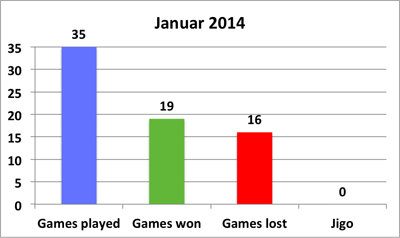
Although I thought it was really hard to do so, I played the required number of games these month and even had one day left when I reached my goal, so I can be very satisfied here. My winning percentage in January was at 54% which I think is good. And I also played only one or two really bad games this month, so can't complain about this either (although it could be even less

).
Right now, I'm regularly hitting the rank of KGS 3k frequently, but most of the times I immediately lose it again just to go up again after 2 or 3 games (kind of an escalator rank ^^; ). That's why I decided that for the next two weeks or so I'll only play rated games to get up to 3k again and play free games as 3k to get used to the playing styles of this rank (and get beaten up a bit to see what mistakes I have to avoid to make). After this time I'll play more rated games again to see if I can prove myself better then. If not, I'll continue with the method from before for another week or two and take another look until I feel sure that I'm a
stable KGS 3k. This would be my goal for February.
During the last week, I solved considerably less tsumego than before but instead I read Tesuji by James Davies from the Elementary Go Series. The first half of the book felt pretty easy, but the second half seems to be more tricky for me. Maybe a hint on what I should be working on.
I think it was a good decision at this point to switch to this book instead of doing more tsumego because in the last week I was able to win a game or two because I could use some of the tesuji I had read about previously which gave me a decisive edge in the fighting that was taking place. After reading Tesuji I'll continue with tsumego. I also decided to finally study After Openings by Kim Sung-rae then, which I had wanted to do for many weeks now. More concretely, I'll study the corner enclosures from chapters 1 (4-4 point) and 2 (3-4 point) and leave the side positions out for now (and study them in between whenever I feel like it).
Therefore, on my agenda are these moves:
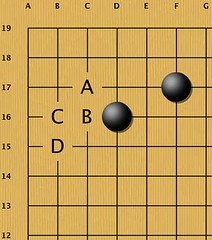
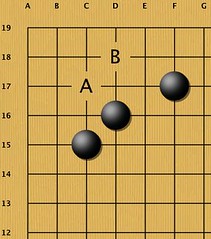
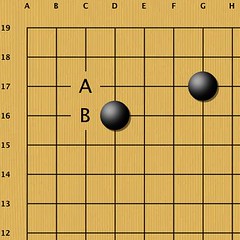
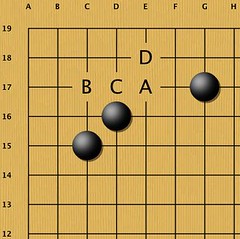
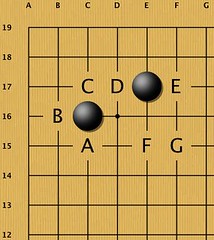
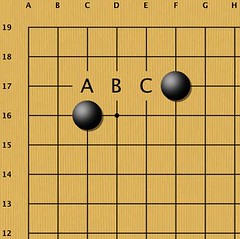
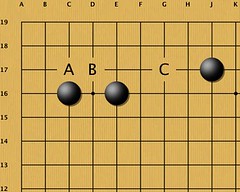
Of course, this will take a LOT longer to learn and to digest and to finally apply (hopefully correctly) in my own games than e.g. studying some tesuji. But I'm sure that studying these moves thoroughly will be extremely helpful for my game because these positions show up so much in games of all levels and therefore all the work will eventually pay off in the end. The book will be very helpful here not only as a reference which explains good and bad moves for both sides, but which also hints at other things that should be thought of during study (like what would happen if black or white tenukied here, is white still alive?) but which couldn't be covered in this space.
For now, I already started to study the A move in the "4-4 small keima"-enclosure. I guess it will take me on average about one month to study one diagramme thoroughly (which means that I understand the moves involved and am able to remember them with confidence). The only exception will be the "komoku small keima"-enclosure which has a hell lot of variations. I'd say that one will take at least twice as much time. I hope that by the end of the year I can say with confidence that I mastered the information in this book. Playing a lot will definitely help to drill the information and I want to play those moves as much as I can.
However, I'm still at a loss to decide in which order I should study the positions.. Should I start with the small keima enclosures first because they occur most often? Or first study the 4-4-enclosures and then move on to 3-4?
I'd appreciate any opinions here.
Concerning February, I already played 4 games in the first two days, so I'm on a good way in this
hardest shortest of all months. But this month has only just begun so we'll see..
Have a good week and some exciting games, see you next week!
Ember
+-+-+-+-+-+-+-+-+-+-+-+-+-+-+-+-+-+-+-+-+-+-+-+-+-+-+-+-+-+-+
+++ Playing statistics +++
Date: 2 February 2014
Games played / to be played: 39 / 361
Days passed / to come: 33 / 332
Games won total: 21
Games lost total: 18
Jigo: 0
Winning percentage total: around 52%
Landmarks: First win against KGS 3k on 5 January 2014 (unrated game, own rank: 4k, color: black, no komi), first win against KGS 3k in a rated game on 19 January 2014 (own rank: 4k, color: black, komi: 0,5 points), first time hitting 3k by playing and not by not-playing (25 January 2014),
January: succeeded in playing the 34 games needed per month to reach 400 games by the end of the year
 But I sincerely hope that I'll be more relaxed after having played a number of games in the next few months. But you are right, attaching here was not a good idea. I was thinking about J17, too, but you know, sometimes your hand klicks faster than your brain can sream "NOOOOOOOOOOOOO!!!!!". Or the like.


 ), but for me it is really a lot: Last year to reach 34 games it might have taken... 4 months? Or maybe 5 even? However, it doesn't feel that burdensome anymore like it was at the beginning. Although that might be typical of beginnings in general until you reach a point where you get used to it.
  And you know why? This is why: It's the game I played last monday for Guo Juan's Group Class against a KGS 2k and even though I screwed up that ko by answering a threat which was no threat at all, I'm really proud of it because I only lost by 6,5 points (it was an even game and he got a komi of 7,5 points which means that I really nicked a point from him, wooohoooooo!
  ).
).  It's almost too much for somebody who was stuck at around 6k for nearly 5 years and on 6k on KGS. Pretty scary even
 was an insane move. Pure greed as as far as I can tell. And why shouldn't he be greedy?! Heaven forbid black makes 15 points on the left side of the board! That's, like, the best side! White's own 15-20 point corner can't compete with left side territory!
 though - I would usually expect that to be at F13, the knight's move. This might have been a faster way to build the top and continue your attack.
 was the final nail in the coffin. The atari at F9 seems necessary to keep his group connected and out. Again, it looks like he got greedy - in this case smelling blood while not realizing his own group was in jeopardy.
 would be weakened even more. I'm not sure, but just nobi out feels like this stone puts more pressure on white because he hast to squeeze through between those stones. But who am I to say that? Just some overrated player.
  was a bad play of mine so he should have taken advantage of that. Theoretically.
 was also bad, similar reason: broken shape for Black -- you hurt yourself.
 was bad, same reason: broken shape for White (
  ) -- he hurt himself.
 broken shape forces W to hurt yourself.
 to rip apart B's original keima, like this:
 to diagram 1:
 , pulling back instead of blocking,