Does NSSK allow to immediately recapture in a ko ?
Posted: Sun Feb 22, 2015 10:33 am
Hi,
I am currently writing an article about the differences between the japanese and the french rules of go. I am currently studying the superko in french rule.
First, I have a question about NSSK, as defined in Robert Jasiek's website :
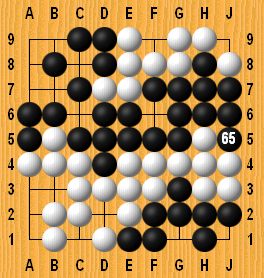
Chinese rule + NSSK. Komi 5.5.
After black 65, white 66 passes (tesuji !)
Black 67 : captures the ko in J9
White 68 : immediately recaptures in J8 !
According to the NSSK rule, this move is legal : White never used any board play to create this position before. Black did !
After that, white passes in answer to any black move other than J9, and everytime Black plays J9, White immediately recaptures in J8. Therefore the top white group is alive and, if the game stops here, White wins by 1.5 points (including komi) !
This situation can only occur as long as all white groups are strictly uncapturable, and have eyespaces small enough so that Black can't build a living group inside one of them.
However, black can still win the game :
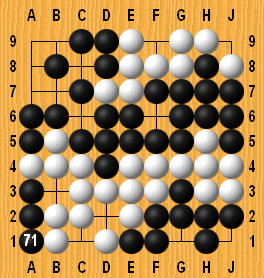
He adds three stones in the bottom left corner (while White passes). If White captures these stones, Black plays J9 and White can't recapture. He looses the ko, the whole top group, and the game. He must pass, and can't capture the three black stones.
Since the three black stones can't be captured, they are alive, and the B3 intersection is dame. Black wins by 5.5 points !
I have sumbitted this situation to the french go community. The official text of the french rule, as published on the FFG website says : A player may not use a board move to give the board a state [position] identical to one that he already has given it. (translation into english is mine.)
If we consider that passing is not "to give the board a given state", then this is Natural Situationnal SuperKo. However, french players agree that this should not be allowed to occur in any game played under french rules.
Denis Feldmann, who wrote a revision of the french rule for the french federation, says that the french rule actually uses Situational SuperKo.
The paradox is that, according to Robert, the AGA wrote an SSK rule while they actually wanted the NSSK, but the FFG wrote an NSSK rule while they actually wanted the SSK !
I am currently writing an article about the differences between the japanese and the french rules of go. I am currently studying the superko in french rule.
First, I have a question about NSSK, as defined in Robert Jasiek's website :
Am I right, thinking that the NSSK rule allows a player to immediately recapture in a ko ? Here is the situation that I am refering to :Positional super ko: A board play may not recreate a position.
Situational super ko: A board play may not recreate a position previously left by the player.
Natural situational super ko: A player may not use a board play to recreate a position if he has used one to create it.
Chinese rule + NSSK. Komi 5.5.
After black 65, white 66 passes (tesuji !)
Black 67 : captures the ko in J9
White 68 : immediately recaptures in J8 !
According to the NSSK rule, this move is legal : White never used any board play to create this position before. Black did !
After that, white passes in answer to any black move other than J9, and everytime Black plays J9, White immediately recaptures in J8. Therefore the top white group is alive and, if the game stops here, White wins by 1.5 points (including komi) !
This situation can only occur as long as all white groups are strictly uncapturable, and have eyespaces small enough so that Black can't build a living group inside one of them.
However, black can still win the game :
He adds three stones in the bottom left corner (while White passes). If White captures these stones, Black plays J9 and White can't recapture. He looses the ko, the whole top group, and the game. He must pass, and can't capture the three black stones.
Since the three black stones can't be captured, they are alive, and the B3 intersection is dame. Black wins by 5.5 points !
I have sumbitted this situation to the french go community. The official text of the french rule, as published on the FFG website says : A player may not use a board move to give the board a state [position] identical to one that he already has given it. (translation into english is mine.)
If we consider that passing is not "to give the board a given state", then this is Natural Situationnal SuperKo. However, french players agree that this should not be allowed to occur in any game played under french rules.
Denis Feldmann, who wrote a revision of the french rule for the french federation, says that the french rule actually uses Situational SuperKo.
The paradox is that, according to Robert, the AGA wrote an SSK rule while they actually wanted the NSSK, but the FFG wrote an NSSK rule while they actually wanted the SSK !

