Page 1 of 2
Getting back into Go
Posted: Tue Mar 01, 2016 2:39 pm
by John Tilley
I have finally decided to come out of the woodwork and join this forum.
I learnt to play Go some 50 years ago, reached BGA 2dan around 1972, but found myself hitting a barrier in playing strength, I
had stopped playing by 1980. A busy job and other interests intervened, however I read the odd book and perhaps never gave up Go 100%.
I retired some 10 years ago and eventually decided to visit my local Go club six months ago.
I seem to be 1kyu(ish) and find myself club secretary. I now focus on tutoring and teaching other players.
I spent 14 months in Japan from 1969-1970, studying Go and worked for The Nihon Kiin in their overseas department.
Re: Getting back into Go
Posted: Tue Mar 01, 2016 3:54 pm
by Bill Spight
Tilley! Long time. Welcome back.

Posted: Tue Mar 01, 2016 7:30 pm
by EdLee
Re: Getting back into Go
Posted: Tue Mar 01, 2016 7:51 pm
by DrStraw
Welcome back. I remember you but you probably don't remember me. After all, I have only been playing 43 years. But I remember seeing you at tournaments when I was not too strong.
Re: Getting back into Go
Posted: Tue Mar 01, 2016 8:20 pm
by jeromie
Welcome! Glad to have you here on the site.
Re: Getting back into Go
Posted: Thu Mar 10, 2016 9:27 am
by Uberdude
Welcome from one of the younger generation of British players (born 1985, started playing 2005). Where in the UK are you? The Cambridge Trigantius tournament is this Saturday 12th, it would be wonderful to see you there.
Re: Getting back into Go
Posted: Thu Mar 10, 2016 10:38 am
by dust
I think John might feature on a remarkable British Go Journal cover featuring 1970s fashion (long hair and 1970s suits), along with Jon Diamond (aka mumps) and Paul Prescott (former British Go Champion).
Re: Getting back into Go
Posted: Thu Mar 10, 2016 1:16 pm
by DrStraw
dust wrote:I think John might feature on a remarkable British Go Journal cover featuring 1970s fashion (long hair and 1970s suits), along with Jon Diamond (aka mumps) and Paul Prescott (former British Go Champion).
Issue 24, Oct 1974
That's the same month I played my first ever tournament, as a 10k.
Diamond on the left, Prescott on the right.
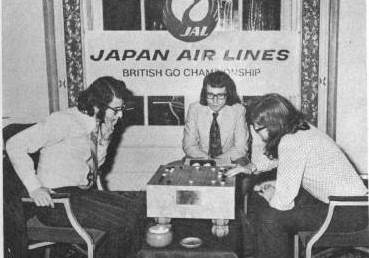
- Presentation1.jpg (18.04 KiB) Viewed 17701 times
EDIT: It is amazing to think that this picture was taken almost 42 years ago and two of the three people in it have posted here in the last two days!!
Re: Getting back into Go
Posted: Thu Mar 10, 2016 2:03 pm
by dust
Thanks!
Re: Getting back into Go
Posted: Thu Mar 10, 2016 3:40 pm
by Katharsys
Welcome! Interested to see some of your games! I'm curious as to how the play style was back then.

Re: Getting back into Go
Posted: Fri Mar 11, 2016 1:05 am
by Charles Matthews
Katharsys wrote:I'm curious as to how the play style was back then.
Interesting point. I recall playing John T. in the days of the London Go Centre, and discussing whether capturing some loose stones was big enough. I must have been a recent 1 dan then.
I think it is genuinely hard for today's players to imagine the study conditions in the mid-1970s. No online go. No databases of games. I remember treasuring each pro game record that was available in magazines. Books in English could make an impact because they had ideas in them that were not previously available (e.g. "Kage's Secret Chronicles").
The consequences were that we were much more self-taught, and the resemblance to pro play in games was pretty much limited to
joseki. The general style was quite slow, heavy, territorial and conservative. (Some people did play a sort of homebrew
shinfuseki.) I once went through the game records of the 1976 European Go Congress top group, and I wouldn't want to repeat the experience.
Basically European go of that time was based on misconceptions, some of them strongly held.
Re: Getting back into Go
Posted: Fri Mar 11, 2016 1:27 am
by dust
I learnt to play Go in London in the 1980s. The London Go Centre had closed, and the kipper ties and long hair were long gone, but I think the 70s playing style was hanging over the scene.
Basically, there was a general impression that attacking and - worse - killing groups were crude plays of amateurs. There was a misunderstanding about Japanese Go, where the shape qualities were appreciated - but there was no real understanding of the power that lay behind the moves. At the time, Matthew Macfadyen were exploring attacking go, but was regarded as a bit of a maverick.
It wasn't until the early 1990s (still pre-internet), when the chinese player Shutai Zhang arrived in London, that some of us appreciated that there was a whole other dimension to Go, with a dynamic fighting tension on the board underlying what appear to be on the surface calm moves. And, of course, he also opened our eyes to the world of attacking go.
Re: Getting back into Go
Posted: Fri Mar 11, 2016 2:57 am
by Charles Matthews
dust wrote:I learnt to play Go in London in the 1980s. The London Go Centre had closed, and the kipper ties and long hair were long gone, but I think the 70s playing style was hanging over the scene.
I had the long hair to 1977, but not the tie.
dust wrote:Basically, there was a general impression that attacking and - worse - killing groups were crude plays of amateurs. There was a misunderstanding about Japanese Go, where the shape qualities were appreciated - but there was no real understanding of the power that lay behind the moves.
I think the early go books in English made a real mess with explaining influence. In fact this is known to be the case, and has been for a while. It took me quite some time to work out why, though. The basic points seem to me now to be:
[*]You probably don't get to real 5d without a proper understanding of how influence factors into positional judgement.
[*]Players at 3d/4d level actually tend to overestimate "attacking go".
[*]Players at 1d/2d level tend to underestimate "living go", because these are the bookworms.
[*]You are supposed to learn about influence, in the traditional paternalistic Japanese system, as Black in handicap games.
The trouble was, in brief, that: (a) people tended to moan about or misunderstand handicap go as Black; and (b) adopted the 3d/4d view of influence as "power", conflated with "thickness". From (a) you get the over-engineered "solid" positions, while from (b) you get the misapprehension that attacking groups is the basic skill, when defending well is actually harder.
So I'm not entirely agreeing with you. There are different flavours of "amateurism" to be overcome.
dust wrote:At the time, Matthew Macfadyen were exploring attacking go, but was regarded as a bit of a maverick.
Reasons for that!
Macfadyen's training, I concluded, was all about the 4d/5d boundary. This definitely addresses the tough problem for European go: 4d players are produced by the tournament circuit, but it is a well-known plateau.
One way for me to conceptualise what the problem is: the 1k/1d boundary is surely very significant for amateurs, but came into view for us in the 1960s. The 4d/5d boundary, seen from below (by a 3d from 1979) is of the same type, but much harder to explain.
dust wrote:It wasn't until the early 1990s (still pre-internet), when the chinese player Shutai Zhang arrived in London, that some of us appreciated that there was a whole other dimension to Go, with a dynamic fighting tension on the board underlying what appear to be on the surface calm moves. And, of course, he also opened our eyes to the world of attacking go.
Shutai Zhang had trained as a pro, so of course knew what was what.
Re: Getting back into Go
Posted: Fri Mar 11, 2016 6:52 am
by HKA
Welcome! Can I assume that you are responsible for a certain little blue (and occasionally green) book that was quite essential back in the pre-internet days?
Re: Getting back into Go
Posted: Wed Mar 16, 2016 9:39 am
by Katharsys
This turned into a very interesting thread.
