Page 1 of 2
Okjib hwal(Korean term for living without 2 complete eyes)
Posted: Sat Aug 20, 2016 3:04 pm
by trout
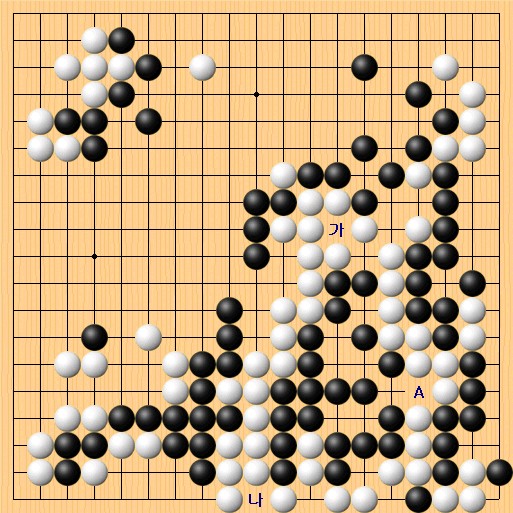
Kim Jiseok(W) vs Choi Cheolhan(B) During KB Baduk league game.
Okjib - False eye, Hwal - Living
B's attempt KO at A will not work because W will not accept any move and take b stone to kill B's group.
It took 49 years to create another one since it happened last time.

Kang Cheolmin 3p(W) vs Yoon Kihyun 6p(B) Yooth cup final in 1967.
Re: Okjib hwal(Korean term for living without 2 complete eye
Posted: Sat Aug 20, 2016 8:40 pm
by yoyoma
Very cool shape! About the ko, black capturing 2 stones on the bottom is a local ko threat right? If white ignores, black can connect making 2 eyes while cutting the white ring at the same time which kills white. So black starts a ko to cut the white ring, and then for his ko threat he tries to cut the ring in another spot, while also saving his own life! I guess white can answer and he has at least one local threat of his own on the lower left edge to connect, and then I don't see a 2nd local threat for black.
BTW the Korean article says "A의 곳 패는 만패블청이라 흑이 들어올 수 없다." What does 만패블청 mean?
Re: Okjib hwal(Korean term for living without 2 complete eye
Posted: Sat Aug 20, 2016 8:56 pm
by trout
"만패블청" means won't respond to any move and resolve KO.
Posted: Sat Aug 20, 2016 9:10 pm
by EdLee
Hi dave, kirby -- the top diagram: even if B tenukis, isn't W dead ?
Re:
Posted: Sat Aug 20, 2016 9:55 pm
by skydyr
EdLee wrote:Hi dave, kirby -- the top diagram: even if B tenukis, isn't W dead ?
Unless I miss what you're referring to, white's alive with a two-headed dragon. Black can't fill either eye that appears to be false, because each side will always have two.
http://senseis.xmp.net/?TwoHeadedDragon
Posted: Sat Aug 20, 2016 10:15 pm
by EdLee
Hi skydyr,
Thanks.
Follow-up trivia question: in this case (of the 2HeadedDragon),
is "false eye" then a misnomer ?
I understand the status is more important that the label,
but in the SL case, W cannot kill B, therefore B is alive,
and so B's 2 "false eyes" are actually real eyes, aren't they ?
Same question for the original top diagram.
Black can't fill either eye that appears to be false, because each side will always have two.
Right, so we don't care how it
appears; we care about its status --
can B fill in either one ? If no to both, then they are real eyes -- aren't they ? (Worth 1 point each for W.)
Re: Okjib hwal(Korean term for living without 2 complete eye
Posted: Sat Aug 20, 2016 10:57 pm
by Kirby
EdLee wrote:
is "false eye" then a misnomer ?
"false eye" is the translation of a portion of the term "okjib hwal". The term "okjib hwal" refers to this specific type of situation. Though the term contains "okjib", "okjib hwal" can be thought of as its own term.
There's a wiki page about "okjib salm" (basically the same thing) here:
https://ko.wikipedia.org/wiki/%EC%98%A5 ... 1%EC%82%B6
Here's an example on that page:
$$B
$$ | . . . . . . . . . . . . . . . . . . . |
$$ | . O O O O O O . . . . . . . . . . . . |
$$ | O O X X X X O . . . . . . . . . . . . |
$$ | X X X O O X O . . . . . . . . . . . . |
$$ | X O O , O X O O . , . . . . . , . . . |
$$ | X O . O O X X O . . . . . . . . . . . |
$$ | . X O O X . X O . . . . . . . . . . . |
$$ | X . X X X X O O . . . . . . . . . . . |
$$ ---------------------------------------
- Click Here To Show Diagram Code
[go]$$B

$$ | . . . . . . . . . . . . . . . . . . . |

$$ | . O O O O O O . . . . . . . . . . . . |

$$ | O O X X X X O . . . . . . . . . . . . |

$$ | X X X O O X O . . . . . . . . . . . . |

$$ | X O O , O X O O . , . . . . . , . . . |

$$ | X O . O O X X O . . . . . . . . . . . |

$$ | . X O O X . X O . . . . . . . . . . . |

$$ | X . X X X X O O . . . . . . . . . . . |

$$  ---------------------------------------[/go]
It says that both black and white are in the "okjib salm" situation. While it is true that the groups are alive, so the eyes are "not false" per English terminology, I don't think it's a problem to use a specific term to describe this, including "okjib" in the name.
Re:
Posted: Sat Aug 20, 2016 11:15 pm
by skydyr
EdLee wrote:Hi skydyr,
Thanks.
Follow-up trivia question: in this case (of the 2HeadedDragon),
is "false eye" then a misnomer ?
I understand the status is more important that the label,
but in the SL case, W cannot kill B, therefore B is alive,
and so B's 2 "false eyes" are actually real eyes, aren't they ?
Same question for the original top diagram.
Black can't fill either eye that appears to be false, because each side will always have two.
Right, so we don't care how it
appears; we care about its status --
can B fill in either one ? If no to both, then they are real eyes -- aren't they ? (Worth 1 point each for W.)
Well, the reason I say 'appears' is because they're not actually false eyes, rather they are just oddly-formed real eyes. False eyes aren't false because they have two corners (or one one the edge) taken by the opponent. They're false because as all the outside liberties are filled, they leave a string of stones with only one liberty and need to be filled to connect. The corner thing is just a heuristic that makes them easy to spot, and is almost always correct.
To put your question another way, take the following example:
$$c False false eye
$$ ---------------------------------------
$$ | . X . X O . . . . . . . . O X . . X . |
$$ | . X . X O O O O O O O O O O X X X X X |
$$ | X X X X X X X X X X X X X X a X O O O |
$$ | O O O O O O O O O O O O O O X X O . . |
$$ | . . . . . . . . . . . . . O O O O . . |
- Click Here To Show Diagram Code
[go]$$c False false eye

$$ ---------------------------------------

$$ | . X . X O . . . . . . . . O X . . X . |

$$ | . X . X O O O O O O O O O O X X X X X |

$$ | X X X X X X X X X X X X X X a X O O O |

$$ | O O O O O O O O O O O O O O X X O . . |

$$ | . . . . . . . . . . . . . O O O O . . |[/go]
Is A a false eye? It looks like one, but I don't think anyone would be confused and think that it's not worth a point (territory counting). Even if you filled one of the eyes on each side, I don't think anyone would question it.
In a sense, the problem is thinking that a living group has to have two eyes. There is no rule that says that it must, and indeed, there is no definition of eyes that I can think of in any standard ruleset. The question is 'can the group be captured, or not?' Thinking of eyes is, again, a crutch or heuristic to help answer the question of whether a group is alive or not.
Regarding the value specifically, as I understand it rules that are territory based define groups as either alive, in seki, or dead. A string is assumed to be in seki if after all the dame are filled, it can't be captured AND it has liberties that are shared with the opponent's stones. In that case, any points the group surrounds are not counted, because the string is in seki. If all its liberties are shared with only stones of the same colour, then it is fully alive and any enclosed liberties are counted as points.
Re: Okjib hwal(Korean term for living without 2 complete eye
Posted: Sun Aug 21, 2016 1:34 am
by John Fairbairn
The 1967 game shown above may not be the first known example in history, as the Korean article says (unless "in Korea" is implied). The only possible rival is a pro game in Japan which I have not seen an which I have seen described (in a book of 1989 and in the context of a game played in 1988) as being played "around 20 years ago".
But we have not had to wait 49 years for another example, as there was a pro example in 1988 in Japan. The relevant portion of the position is shown below. White lived with the triangle move. It takes some reading.
Then of course we had the 1998 example in the 20th WAGC.
"만패블청" means won't respond to any move and resolve KO.
Slightly clearer English: Resolving a ko by not answering even a large ko threat (literally: not heeding 10000 hegemons).
It's interesting where the word "two-headed dragon" comes from in the usual English name, as the Japanese name is just "false eye life" (though I have also seen "two-headed life") and one Chinese name is "two-headed snake". I have come across "dragon eats its own tail" but in that case the dragon is presumably still one-headed.
there is no definition of eyes that I can think of in any standard ruleset
You can have a circular argument about the definition of definition, or more usefully argue about usefulness of a definition, but eyes are defined in the 1949 and 1989 Japanese rules.
Incidentally, the old Korean game above, from the 5th Young Players Cup, features players we would hardly call youths today, but young nonetheless, and they were playing with 5 hours each. O tempora, o mores! (Or, perhaps better: o tempora, o mures!)
Re: Okjib hwal(Korean term for living without 2 complete eye
Posted: Sun Aug 21, 2016 9:10 am
by Kirby
John Fairbairn wrote:The 1967 game shown above may not be the first known example in history, as the Korean article says (unless "in Korea" is implied).
Not only is "in Korea" implied, but this is also specific to official matches. The cyberoro article [1] from which trout likely found this from is more clear:
국내 프로의 공식대국에서 옥집활이 등장한 것은 이번이 두 번째
This is the second time okjibhwal has made an appearance in an official domestic game.
Also, the news article is posted in the "domestic news" section of the site. Korean readers interested in domestic go news can be interested in this, even if it doesn't include reference to all foreign game records and unofficial matches.
[1]
http://cyberoro.com/news/news_view.oro? ... num=522046
Re: Okjib hwal(Korean term for living without 2 complete eye
Posted: Sun Aug 21, 2016 10:17 am
by aeb
John Fairbairn wrote:The 1967 game shown above may not be the first known example in history. The only possible rival is a pro game in Japan which I have not seen and which I have seen described (in a book of 1989 and in the context of a game played in 1988) as being played "around 20 years ago".
That was a game I had in my unsorted collection, and have just put at
http://homepages.cwi.nl/~aeb/go/games/g ... za18/3.sgf
It is Ishigure Ikuro vs Shinohara Masami, 18th Oza, 1969-11-05.
After move 186 the board looks like this:[img]snake_oza.png[/img]
Posted: Sun Aug 21, 2016 10:30 am
by EdLee
Hi aeb, for this game doesn't B at M12 kill ?
Re:
Posted: Sun Aug 21, 2016 11:23 am
by aeb
EdLee wrote:Hi aeb, for this game doesn't B at M12 kill ?
No. (You asked the same question earlier. The eye does not become false.)
Posted: Sun Aug 21, 2016 12:14 pm
by EdLee
Hi aeb, Thanks.
Re: Okjib hwal(Korean term for living without 2 complete eye
Posted: Sun Aug 21, 2016 1:43 pm
by Mike Novack
I think that perhaps this is a case of talking about LARGE cases (many stone examples) where multiple groups none of which have two eyes on their own are alive because they mutually touch two separate eyes. We are all used to seeing the small examples common in play.
When we say "group" we most often mean a CONNECTED set of stones. Two such groups of connected stones are alive if they both touch separate eyes even though the groups cannot be connected because that would destroy one of these eyes.
If instead we redefine "group" in the negative sense this apparent special case goes away. Instead of saying a group is "a set of stones that are connected" change that to "a set of stones that cannot be disconnected by a legal play".