djhbrown wrote:... the human instinct for cooperation and neighbourliness. We are pack animals, who have achieved our evolutionary success by working together
Jacob Bronowski wrote:The most powerful drive in the ascent of man is the pleasure he derives in his own skill. He loves to do what he does well; and having done it well, he loves to do it better. You see it in his science, you see it in the magnificence with which he carves and builds. The loving care; the gaiety; the effrontery!
http://www.youtube.com/watch?v=rIcOpCxb ... h&index=10
the picture shows Swim's preliminary perceptions of the situation after move 33.
Before analysing her perceptions, Swim asks you to tell her your subjective beliefs about the relative worth of territory and shadow, and how much of the still neutral space you expect to be able to get.
To do this,
Kirby, with reference to the code below, please can you choose values for f, g, and h.
f and g represent your opinion of the relative values of prospective territory and influence (shadow)
they are general functions, but for this experiment, we can consider them as simple weight factors; for example, f=g=1
similarly, h can be a weight factor, representing your general degree of optimism about to how much of the open space you can sequester.
since you are stronger than your opp, one simple objective heuristic you could use is n*(hisrank/yourrank) - this assumes you think you will end up with n points per stone from now on, but it doesn't weigh in your feelings about your or his chances of capturing weak groups - it would be possible to define a more general function for h, but i don't think that's necessary at this stage of experimentation, since our focus is on your appraisal of the effectiveness of Swim's reasoning methods, which will begin once we have decided values for f, g and h.
for an even game, the simplest choice is to just let f,g = 1 and h = 0.25 (which assumes it will be evenly shared; the open space is reduced each time a move is played - if stones get captured, they are more likely to become territory than open space).
Code: Select all
let lead =  value (me) - value (you);
if lead + chance > 0 then playsafe
else attack

value (x) = f (territory (x), g (influence (x))
                  + if white (x) then komi

territory (x) =   size (eyespace (x)) +  prisoners (x))

influence (x) =  if weak (x) then 0
                 else g (size (shadow (x))

chance   =   h (size (neutral space))
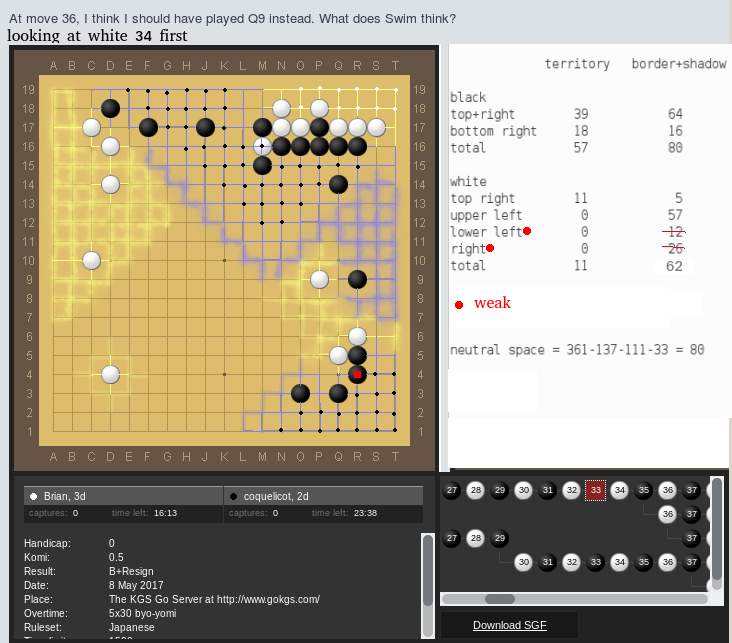
- kirby3a.png (166.66 KiB) Viewed 17991 times
Code: Select all
let lead =  value (me) - value (you);
if lead + chance > 0 then playsafe
else attack

value(player) = sum(value, player.group)

value (x) = f (territory (x),
               g (influence (x))
            + if white (x) then komi

territory (x) =   size (eyespace (x))
                  +  prisoners (x))
influence (x) =  if weak (x) then 0
                 else g (size (shadow (x))

chance   =   h (size (neutral space))
Swim's output shown in black
additional comments in brown
weak groups have no value.
white has 4 groups: top right is alive; upper left is strong because its territory+shadow is big.
the minimum size needed to make 2 eyes is 7x3 = 21 on the side, and 7x5 = 35 in the middle.
lower left hoshi stone is weak
(even though it's not under direct attack)
white's right side group has a link to the side, but its eyespace of 12 points < 21, so it's weak.
if f=g=1:
value(black) = 57+80 = 137
value(white) = 11+62 = 73
if h = 0.25:
chance = 80/4 + 6.5 = 26.5
lead = -64
lead+chance = -64+26.5 = -37.5
therefore, white must attack
 i think i know what your problem is, even before asking Swim