Page 1 of 1
Handicap & Komi for 9×9 and 13×13 Boards
Posted: Wed Jul 03, 2019 6:40 am
by Bonobo
What do our experts think of this
Handicap & Komi table for 9×9 & 13×13 boards?
I collated H&K suggestions from
two different PDFs posted in the German DGoB forum into this table and would like to know what people experienced with small-board tournaments may have to add, comment, or improve.
Thanks in advance.
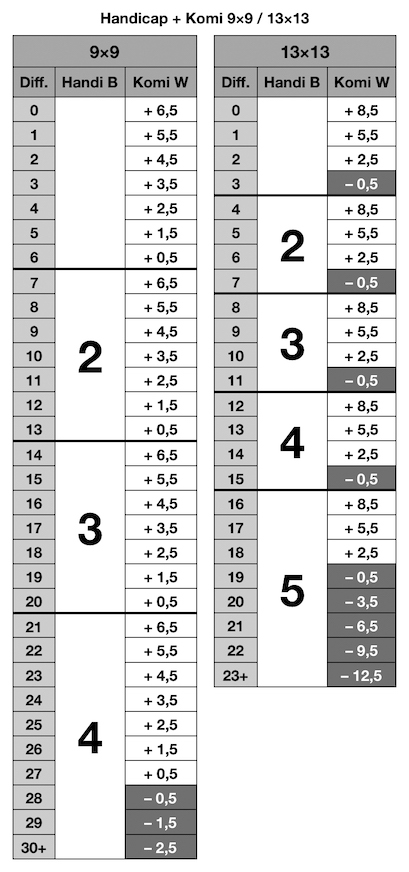
- Handicap & Komi for 9x9 & 13x13 sm.jpeg (134.07 KiB) Viewed 8264 times
Re: Handicap & Komi for 9×9 and 13×13 Boards
Posted: Wed Jul 03, 2019 7:33 am
by HermanHiddema
Those tables are severely broken.
On 9x9, after +0,5 the next value should be -0,5, then -1,5 all the way to -5,5 or -6,5 before you give 2 handicap.
Similarly, on 13x13 there should be -3,5 and perhaps -6,5 before giving handicap.
Re: Handicap & Komi for 9×9 and 13×13 Boards
Posted: Wed Jul 03, 2019 7:53 am
by HermanHiddema
To make such tables, we need three values:
A. The point value of a stone in the opening (2x komi)
B. The point value of sente in the opening (komi)
C. The point value of 1 rank difference on that board size (on 19x19 this equal to the point value of 1 stone)
Then black should get C points per rank compensation.
Suppose we take the value of a handicap stone on 9x9 as 14. and the value of one rank as 2 points, then black should get one stone every 7 ranks. And additionally the komi should be adjusted by 2 points every rank. Your table does have 1 extra stone per 7 ranks, but only 1 point per rank. A correct table would be:
0 => even + 6,5
1 => even + 4,5
2 => even + 2,5
3 => even + 0,5
4 => even - 1,5
5 => even - 3,5
6 => even - 5,5
7 => 2 stones + 6,5
8 => 2 stones + 4,5
9 => 2 stones + 2,5
10 => 2 stones + 0,5
11 => 2 stones - 1,5
12 => 2 stones - 3,5
13 => 2 stones - 5,5
14 => 3 stones + 6,5
15 => 3 stones + 4,5
16 => 3 stones + 2,5
17 => 3 stones + 0,5
18 => 3 stones - 1,5
19 => 3 stones - 3,5
20 => 3 stones - 5,5
21 => 4 stones + 6,5
etc
In the table you have, there's a huge jump between 6 ranks (very unfair to black) and 7 ranks (perfectly reasonable).
Re: Handicap & Komi for 9×9 and 13×13 Boards
Posted: Wed Jul 03, 2019 8:10 am
by Uberdude
See
https://senseis.xmp.net/?HandicapForSmallerBoardSizes, which links to
https://web.archive.org/web/20080112004 ... handicaps/ with handicaps for 13x13 as used at the British small board championship and more generous to black (or should that be less generous to white as white tended to win too much) from the Cambridge club's Sonoyama 13x13 tournament (which is 10 min SD, should generally help white compared to slower time limits).
Re: Handicap & Komi for 9×9 and 13×13 Boards
Posted: Wed Jul 03, 2019 12:29 pm
by gennan
So for
9x9, the Cambridge handicap is 1 stone per 5 ranks and Bonobo's handicap is 1 stone per 7 ranks.
In my kids club I started with 1 stone per 6 ranks and I think it's holding up well over the years.
It means I give 8 stones to a novice (42k) and 4 stones to an 18k.
And for
13x13, the 'BGA' handicap is 1 stone per 3 ranks, while the Cambridge/Sonoyama handicap is 1 stone per 2.5 ranks and Bonobo's handicap is 1 stone per 4 ranks.
I would expect that 1 stone per 4 ranks favours white heavily.
In my kids club I started with 1 stone per 2.5 ranks. But over the years, I got the impression that it still slightly favours white, so I increased it a bit to 1 stone per 2.2 ranks. After that change, it seems ranks/handicaps became more balanced between the different board sizes.
It means I give 8 stones to a 15k and 4 stones to a 6k.
Most of the games in my kids club are on smaller boards, using these handicaps. Many thousands of games were played with it in the 7 years since the club started.
Re: Handicap & Komi for 9×9 and 13×13 Boards
Posted: Wed Jul 03, 2019 2:50 pm
by sybob
gennan wrote:
In my kids club I started with 1 stone per 2.5 ranks. But over the years, I got the impression that it still slightly favours white, so I increased it a bit to 1 stone per 2.2 ranks. After that change, it seems ranks/handicaps became more balanced between the different board sizes.
It means I give 8 stones to a 15k and 4 stones to a 6k.
Most of the games in my kids club are on smaller boards, using these handicaps. Many thousands of games were played with it in the 7 years since the club started.
And how about komi, using this table?
Always 6.5?
Re: Handicap & Komi for 9×9 and 13×13 Boards
Posted: Thu Jul 04, 2019 12:09 am
by gennan
sybob wrote:gennan wrote:
In my kids club I started with 1 stone per 2.5 ranks. But over the years, I got the impression that it still slightly favours white, so I increased it a bit to 1 stone per 2.2 ranks. After that change, it seems ranks/handicaps became more balanced between the different board sizes.
It means I give 8 stones to a 15k and 4 stones to a 6k.
Most of the games in my kids club are on smaller boards, using these handicaps. Many thousands of games were played with it in the 7 years since the club started.
And how about komi, using this table?
Always 6.5?
Komi would take up too much space in my tables to cover ranks from 42k to 9p, so I just don't bother with komi in the kids club. I just round the handicaps to whole handicap stones.
For a tournament, you could interpolate with komi for a more precise handicap.
I should check this, but I think this would work:
handicap = rounddown(abs(dr) / f + 0.5)
komi = fractionalpart(abs(dr) / f + 0.5) * k * 2
where
dr = rank difference
k = komi for that board size
f = handicap factor for that board size
size 19: f = 1, k = 6.5
size 13: f = 2.2, k = 6.5 (or 8.5 if you think that's more accurate on 13x13)
size 9: f = 6, k = 6.5
you may round the computed komi to the nearest non-integer half-integer if you want to prevent jigo.
Edit: fixed mistakes in the formulas.
Re: Handicap & Komi for 9×9 and 13×13 Boards
Posted: Thu Jul 04, 2019 8:09 am
by bogiesan
Tempest in a go bowl.
imposing komi on beginning players requires they understand how a few points will affect their results. If the players cannot count accurately during play and forecast the value of endgame plays, what is the purpose of komi in small board games? It is my experience that beginners just want to play and kick ass; they only learn to care about the subtlety of the game if they arrive at the realization that there’s more to go than winning on their own. I have found the appreciation of go cannot be forced. Attempting to do so turns kids and adults off quickly. I just let them play and I am thankful for their brief time away from Donkeys and Dragons.
In a rated match, completely different story. The values of handicap and Komi are enforced by the organization under whose rules the games are governed.