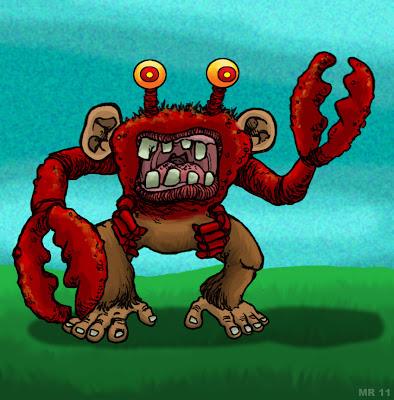
Are you a crab or a monkey?
Posted: Fri Sep 02, 2011 10:24 am
There is a Japanese (actually Asia-wide) folktale about a crab that has found a tasty rice cracker and a monkey who has a persimmon seed. The monkey persuades the crab to swap and gobbles up his snack. The far-sighted crab plants the seed and soon a tree full of fruit grows. But the fruit is too high for the crab and so she begs help from the monkey. But when the monkey climbs up, he gobbles up the ripe fruit and hurls the hard persimmons at the crab, injuring her. Other crabs rally round and plot a way to get revenge on the dastardly simian. We can leave the details to one side, and in any case there are many versions of the tale. Suffice it to say that the crabs did get revenge. In one extended version, the monkey tried to do the dirty, literally, on the victorious crabs hiding in their hole. But when the monkey stuck his bum into the hole, the crabs nipped off all the hairs. Which is why, today, monkeys have hairless posteriors and crabs have hairs on their claws.
The go writer Saito Kaneaki, who reported on the Judan, once used the analogy of monkeys and crabs to describe go players who like quick profit and those who took a long-term view and relied on atsumi thickness.
Takagawa Kaku liked this analogy so much that he made a list of crabs and monkeys. This is his selection:
In the days when they were in their prime, Go Seigen, Hashimoto Utaro and Sakata Eio were monkeys (and Go loved to devour real crabs). Fujisawa Hideyuki and Takagawa were crabs.
Of the players who were still up and coming then, Otake Hideo and Takemiya Masaki were very much crabs, he said. Ishida Yoshio was very much a monkey. Young Kato Masao was a crab but one with strong monkey tendencies. It was still to early to say which way he would eventually go, but Takagawa believed you did end up one or the other. Readers will recall how as a newcomer, Kato won a lot of games but could never turn his plus record into titles. He agonised over why. Perhaps he had yet to stabilise his style, and perspicacious Takagawa had spotted this.
Among players of the past, even Shusaku was a crab, he said. When we think of the famously solid Shusaku kosumi, this may seem surprising, at least if you have the association solid = territory in your mind. Takagawa seems to be hinting at the perhaps better association solid = atsusa thickness.
One other intriguing assessment by Takagawa is of Iwamoto Kaoru. He doesn't actually say he's a crab, but he does say that Iwamoto has a highly developed characteristic of turning atsumi thickness into territory little by little in the endgame. This in itself is not a rare use of thickness, but it is unusual for a player to make it characteristic of his style.
So, do you have a hairless posterior or do you have claws with a five o'clock shadow?
The go writer Saito Kaneaki, who reported on the Judan, once used the analogy of monkeys and crabs to describe go players who like quick profit and those who took a long-term view and relied on atsumi thickness.
Takagawa Kaku liked this analogy so much that he made a list of crabs and monkeys. This is his selection:
In the days when they were in their prime, Go Seigen, Hashimoto Utaro and Sakata Eio were monkeys (and Go loved to devour real crabs). Fujisawa Hideyuki and Takagawa were crabs.
Of the players who were still up and coming then, Otake Hideo and Takemiya Masaki were very much crabs, he said. Ishida Yoshio was very much a monkey. Young Kato Masao was a crab but one with strong monkey tendencies. It was still to early to say which way he would eventually go, but Takagawa believed you did end up one or the other. Readers will recall how as a newcomer, Kato won a lot of games but could never turn his plus record into titles. He agonised over why. Perhaps he had yet to stabilise his style, and perspicacious Takagawa had spotted this.
Among players of the past, even Shusaku was a crab, he said. When we think of the famously solid Shusaku kosumi, this may seem surprising, at least if you have the association solid = territory in your mind. Takagawa seems to be hinting at the perhaps better association solid = atsusa thickness.
One other intriguing assessment by Takagawa is of Iwamoto Kaoru. He doesn't actually say he's a crab, but he does say that Iwamoto has a highly developed characteristic of turning atsumi thickness into territory little by little in the endgame. This in itself is not a rare use of thickness, but it is unusual for a player to make it characteristic of his style.
So, do you have a hairless posterior or do you have claws with a five o'clock shadow?