Page 1 of 1
Russian single-convex stones
Posted: Mon Jan 09, 2012 11:03 am
by FlyingAxe
I know there have been a few threads on single-convex vs. double-convex stones, but I was wondering what you guys thought about these Russian stones:
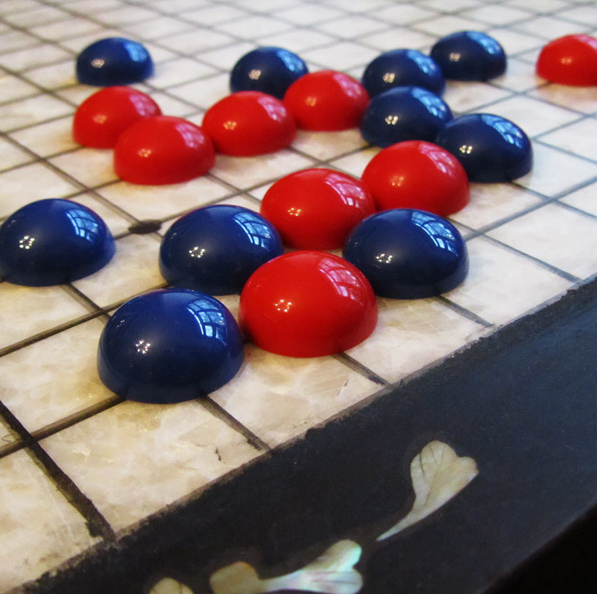
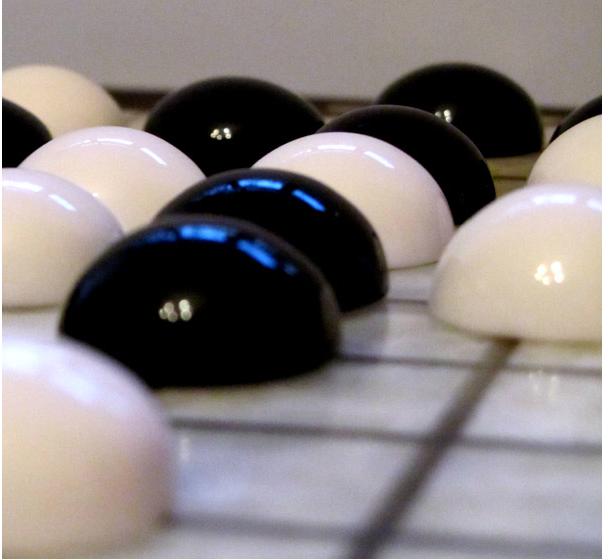
More pictures here:
http://shop.way-of-go.com/shop/group_597/
The web-site claims that the "although modern Chinese stones have become flat, originally they were half-spherical; these stones were made according to the original design". Also, regarding the blue-and-red stones, they claim that the coloring was made according to "instructions found in Chinese manuscripts".
I am wondering if this is just a marketing ploy, or if there is any truth to these claims. Also, how would these stones handle? I imagine they would be easier to remove from the board than the modern single-convex stones, but would it be easy to place them on the board? Although there are a few videos online of Igor Grishin (Игорь Гришин), the owner of the store, I couldn't find any of him playing with these stones.
Re: Russian single-convex stones
Posted: Mon Jan 09, 2012 12:13 pm
by bogiesan
I was cruising a bunch of links from Sensie's Library last night and came across photos of ancient Chinese stones. Sorry, didn't grab the bookmark, maybe someone else can. He's right, more or less. There are samples of hemispherical stones, some are highly ornate, others seem to be contemporary in glass or clear plastic. Just guessing these are placed deliberately with thumb and forefinger instead of the Japanese-style whack.
Re: Russian single-convex stones
Posted: Mon Jan 09, 2012 1:33 pm
by jts
bogiesan wrote:I was cruising a bunch of links from Sensie's Library last night and came across photos of ancient Chinese stones. Sorry, didn't grab the bookmark, maybe someone else can. He's right, more or less. There are samples of hemispherical stones, some are highly ornate, others seem to be contemporary in glass or clear plastic. Just guessing these are placed deliberately with thumb and forefinger instead of the Japanese-style whack.
Why would these be placed noob-style? I find it easier to get the pa-chi sound with single-convex stones. They slide off the fingernail in a more stable way.
Re: Russian single-convex stones
Posted: Tue Jan 10, 2012 12:44 pm
by bogiesan
jts wrote:
Why would these be placed noob-style? I find it easier to get the pa-chi sound with single-convex stones. They slide off the fingernail in a more stable way.
Continuing the conversation, much like you were. Have you ever held one of these big hemispheres? I have a set of semi-convex stones and, yes, they're not difficult to snap down. But these look like more of a challenge. Much more material, not necessarily mass, above the plane as well as a far steeper curve. Snapping them down could send them flying like a wet pumpkin seed.
Re: Russian single-convex stones
Posted: Tue Jan 10, 2012 2:16 pm
by jts
bogiesan wrote:Continuing the conversation, much like you were. Have you ever held one of these big hemispheres? I have a set of semi-convex stones and, yes, they're not difficult to snap down. But these look like more of a challenge. Much more material, not necessarily mass, above the plane as well as a far steeper curve. Snapping them down could send them flying like a wet pumpkin seed.
Ah, I see. I didn't realize you were referring exclusively to the size. But the Japanese make stones that are this big too (22 mm x 11 mm). I've never used this Russian brand of stones, naturally, but within the range I've experienced the thinner stones are harder to snap because your fingers are closer together, so you need to apply much more force to get the desired impact velocity. That, of course, can lead to mistakes.

Is your experience that the thinnest stones are are easier?
Posted: Tue Jan 10, 2012 8:30 pm
by EdLee

- mm.jpg (28.78 KiB) Viewed 8826 times
Re: Russian single-convex stones
Posted: Tue Jan 10, 2012 9:41 pm
by tchan001
FlyingAxe wrote:
The web-site claims that the "although modern Chinese stones have become flat, originally they were half-spherical; these stones were made according to the original design". Also, regarding the blue-and-red stones, they claim that the coloring was made according to "instructions found in Chinese manuscripts".
I am wondering if this is just a marketing ploy, or if there is any truth to these claims. Also, how would these stones handle? I imagine they would be easier to remove from the board than the modern single-convex stones, but would it be easy to place them on the board? Although there are a few videos online of Igor Grishin (Игорь Гришин), the owner of the store, I couldn't find any of him playing with these stones.
It's a pretty bold claim that this shape is the "original design" of go stones in China. I know that Igor Grishin has some Ming dynasty stones in his collection (pictures shown in the
"All About Go's" Gallery of Go Equipment) which looks of that design, but they seem to only be from the Ming Dynasty (1368–1644).
The famous
Mokuga Shitan no Kikyoku (木画紫檀碁局), a red sandalwood go board which was a gift from China to the Japanese Emperor Shomu (701-756), has some ivory stones which certainly do not seem to be just semi spherical. And this is definitely much older than the Ming Dynasty stones from Igor's collection.
Then we have a picture from a
HK website on the history of go and the original design of go stones seems to be natural pebbles. I doubt you can get more "original" than this design for go stones.
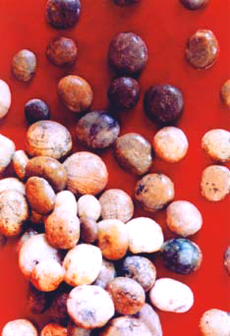
- stone_stone_mt.jpg (91.66 KiB) Viewed 8755 times
Re:
Posted: Thu Jan 12, 2012 3:56 am
by OtakuViking
Re: Russian single-convex stones
Posted: Fri Jan 13, 2012 11:31 am
by palapiku
When I was in Beijing I went to a museum and saw some ancient Go stones. They were made of stone and completely flat, like very thick coins. I don't know how old they were, though.
Re: Russian single-convex stones
Posted: Sat Jan 14, 2012 5:38 pm
by FlyingAxe
jts wrote:bogiesan wrote:I was cruising a bunch of links from Sensie's Library last night and came across photos of ancient Chinese stones. Sorry, didn't grab the bookmark, maybe someone else can. He's right, more or less. There are samples of hemispherical stones, some are highly ornate, others seem to be contemporary in glass or clear plastic. Just guessing these are placed deliberately with thumb and forefinger instead of the Japanese-style whack.
Why would these be placed noob-style? I find it easier to get the pa-chi sound with single-convex stones. They slide off the fingernail in a more stable way.
I only get a double sound that resembles placing a coin on a table; nothing similar to placing a bi-convex stone.