And this reminded me of a situation that happened when I was at the World Mindsports games in Beijing, that I thought I'd share.Something else to consider is that there isn't just one type of person at any rank.
Someone might be playing extraordinarily strange moves, that I would know that I could punish, but which people at that level can't punish at all. I might give that person a much lower rank than a person who played slow but solid moves, because the latter didn't leave obvious ways for ME to kill them.
These two might actually be the same rank, or the first person might actually be stronger, but I'm going to view ranks through the lens of what I can punish.
I made friends with a chinese businessman/enthusiast who was visiting the tournament. (He was my smoking buddy)
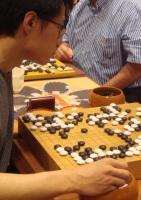
We played a number of games in the common area, and I won a good number of them. He seemed impressed that a westerner was able to keep pace with him, and invited me to come have a game against a professional friend of his. We went down to one of the game areas and he introduced me to the professional and one of the professional's students (a Tygem 9d).
(I have since forgotten the professional's name, the name was in Chinese and I had trouble with it then, now, 4 years later, it escapes me completely)
The Pro invited me to sit down and play him with a 3-stone handicap and completely blew me off the board. Afterward, I got a distinct impression of disgust from him. He asked me how long I had been playing, and I told him 6 years, he said "that long? People in China can get to where you are in 1 year"
He then started into a lesson on basic strategy, presenting the line of territory, the line of power, and the line of defeat... I listened, but I was embarrassed. I was aware of my friend standing by, shifting awkwardly, and while I wasn't about to embarrass him by storming away, I was internally seething. All I could think about was "Really? This is all you see in my play? Is this how you teach?"
Afterwards, he left and I sat down and had a game with his student. It turns out anger is a particularly effective motivator for me, because I played some of the best go I've ever played. I lost, but only because I played too fast on the killing move, and he survived. Afterwards, he complimented me on my game and I recovered my composure a bit.
I've thought about this moment from time to time since, as someone who got to my current rank pretty quickly (by American standards), I was completely unused to being effectively told that I had no potential.
But I wonder if my professional opponent had a biased view of the potential of players, based on the standard way that players learn in china. I feel like, at the Chinese 4d-5d level, most have learned to play in a specific way, because they're being taught by a system with a standardized set of proverbs. I have weaknesses that would have been eliminated early on.
No chinese 4d-5d would play some of the moves I play, they're above them. But at the same time, I have some strengths that compensate, and my record against folks at the Chinese 4d level is pretty good. The odd collection of strengths and weaknesses makes it difficult for someone to objectively quantify my rank.
Anyway, just an anecdote I thought I'd share.