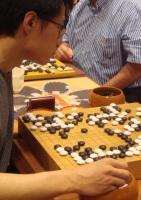
I got a new board for Christmas, and have decided to use it to change my go routine. My plan is to focus on using the board and stones to study. I want to do this because just reading through books isn't effective for me. When I see a numbered diagram, I typically struggle more with the diagram than with the unfolding struggle it's supposed to illustrate. Likewise, when I use the computer, I find the wealth of tools, options and distractions reduces my concentration. In short, I'm hoping to improve my go thinking.
What I've started to do, is to replay commented pro games that I have in book form. I like spending time with one game, getting to know something about it and the players and the commentator. Aside from the comments in the book, I've also been using Ten's guide to studying professional games to get a better handle on what's going on.
There is however a downside for me of this study method, which is the absence of a social component. Just sitting in front of my board without any chatting or feedback or kibbitzing is a bit too ascetic for my tastes, which is why I've decided to supplement it with a journal of my own. Feel free to chime in.
Among the first game I've chosen to look at is this one between Otake Hideo, Gosei and Kobayashi Koichi, Judan from 1984. Most of the action takes place following Kobayashi's stunning invasion at move 61 and how he subsequently took advantage of a weakness that had been sitting there since move 14. What also struck me was blacks willingness to let white get (presumbly) secure territory on the bottom in exchange for a bit of access to the center with which to imply a threat to white's top right center group. Here's the game:
daal's board
-
daal

- Oza
- Posts: 2508
- Joined: Wed Apr 21, 2010 1:30 am
- GD Posts: 0
- Has thanked: 1304 times
- Been thanked: 1128 times
daal's board
- Attachments
-
- Otake-Kobayashi 84-11-22.sgf
- (1.33 KiB) Downloaded 1419 times
Patience, grasshopper.
-
EdLee
- Honinbo
- Posts: 8859
- Joined: Sat Apr 24, 2010 6:49 pm
- GD Posts: 312
- Location: Santa Barbara, CA
- Has thanked: 349 times
- Been thanked: 2070 times
daal, congrats on your new board. Have you considered using your new set for your online real-time (KGS/IGS) games?
I've been doing it for years (it is one reason I set a very slow time setting, so I can relay between the computer
and the physical set). I like it much much better to play on a real set.
I've been doing it for years (it is one reason I set a very slow time setting, so I can relay between the computer
and the physical set). I like it much much better to play on a real set.
-
daal
- Oza
- Posts: 2508
- Joined: Wed Apr 21, 2010 1:30 am
- GD Posts: 0
- Has thanked: 1304 times
- Been thanked: 1128 times
Re: daal's board
Yes, Ed, I have tried it, and to a certain extent I like it too because it naturally slows me down and gives me a nice opportunity to use my equipment - but what I've also found is that as the game goes on, I find myself looking more at the computer and less at the board to see what's going on, so it kind of defeats the purpose for me. It's still nice for the fuseki though.
Patience, grasshopper.
-
EdLee
- Honinbo
- Posts: 8859
- Joined: Sat Apr 24, 2010 6:49 pm
- GD Posts: 312
- Location: Santa Barbara, CA
- Has thanked: 349 times
- Been thanked: 2070 times
Hmmm, that's interesting, I never experienced that.daal wrote:...looking more at the computer and less at the board...
I sit on the floor, facing the real set, and the computer is off to my left,
so I must turn toward the left to relay, otherwise my default body position
is completely focused on the real set, just like in a real game.
-
daal
- Oza
- Posts: 2508
- Joined: Wed Apr 21, 2010 1:30 am
- GD Posts: 0
- Has thanked: 1304 times
- Been thanked: 1128 times
Re: daal's board
I spent some more time today replaying the above game, which I got from a Hinoki Press commented game collection called The Best of Kido: The Art of Positional Analysis. Kobayashi commented this game himself, and at one point offers a variation for move 86bconnecting directly at h15. He then explains why Otake presumably rejected it, showing a 17 move sequence ending at the point at which it is clear that white! (Otake) wins the capturing race, taking the entire top side, but would allow black to play C10 (marked) giving black "the initiative and the advantage." This sort of thing blows me away. Not only reading out that black gets captured, but also envisioning that getting c10 would make it worth black's while.

Patience, grasshopper.
-
EdLee
- Honinbo
- Posts: 8859
- Joined: Sat Apr 24, 2010 6:49 pm
- GD Posts: 312
- Location: Santa Barbara, CA
- Has thanked: 349 times
- Been thanked: 2070 times
-
daal
- Oza
- Posts: 2508
- Joined: Wed Apr 21, 2010 1:30 am
- GD Posts: 0
- Has thanked: 1304 times
- Been thanked: 1128 times
Re: daal's board
I spent some time going through chapter 3 and part of chapter 4 of This is Haengma by Kim Sung-rae, putting the diagrams and problems on the board and looking at them there. A few things struck me about studying this way:
+ If the diagrams showed more than 3 moves, I really understood the explanations quite a bit better by playing through the sequences.
+ It's a heck of a lot quicker and more pleasant to put stones on a board than to make an .sgf file.
+ When trying out variations, I paid more attention to where the stones originally were. Removing stones is different than clicking << or a move number.
+ The stones just feel great in the hands. A handful of them is somewhere between a handful of sand and a handful of money.
+ If the diagrams showed more than 3 moves, I really understood the explanations quite a bit better by playing through the sequences.
+ It's a heck of a lot quicker and more pleasant to put stones on a board than to make an .sgf file.
+ When trying out variations, I paid more attention to where the stones originally were. Removing stones is different than clicking << or a move number.
+ The stones just feel great in the hands. A handful of them is somewhere between a handful of sand and a handful of money.
Patience, grasshopper.
-
skydyr
- Oza
- Posts: 2495
- Joined: Wed Aug 01, 2012 8:06 am
- GD Posts: 0
- Universal go server handle: skydyr
- Online playing schedule: When my wife is out.
- Location: DC
- Has thanked: 156 times
- Been thanked: 436 times
Re: daal's board
I recently purchased this book and am working through it too. I'm mostly done with a quick read through and was planning on looking more closely at the examples in a second read through in a bit.daal wrote:I spent some time going through chapter 3 and part of chapter 4 of This is Haengma by Kim Sung-rae, putting the diagrams and problems on the board and looking at them there. A few things struck me about studying this way:
+ If the diagrams showed more than 3 moves, I really understood the explanations quite a bit better by playing through the sequences.
+ It's a heck of a lot quicker and more pleasant to put stones on a board than to make an .sgf file.
+ When trying out variations, I paid more attention to where the stones originally were. Removing stones is different than clicking << or a move number.
+ The stones just feel great in the hands. A handful of them is somewhere between a handful of sand and a handful of money.
-
daal
- Oza
- Posts: 2508
- Joined: Wed Apr 21, 2010 1:30 am
- GD Posts: 0
- Has thanked: 1304 times
- Been thanked: 1128 times
Re: daal's board
I went through a bit more of the Haengma book, but although putting the stones on the board helped me see what the author was explaining, I couldn't figure out what he was teaching. The first two parts of chapter 4 were about cutting the one-space jump and cutting the knight's move. They both made sense. The point about the one-space jump is that you have to make yourself strong enough first before cutting. The point about the knight's move was that you should first check the resulting ladder. Got it.
The next two parts were about cutting the large knight's move and cutting the two-space jump. Here he lost me. The point about cutting the large knight's move was that you have to choose the correct move according to the situation. O really? The instructions to the problems stated: cut the large knight's haengma with the attachment. Ok, if you say so. Then came the two-space jump. The illustrating position was as follows:
This looks fairly symmetrical to me, but then came a series of 10 diagrams, half of which seemed to me utterly redundant. Grr. After this came a pro game between Yi Se-tol and Cho Han-seung to illustrate cutting the two-space jump. I couldn't understand the sequence, and the comment at the end was: "In the folllow up, White desperately resisted with 1, but the situation is still difficult. Black was successful in cutting the two-space haengma." I figured I might as well look at the game, so I found it on Smart go, and played it out, only to find that although white was forced to resign, the two space jump got connected
Here's the game if you're interested:
The next two parts were about cutting the large knight's move and cutting the two-space jump. Here he lost me. The point about cutting the large knight's move was that you have to choose the correct move according to the situation. O really? The instructions to the problems stated: cut the large knight's haengma with the attachment. Ok, if you say so. Then came the two-space jump. The illustrating position was as follows:
This looks fairly symmetrical to me, but then came a series of 10 diagrams, half of which seemed to me utterly redundant. Grr. After this came a pro game between Yi Se-tol and Cho Han-seung to illustrate cutting the two-space jump. I couldn't understand the sequence, and the comment at the end was: "In the folllow up, White desperately resisted with 1, but the situation is still difficult. Black was successful in cutting the two-space haengma." I figured I might as well look at the game, so I found it on Smart go, and played it out, only to find that although white was forced to resign, the two space jump got connected
Here's the game if you're interested:
- Attachments
-
- s2006-11-07ka.sgf
- (1.19 KiB) Downloaded 1282 times
Patience, grasshopper.
-
skydyr
- Oza
- Posts: 2495
- Joined: Wed Aug 01, 2012 8:06 am
- GD Posts: 0
- Universal go server handle: skydyr
- Online playing schedule: When my wife is out.
- Location: DC
- Has thanked: 156 times
- Been thanked: 436 times
Re: daal's board
In this particular game, I think that his point may have been that white got a bad result, even if he did end up connecting. Certainly by the time everything is connected, it looks like white has a heavy group that isn't doing much while black has gouged out the entire right side from under white.daal wrote: This looks fairly symmetrical to me, but then came a series of 10 diagrams, half of which seemed to me utterly redundant. Grr. After this came a pro game between Yi Se-tol and Cho Han-seung to illustrate cutting the two-space jump. I couldn't understand the sequence, and the comment at the end was: "In the folllow up, White desperately resisted with 1, but the situation is still difficult. Black was successful in cutting the two-space haengma." I figured I might as well look at the game, so I found it on Smart go, and played it out, only to find that although white was forced to resign, the two space jump got connected
My take from those sections that you mentioned was that on a broader sense, you needed to read the cut and make preparatory moves before you cut. The rest I took as a general example of what to expect from each one, so it is easier to see how a preparatory move might interact with it. Some of the answers to the problems left me kind of wondering, though, as they seemed too simple. As if they weren't problems at all, but 'place the stones just like I told you' exercises.
-
lovelove
- Lives in gote
- Posts: 604
- Joined: Mon Nov 05, 2012 4:21 am
- Rank: Tygem 5 Dan
- GD Posts: 0
- Location: Séoul, Corée
- Has thanked: 88 times
- Been thanked: 365 times
Re: daal's board
Your reading a haengma book. The author should be explaining about haengma.daal wrote:I went through a bit more of the Haengma book, but although putting the stones on the board helped me see what the author was explaining, I couldn't figure out what he was teaching.
....
Amsterdam, soon.
-
daal
- Oza
- Posts: 2508
- Joined: Wed Apr 21, 2010 1:30 am
- GD Posts: 0
- Has thanked: 1304 times
- Been thanked: 1128 times
Re: daal's board
The author uses the word haengma to mean movement towards the center. In the sections about how the large knight's move and the two-space jump can be cut, I understood that these haengmas have weaknesses that both players should be aware of, but I didn't understand how to find or determine which cut is best. I might just be too weak for that though.lovelove wrote:Your reading a haengma book. The author should be explaining about haengma.daal wrote:I went through a bit more of the Haengma book, but although putting the stones on the board helped me see what the author was explaining, I couldn't figure out what he was teaching.
....
Patience, grasshopper.
-
lovelove
- Lives in gote
- Posts: 604
- Joined: Mon Nov 05, 2012 4:21 am
- Rank: Tygem 5 Dan
- GD Posts: 0
- Location: Séoul, Corée
- Has thanked: 88 times
- Been thanked: 365 times
Re: daal's board
It is just all reading reading reading and some intuitive things. The examples on the book or any other go books are nothing to care about, but keep looking at those diagrams repeatedly or memorizing them do help having a good sense in go.daal wrote:The author uses the word haengma to mean movement towards the center. In the sections about how the large knight's move and the two-space jump can be cut, I understood that these haengmas have weaknesses that both players should be aware of, but I didn't understand how to find or determine which cut is best. I might just be too weak for that though.lovelove wrote:Your reading a haengma book. The author should be explaining about haengma.daal wrote:I went through a bit more of the Haengma book, but although putting the stones on the board helped me see what the author was explaining, I couldn't figure out what he was teaching.
....
Amsterdam, soon.
-
daal
- Oza
- Posts: 2508
- Joined: Wed Apr 21, 2010 1:30 am
- GD Posts: 0
- Has thanked: 1304 times
- Been thanked: 1128 times
Re: daal's board
I've been sticking to my plan (for a whole week!), and I'm becoming more convinced that it's beneficial. When playing out a pro game on the board, I feel considerably more attentive and interested in the game than when I click through one on the computer. I guess it's just a psychological effect, but hey, that's part of the game too. What happens is that when I put the stones on the board, I feel involved. After going through the game once I want to go through it again to see how much I remember. After that, I want to go through it again to examine any questions that came up. I spend more time looking, perhaps because real stones on a real board are visually more interesting to look at.
There's another thing though that I'm finding about using my board, and that's that I can read better. My first experiences with a real board were irritating, because the irregularities of stone placement made it hard for my computer-trained eyes to see what was going on, and sometimes I would simply not see things like cutting points because the board looked so busy. Now that I have my own, and am using it regularly, I've gotten more comfortable with looking at it and seeing what's going on. Today, while looking at a game, a ladder appeared, and I was reminded of Kagayama saying something about needing to see an optometrist if you can't visualize a ladder. I've often found when trying to read a ladder on the computer that I lose my place and have to start again. Doesn't seem to happen on my board.
The variation that made me think about reading ladders starts on move 24:
There's another thing though that I'm finding about using my board, and that's that I can read better. My first experiences with a real board were irritating, because the irregularities of stone placement made it hard for my computer-trained eyes to see what was going on, and sometimes I would simply not see things like cutting points because the board looked so busy. Now that I have my own, and am using it regularly, I've gotten more comfortable with looking at it and seeing what's going on. Today, while looking at a game, a ladder appeared, and I was reminded of Kagayama saying something about needing to see an optometrist if you can't visualize a ladder. I've often found when trying to read a ladder on the computer that I lose my place and have to start again. Doesn't seem to happen on my board.
The variation that made me think about reading ladders starts on move 24:
- Attachments
-
- Kataoka-Kobayashi.sgf
- (1.99 KiB) Downloaded 1266 times
Patience, grasshopper.
-
lovelove
- Lives in gote
- Posts: 604
- Joined: Mon Nov 05, 2012 4:21 am
- Rank: Tygem 5 Dan
- GD Posts: 0
- Location: Séoul, Corée
- Has thanked: 88 times
- Been thanked: 365 times
Re: daal's board
Check out 25th of my lecture, for move 24 attachment joseki.
I don't know how to get an URL for a single post.
I don't know how to get an URL for a single post.
Amsterdam, soon.