I'm happy that Ke Jie is up to 12th, not too bad for a 17 year old. At the US Go Congress, a pro told me that he has the endearing quality of routinely seeming baffled as to how he won the game. Innocent and charming, rather than arrogant.
Go look at his games, they show great flexibility to my weak eyes, and are great fun.
World ranking by Dr Bae Taeil
-
wineandgolover

- Lives in sente
- Posts: 867
- Joined: Sun Jul 25, 2010 6:05 am
- GD Posts: 0
- Has thanked: 318 times
- Been thanked: 346 times
-
Knotwilg

- Oza
- Posts: 2433
- Joined: Fri Jan 14, 2011 6:53 am
- Rank: KGS 2d OGS 1d Fox 4d
- GD Posts: 0
- KGS: Artevelde
- OGS: Knotwilg
- Online playing schedule: UTC 18:00 - 22:00
- Location: Ghent, Belgium
- Has thanked: 360 times
- Been thanked: 1021 times
- Contact:
Re: World ranking by Dr Bae Taeil
On the other hand, you cannot blame Iyama for focussing on the tournaments with the biggest prize money. As long as the toughest competitions are not those with the biggest loot, a consistent ranking cannot be made.
-
mitsun
- Lives in gote
- Posts: 553
- Joined: Fri Apr 23, 2010 10:10 pm
- Rank: AGA 5 dan
- GD Posts: 0
- Has thanked: 61 times
- Been thanked: 250 times
Re: World ranking by Dr Bae Taeil
I do not think the weighting factor has much effect on ratings. In order to get a high rating, you need a high win/loss ratio against a wide range of opponents. A single game in a first class tournament may count like several games in a lower class tournament, but that weight applies to losses as well as wins.
If Japanese and Korean players never met in tournaments, then comparative ratings would of course not be possible, but I guess there is enough mixing for this not to be a big problem.
I am a bit surprised at the spread of ratings. It looks like the top players win 75% of games against players ranked around thirty (rating difference 400 points). In other Go ranking schemes, this would imply a one stone difference in strength.
If Japanese and Korean players never met in tournaments, then comparative ratings would of course not be possible, but I guess there is enough mixing for this not to be a big problem.
I am a bit surprised at the spread of ratings. It looks like the top players win 75% of games against players ranked around thirty (rating difference 400 points). In other Go ranking schemes, this would imply a one stone difference in strength.
-
Uberdude
- Judan
- Posts: 6727
- Joined: Thu Nov 24, 2011 11:35 am
- Rank: UK 4 dan
- GD Posts: 0
- KGS: Uberdude 4d
- OGS: Uberdude 7d
- Location: Cambridge, UK
- Has thanked: 436 times
- Been thanked: 3720 times
Re: World ranking by Dr Bae Taeil
But it will mean Iyama can gain rating in Japan more quickly by beating up all the low-rated Japanese pros there with his high win-rate in big purse tournaments.mitsun wrote:I do not think the weighting factor has much effect on ratings. In order to get a high rating, you need a high win/loss ratio against a wide range of opponents. A single game in a first class tournament may count like several games in a lower class tournament, but that weight applies to losses as well as wins.
-
mitsun
- Lives in gote
- Posts: 553
- Joined: Fri Apr 23, 2010 10:10 pm
- Rank: AGA 5 dan
- GD Posts: 0
- Has thanked: 61 times
- Been thanked: 250 times
Re: World ranking by Dr Bae Taeil
That only helps Iyama if those low-rated Japanese pros are over-rated. Otherwise everything works out correctly, based on his win/loss ratio and his opponents ratings. Yes, his rating will change more quickly, since in effect he is playing more games (from the extra weighting), but his rating should not converge to a different value. Against low-rated pros, he will need a high win/loss ratio just to maintain his higher rating.Uberdude wrote:But it will mean Iyama can gain rating in Japan more quickly by beating up all the low-rated Japanese pros there with his high win-rate in big purse tournaments.mitsun wrote:I do not think the weighting factor has much effect on ratings. In order to get a high rating, you need a high win/loss ratio against a wide range of opponents. A single game in a first class tournament may count like several games in a lower class tournament, but that weight applies to losses as well as wins.
-
Uberdude
- Judan
- Posts: 6727
- Joined: Thu Nov 24, 2011 11:35 am
- Rank: UK 4 dan
- GD Posts: 0
- KGS: Uberdude 4d
- OGS: Uberdude 7d
- Location: Cambridge, UK
- Has thanked: 436 times
- Been thanked: 3720 times
Re: World ranking by Dr Bae Taeil
Or if Iyama is under-rated, which with him down in 45th place last year I think was the case.mitsun wrote: That only helps Iyama if those low-rated Japanese pros are over-rated.
-
ez4u

- Oza
- Posts: 2419
- Joined: Wed Feb 23, 2011 10:15 pm
- Rank: Jp 6 dan
- GD Posts: 0
- KGS: ez4u
- Location: Tokyo, Japan
- Has thanked: 2355 times
- Been thanked: 1337 times
Re: World ranking by Dr Bae Taeil
Iyama has a double advantage: not only is he playing in all the big-money (overweighted) Japanese titles but as the defending titleholder he is seeded directly into the finals (overweighted), which are longer in Japan than in China or Korea. I assume this also helps explain Yamashita's position. I would expect Kono Rin to make a disproportionate jump in the ratings later this year as well.
Dave Sigaty
"Short-lived are both the praiser and the praised, and rememberer and the remembered..."
- Marcus Aurelius; Meditations, VIII 21
"Short-lived are both the praiser and the praised, and rememberer and the remembered..."
- Marcus Aurelius; Meditations, VIII 21
-
deja

- Lives in gote
- Posts: 379
- Joined: Sun Apr 18, 2010 9:44 am
- GD Posts: 0
- Has thanked: 105 times
- Been thanked: 123 times
Re: World ranking by Dr Bae Taeil
I assume the KBA weighting factor is not trivial, otherwise why put it in? The larger point here is that I don't think the KBA rating system was intended to be used for international pro rankings given the different tournament systems of each country.mitsun wrote:I do not think the weighting factor has much effect on ratings...
...If Japanese and Korean players never met in tournaments, then comparative ratings would of course not be possible, but I guess there is enough mixing for this not to be a big problem.
Our case study - Iyama Yuta - has a single international tournament title to his name over his entire professional career (2013 Asian TV Cup). In fact, outside of that single international title, he's never made it to the final round of any other international tournament. Nevertheless, he's ranked 5th on the list above Lee Sedol (ranked 8th) who has won and defended 6 international titles 14 different times. On the face of it, something just doesn't seem right here.
For comparison: The highest paying national tournaments in both Korea (Myeongin) and China (Qisheng - created in 2013) are just shy of $100,000 each in U.S. dollars.
Here's the list for Japan's top five paying tournaments in U.S. dollars (today's exchange rate, rounded off):
Kisei --- $434,000
Meijin --- $357,000
Honinbo --- $308,000
Tengen --- $135,000
Oza --- $135,000
Here's the list for the top five paying international tournaments in U.S. dollars (today's exchange rate, rounded off):
ING --- $400,000
Samsung --- $293,000
Bailing --- $293,000
LG --- $244,000
Chunlan --- $195,000
Given the KBA weighting factor, Iyama Yuta has effectively won the weighted equivalent of the top 5 international tournaments - and then some - over the past two years without leaving Japan. Having said all of this, It would be interesting to run the numbers again without the tournament weighting factor to see how the rankings differ.
Note: someone please correct me on my tournament prize figures if I've miscalculated, or any other factual error.
"This is a game that rewards patience and balance. You must think like a man of action and act like a man of thought."
-Jonas Skarssen
-Jonas Skarssen
-
mitsun
- Lives in gote
- Posts: 553
- Joined: Fri Apr 23, 2010 10:10 pm
- Rank: AGA 5 dan
- GD Posts: 0
- Has thanked: 61 times
- Been thanked: 250 times
Re: World ranking by Dr Bae Taeil
The weighting factor increases the importance of a game, so if Iyama plays a lot of heavily weighted slow games and a few lightly weighted fast games, his rating will be determined disproportionally by the slow game results.ez4u wrote:Iyama has a double advantage: not only is he playing in all the big-money (overweighted) Japanese titles but as the defending titleholder he is seeded directly into the finals (overweighted), which are longer in Japan than in China or Korea.
I understand that longer thinking time helps a pro play better, but does it actually increase his winning probability against a weaker pro who is given the same thinking time? If anything, I would think it would go the other way, that short thinking time accentuates strength differences.
This argument would say that Iyama has a disadvantage, having to maintain a high win/loss ratio in slow games to earn his rating
 But then again, I guess you could argue that if his weaker opponents benefit from the long thinking time, they are likely are over-rated (compared to fast game players), helping Iyama obtain an inflated rating when he beats them
  Rating systems are tricky.
 Whichever way the above argument goes, the rating system is certainly not comparing Iyama's strength at slow play to a Korean player's strength at fast play; to first order at least, that time limit effect is taken out by the system.
-
Mef
- Lives in sente
- Posts: 852
- Joined: Fri Apr 23, 2010 8:34 am
- Rank: KGS [-]
- GD Posts: 428
- Location: Central Coast
- Has thanked: 201 times
- Been thanked: 333 times
Re: World ranking by Dr Bae Taeil
I think there is a slight misunderstanding going around about the role of the weighting factor.deja wrote:I assume the KBA weighting factor is not trivial, otherwise why put it in? The larger point here is that I don't think the KBA rating system was intended to be used for international pro rankings given the different tournament systems of each country.mitsun wrote:I do not think the weighting factor has much effect on ratings...
...If Japanese and Korean players never met in tournaments, then comparative ratings would of course not be possible, but I guess there is enough mixing for this not to be a big problem.
Our case study - Iyama Yuta - has a single international tournament title to his name over his entire professional career (2013 Asian TV Cup). In fact, outside of that single international title, he's never made it to the final round of any other international tournament. Nevertheless, he's ranked 5th on the list above Lee Sedol (ranked 8th) who has won and defended 6 international titles 14 different times. On the face of it, something just doesn't seem right here.
For comparison: The highest paying national tournaments in both Korea (Myeongin) and China (Qisheng - created in 2013) are just shy of $100,000 each in U.S. dollars.
Here's the list for Japan's top five paying tournaments in U.S. dollars (today's exchange rate, rounded off):
Kisei --- $434,000
Meijin --- $357,000
Honinbo --- $308,000
Tengen --- $135,000
Oza --- $135,000
Here's the list for the top five paying international tournaments in U.S. dollars (today's exchange rate, rounded off):
ING --- $400,000
Samsung --- $293,000
Bailing --- $293,000
LG --- $244,000
Chunlan --- $195,000
Given the KBA weighting factor, Iyama Yuta has effectively won the weighted equivalent of the top 5 international tournaments - and then some - over the past two years without leaving Japan. Having said all of this, It would be interesting to run the numbers again without the tournament weighting factor to see how the rankings differ.
Note: someone please correct me on my tournament prize figures if I've miscalculated, or any other factual error.
As I understand it, it simply means more of Iyama's games are weighted heavily, hence for Iyama it basically cancels out.
Where it makes a difference is if you have someone who wins a major title, but then finishes poorly in a couple blitz TV tournaments. Their rating will give more consideration to the performance in the title than the blitz events.
The weighting factor is about scaling the effect of games *within one player's rating calculation*, not about scaling one person's rating relative to another.
Also, for a player like Iyama, number of international titles won is a poor metric to use, especially when comparing to Korean and Chinese counterparts. A better evaluation would be overall win rate in international events. I'm not at my computer right now so I can't look up that comparison...
-
deja
- Lives in gote
- Posts: 379
- Joined: Sun Apr 18, 2010 9:44 am
- GD Posts: 0
- Has thanked: 105 times
- Been thanked: 123 times
Re: World ranking by Dr Bae Taeil
Thanks for the clarification, Mef. This makes more sense and highlights my misunderstanding, which I'm sure Mitsun was pointing out as well.Mef wrote:The weighting factor is about scaling the effect of games *within one player's rating calculation*, not about scaling one person's rating relative to another.
"This is a game that rewards patience and balance. You must think like a man of action and act like a man of thought."
-Jonas Skarssen
-Jonas Skarssen
-
mitsun
- Lives in gote
- Posts: 553
- Joined: Fri Apr 23, 2010 10:10 pm
- Rank: AGA 5 dan
- GD Posts: 0
- Has thanked: 61 times
- Been thanked: 250 times
Re: World ranking by Dr Bae Taeil
I don't think that distinction makes sense. The system does assign individual ratings to every player, but the use of those ratings is to predict win/loss probabilities when two players compete against each other.Mef wrote:The weighting factor is about scaling the effect of games *within one player's rating calculation*, not about scaling one person's rating relative to another.
Imagine two parallel rating systems for the same group of players, one for slow games and one for fast games. It is entirely plausible that some players would be ranked higher under one system, while other players would be ranked higher under the other system. Now combine the two systems by lumping all the games together with some weighting factors. If the slow games are given high weights, then the final ratings will be skewed toward the slow game ratings. I guess we all agree on this?
I agree with everyone that Iyama's rating mostly describes his strength at slow play, but I do not think this gives him any particular rating advantage in the combined system. For all we know, he might have an even higher win/loss ratio, against the same set of opponents, if they played blitz games.
-
Elom
- Lives in sente
- Posts: 827
- Joined: Mon Aug 11, 2014 1:18 am
- Rank: OGS 9kyu
- GD Posts: 0
- Universal go server handle: WindnWater, Elom
- Location: UK
- Has thanked: 568 times
- Been thanked: 85 times
Re: World ranking by Dr Bae Taeil
I always thought that faster time settings give the weaker player a better chance (like when Ishida Yoshio 9p played Crazystone, read the GGG article). Think about the Globis Cup and Asian tv cup! It's only natural that as Japanese players improve, the first succesess would be in HayaGo tournaments.
It's similar to two pros playing on a 9x9-- one "average" level and one a top pro-- the game would be pretty much even.
To me, it seems, despite the fact that you're not rated for winning titles but for winning games, the fact of the matter is that according to Dr Bea Taeil's system, winning a national title with twice as much prize money as an international one would mean that if someone's rated 1000 and wins a National tournament with 2x prixe money and play opponent's with an average of 750 points, and then you also rated with 1000 points play in an international with the same amount people played and same winning percentage, they'd have to have an average rating of 1500 for you to increase your rating by the same amount.
Losing in some international tournaments 10 times against one person can be rectified by beating that same person once in a some Japanese tounaments.
If not many top Japanese players compete in international cups, but the up and coming japanese players do and frequently lose, if the K factor for international tournaments is doubled, the up and coming players ranks would be lower an when top japanese players play the up and coming players, the top players ranks wont increase much if they beat them, but decrease a lot if they lose to them.
I persnally think would be fairer, because rising stars in Korea and China would hold a better position.
Hope this helps!
It's similar to two pros playing on a 9x9-- one "average" level and one a top pro-- the game would be pretty much even.
To me, it seems, despite the fact that you're not rated for winning titles but for winning games, the fact of the matter is that according to Dr Bea Taeil's system, winning a national title with twice as much prize money as an international one would mean that if someone's rated 1000 and wins a National tournament with 2x prixe money and play opponent's with an average of 750 points, and then you also rated with 1000 points play in an international with the same amount people played and same winning percentage, they'd have to have an average rating of 1500 for you to increase your rating by the same amount.
Losing in some international tournaments 10 times against one person can be rectified by beating that same person once in a some Japanese tounaments.
If not many top Japanese players compete in international cups, but the up and coming japanese players do and frequently lose, if the K factor for international tournaments is doubled, the up and coming players ranks would be lower an when top japanese players play the up and coming players, the top players ranks wont increase much if they beat them, but decrease a lot if they lose to them.
I persnally think would be fairer, because rising stars in Korea and China would hold a better position.
Hope this helps!
On Go proverbs:
"A fine Gotation is a diamond in the hand of a dan of wit and a pebble in the hand of a kyu" —Joseph Raux misquoted.
"A fine Gotation is a diamond in the hand of a dan of wit and a pebble in the hand of a kyu" —Joseph Raux misquoted.
-
hyperpape
- Tengen
- Posts: 4382
- Joined: Thu May 06, 2010 3:24 pm
- Rank: AGA 3k
- GD Posts: 65
- OGS: Hyperpape 4k
- Location: Caldas da Rainha, Portugal
- Has thanked: 499 times
- Been thanked: 727 times
Re: World ranking by Dr Bae Taeil
I am not an expert on ratings, but if one wanted a rating, the initial assumption would be to not bother with a K-factor, and just run some sort of algorithm (e.g. whole history ratings) on the raw games.
Perhaps that wouldn't work for international comparisons, but I've never read any non-speculative reason it wouldn't.
Perhaps that wouldn't work for international comparisons, but I've never read any non-speculative reason it wouldn't.
-
EdLee
- Honinbo
- Posts: 8859
- Joined: Sat Apr 24, 2010 6:49 pm
- GD Posts: 312
- Location: Santa Barbara, CA
- Has thanked: 349 times
- Been thanked: 2070 times
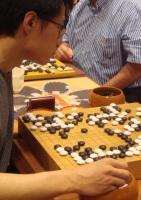
There is a video on WeiQiTV from the recent 58th European Go Congress (only ~2 weeks ago).Elom wrote:I always thought that faster time settings give the weaker player a better chance
A top Chinese pro (Liu Xing) gave a European high dan 3 stones, 10-second blitz.
Liu Xing won (twice). The other board is another Chinese pro vs. another
European high dan, same settings. Later, a top Chinese woman pro gave 2 stones.
The Chinese pros won all the blitz games on this video.