Territory scoring confusion

If you're new to the game and have questions, post them here.
User avatar
Cassandra
Lives in sente
Posts: 1326
Joined: Wed Apr 28, 2010 11:33 am
Rank: German 1 Kyu
GD Posts: 0
Has thanked: 14 times
Been thanked: 153 times

Re: Territory scoring confusion

Post by Cassandra »

Bill Spight wrote: I think that the second alternative was tried in the Japanese 1949 rules. But their "illogicality" became an issue.
As a matter of course, you must be able to adjust your table of "exceptions" over time, when you become aware of new insights. Might be that you will have to adjust your "core" rules, also, according to the circumstances.

E.g. "Bent-Four in the corner is dead." is true for the "isolated" case only.

Once you understood that there might be (to be honest: somewhat unlikely in actual play) positions, where your "rule" leads to a somewhat illogical (may be also unwanted) result, you will have to think about adjustment.
The really most difficult Go problem ever: https://igohatsuyoron120.de/index.htm
Igo Hatsuyōron #120 (really solved by KataGo)
User avatar
Cassandra
Lives in sente
Posts: 1326
Joined: Wed Apr 28, 2010 11:33 am
Rank: German 1 Kyu
GD Posts: 0
Has thanked: 14 times
Been thanked: 153 times

Re: Territory scoring confusion

Post by Cassandra »

Bill Spight wrote: You are correct. Under the Japanese 1989 rules the White stone is dead under the rules for hypothetical play. My point is that that result is arguable, and other rules might treat this position differently. And, in fact, under the Japanese 1989 rules it is possible that rule 13 applies, and both players lose.
Click Here To Show Diagram Code
[go]$$B Disputed
$$ -----------------
$$ . X O . a . O X .
$$ . X O . . O O X .
$$ . X O O O O X X .
$$ . X X X X X X . .
$$ . . . . . . . . .[/go]
Under hypothetical play Black to play can capture the White stones, so they are dead. However, this diagram is used in the official commentary to illustrate the both lose rule. There seems to be a contradiction or ambiguity in the Japanese rules. (However, "The White stones are dead and both players lose," is not a contradiction. :))

Actually, I think that if such a position remained on the board at the end of a pro game, the both lose rule would be invoked, and both players would lose a whole lot of face.
Dear Bill,

There is NO contradiction in the rules, concerning the shape displayed. The other example used in J1989 is more harmless, because no question of "Life & Death" is involved, but turning a position into a Seki, thus robbing territory "only".

I am sure you will agree that the position shown here is "unfinished" (you call this type of position "hot", I think). Either player should have played at "a". I am also sure that you will agree that it is absolutely unlikely to have this position on the board at the "end" of a professional game. Thus, the choice of the Nakade position here somewhat artificial.

After the game stopped, both players have to agree about the status of groups, and territory.

If there were NO Article 13 in the rules, White's only chance not to lose the game would be to NOT AGREE that her stones in question are dead. Which is silly, contradicting the sense of the rules, and much more losing face that having overlooked the move at "a".

To avoid this very unpleasant happening, Article 13 overrides here, turning the position from a "simple" issue of "Life & Death" to an issue that could affect the result of the game. Black has a bit of complicity, too, so it seems fair that the arrangement in the rules applys equally to both players.


I think it was also you who mentioned that a ruleset cannot decide with certainty about the outcome of an unfinished game. In the above mentioned example, both players apparently were inattentive to the game, so I would like to assume that Article 13 of J1989 matches East-Asian understanding of some kind of "punishment" for this improper behaviour.
The really most difficult Go problem ever: https://igohatsuyoron120.de/index.htm
Igo Hatsuyōron #120 (really solved by KataGo)
beginsA291
Beginner
Posts: 7
Joined: Tue May 19, 2015 2:22 am
Rank: kgs 30 kyu
GD Posts: 0

Re: Territory scoring confusion

Post by beginsA291 »

Looking back to page 2 again (and the issue in my OP), and quoting Kirby :

This thread has a lot of interesting discussion, but in my opinion, it has become more complicated than it needs to be*.

Let's go back to your original example:
Click Here To Show Diagram Code
[go]$$
$$ ------------
$$ | . . O X C C |
$$ | . . O X W C |
$$ | . . O X C C |
$$ | . . O X C C |
$$ | . . O X C C |
$$ | . . O X C C |
$$ | . . O X C C |
$$ -----------[/go]
If both players pass, the game is over. The marked white stone is within the black area, as shown above, and it counts as black's points. That's because both players passed, which means the stones within the bordered off areas are dead.

If white doesn't pass, and makes something happen (eg. captures stones, etc.), then the game's not over.

That's the big picture. End quote Kirby.


But Kirby this was exactly my issue. That "big picture" is not enough. That white invading stone has liberties and so is is plausibly alive. A simple two eye shape is certainly alive and can never be killed. It's not true that any whites inside blacks territory simply get swept away or captured. We also need to know the after game end testing rules that decides the issue of whether invaders are alive or dead.

Perhaps it's so ingrained and instinctive in non-beginers that you do find it hard to conceive that anyone could think differently.

I suppose that if you learn in a club you quickly pick up those rules. But I've just been playing at home.

-------
Bill, I had a look at your problem. In fact I managed it quite easily. But I'm not sure if I understand your illustration above, "Under hypothetical play Black to play can capture the White stones, so they are dead." :
Click Here To Show Diagram Code
[go]$$B Disputed
$$ -----------------
$$ . X O . X . O X .
$$ . X O . . O O X .
$$ . X O O O O X X .
$$ . X X X X X X . .
$$ . . . . . . . . .[/go]
Surely black has to play where I indicated in order to stop white forming two eyes. Then from here it leads to seki not capture.

-------
Generally speaking one thing I like about Go so far is that my thinking is more intuitive, rather than the 'this move, then that move, then further move etc' you get in chess. Also I never bothered to learn the chess openning sequences properly because it always felt like being just a (never ending) memory task.

Though I play chess ok I could never really be motivated to get good at it because of this. Actually it's not quite right that my thinking in chess consists simply in examining the move tree. Rather it includes composing different pieces of such analysis in the right order together in an optimum way. But it is still close to actual move sequences.

I know Go has an openning theory as well, but for this stage, and for the most of the game really you seem to be making assesments on a more intuitive or philosophical basis as I say. You only resort to move by move analysis right at the end (whether that is the end of the whole game, or the end for just a part of the board).
Bill Spight
Honinbo
Posts: 10905
Joined: Wed Apr 21, 2010 1:24 pm
Has thanked: 3651 times
Been thanked: 3373 times

Re: Territory scoring confusion

Post by Bill Spight »

Cassandra wrote:
Bill Spight wrote: You are correct. Under the Japanese 1989 rules the White stone is dead under the rules for hypothetical play. My point is that that result is arguable, and other rules might treat this position differently. And, in fact, under the Japanese 1989 rules it is possible that rule 13 applies, and both players lose.
Click Here To Show Diagram Code
[go]$$B Disputed
$$ -----------------
$$ . X O . a . O X .
$$ . X O . . O O X .
$$ . X O O O O X X .
$$ . X X X X X X . .
$$ . . . . . . . . .[/go]
Under hypothetical play Black to play can capture the White stones, so they are dead. However, this diagram is used in the official commentary to illustrate the both lose rule. There seems to be a contradiction or ambiguity in the Japanese rules. (However, "The White stones are dead and both players lose," is not a contradiction. :))

Actually, I think that if such a position remained on the board at the end of a pro game, the both lose rule would be invoked, and both players would lose a whole lot of face.
Dear Bill,

There is NO contradiction in the rules, concerning the shape displayed. The other example used in J1989 is more harmless, because no question of "Life & Death" is involved, but turning a position into a Seki, thus robbing territory "only".
Like the position beginsA291 presented us. :)
I am sure you will agree that the position shown here is "unfinished" (you call this type of position "hot", I think). Either player should have played at "a". I am also sure that you will agree that it is absolutely unlikely to have this position on the board at the "end" of a professional game. Thus, the choice of the Nakade position here somewhat artificial.
Absolutely. I doubt if the both lose rule will ever be invoked in pro play. OTOH, as I have pointed out, amateurs often come up with such "unfinished" positions and ask what the score is. I do not believe that the both lose rule is appropriate for amateur rules.
After the game stopped, both players have to agree about the status of groups, and territory.

If there were NO Article 13 in the rules, White's only chance not to lose the game would be to NOT AGREE that her stones in question are dead. Which is silly, contradicting the sense of the rules, and much more losing face that having overlooked the move at "a".

To avoid this very unpleasant happening, Article 13 overrides here, turning the position from a "simple" issue of "Life & Death" to an issue that could affect the result of the game.
Yes, there is only a contradiction if you assume that the results of hypothetical play determine the outcome of the game. :mrgreen:
Black has a bit of complicity, too, so it seems fair that the arrangement in the rules applys equally to both players.
Yes, aside from missing the kill during play, Black could have reopened play and allowed White to live (since White would play first in the resumption).
I think it was also you who mentioned that a ruleset cannot decide with certainty about the outcome of an unfinished game.
Well, that is my opinion. But I think that John Tromp and Robert Jasiek would disagree, and maybe Ing. Ing's proximity scoring can score any board, for instance. One can take the attitude that the game ends when the game ends, regardless of how things might have turned out if play had continued, and that there is no such thing as a position without a "proper" score.
In the above mentioned example, both players apparently were inattentive to the game, so I would like to assume that Article 13 of J1989 matches East-Asian understanding of some kind of "punishment" for this improper behaviour.
Well, I think that the both lose provision is a flaw in the rules. It is possible that it might be invoked for pro play, if there is a very complicated position that both players misjudge. However, as it is, it punishes amateurs for being amateurs.
The Adkins Principle:
At some point, doesn't thinking have to go on?
— Winona Adkins

Visualize whirled peas.

Everything with love. Stay safe.
Bill Spight
Honinbo
Posts: 10905
Joined: Wed Apr 21, 2010 1:24 pm
Has thanked: 3651 times
Been thanked: 3373 times

Re: Territory scoring confusion

Post by Bill Spight »

beginsA291 wrote:Looking back to page 2 again (and the issue in my OP), and quoting Kirby :

This thread has a lot of interesting discussion, but in my opinion, it has become more complicated than it needs to be*.

Let's go back to your original example:
Click Here To Show Diagram Code
[go]$$
$$ ------------
$$ | . . O X C C |
$$ | . . O X W C |
$$ | . . O X C C |
$$ | . . O X C C |
$$ | . . O X C C |
$$ | . . O X C C |
$$ | . . O X C C |
$$ -----------[/go]
If both players pass, the game is over. The marked white stone is within the black area, as shown above, and it counts as black's points. That's because both players passed, which means the stones within the bordered off areas are dead.

If white doesn't pass, and makes something happen (eg. captures stones, etc.), then the game's not over.

That's the big picture. End quote Kirby.


But Kirby this was exactly my issue. That "big picture" is not enough. That white invading stone has liberties and so is is plausibly alive. A simple two eye shape is certainly alive and can never be killed. It's not true that any whites inside blacks territory simply get swept away or captured. We also need to know the after game end testing rules that decides the issue of whether invaders are alive or dead.

Perhaps it's so ingrained and instinctive in non-beginers that you do find it hard to conceive that anyone could think differently.
Kirby can speak for himself, but let me point out that there is another question. Why did White pass? At the end of play neutral points should be filled. If the White stone is alive, why didn't White fill in a neutral point? White's pass is an indication that White thinks that the stone is dead. :)
I suppose that if you learn in a club you quickly pick up those rules. But I've just been playing at home.
More power to you. :) I once taught the game to a young married couple who had just bought a set. I hope that they are still playing.

-------
Bill, I had a look at your problem. In fact I managed it quite easily.
Good. I thought that you might. :)

I hope that you got the point that territory scoring in Capture Go is basically the same as territory scoring in regular go.
Click Here To Show Diagram Code
[go]$$B Black +3
$$ | O O O O O . .
$$ | O X X X O O .
$$ | X C X X X O .
$$ | C X . O X O .
$$ ---------------[/go]
Suppose that the game is Capture-4, where on his play a player may surrender a stone as a captive instead of making a play on the board. Then the corner position is worth 3 points (moves) for Black. Black needs two eyes to live, so we do not count the marked points. That is the main difference between capture go territory and modern territory, although ancient territory scoring worked that way.

Black's three moves in the corner come from one move to capture the White stone, one move to fill the eye, and, because of the White captive, Black gains one move on White in handing over stones.

The three points in that eye in regular go come from two points of territory plus one dead stone. Black does not have to capture the stone. If he did, he would have only two points in that eye, one point of territory and one captured stone.

It is a curious fact about territory scoring that a captive is counted as one point. It is also curious that dead stones do not have to be captured at the end of the game, but are simply removed.

Neither of these facts is strange in capture go. :D If you played capture go out, then the dead stones would be captured. But if you stop play and count the score, they are not.
But I'm not sure if I understand your illustration above, "Under hypothetical play Black to play can capture the White stones, so they are dead." :
Click Here To Show Diagram Code
[go]$$B Disputed
$$ -----------------
$$ . X O . X . O X .
$$ . X O . . O O X .
$$ . X O O O O X X .
$$ . X X X X X X . .
$$ . . . . . . . . .[/go]
Surely black has to play where I indicated in order to stop white forming two eyes. Then from here it leads to seki not capture.
Well, we are talking about regular go. Here is how Black captures the White stones with hypothetical play. White passes unless otherwise indicated.
Click Here To Show Diagram Code
[go]$$B Rolling up the eye
$$ -----------------
$$ . X O 5 1 8 O X .
$$ . X O 7 3 O O X .
$$ . X O O O O X X .
$$ . X X X X X X . .
$$ . . . . . . . . .[/go]
:b7: is atari, :w8: captures four Black stones, leaving
Click Here To Show Diagram Code
[go]$$B 4 point eye
$$ -----------------
$$ . X O . . O O X .
$$ . X O O O O X X .
$$ . X X X X X X . .
$$ . . . . . . . . .[/go]
Click Here To Show Diagram Code
[go]$$Bm9 Rolling up the eye (ii)
$$ -----------------
$$ . X O 5 1 O O X .
$$ . X O 6 3 O O X .
$$ . X O O O O X X .
$$ . X X X X X X . .
$$ . . . . . . . . .[/go]
Leaving
Click Here To Show Diagram Code
[go]$$B 3 point eye
$$ -----------------
$$ . X O . . O O X .
$$ . X O O . O O X .
$$ . X O O O O X X .
$$ . X X X X X X . .
$$ . . . . . . . . .[/go]
Click Here To Show Diagram Code
[go]$$Bm15 Rolling up the eye (iii)
$$ -----------------
$$ . X O 4 1 O O X .
$$ . X O O 3 O O X .
$$ . X O O O O X X .
$$ . X X X X X X . .
$$ . . . . . . . . .[/go]
Leaving
Click Here To Show Diagram Code
[go]$$B 2 point eye
$$ -----------------
$$ . X O O . O O X .
$$ . X O O O O X X .
$$ . X X X X X X . .
$$ . . . . . . . . .[/go]
Click Here To Show Diagram Code
[go]$$Bm19 Rolling up the eye (iv)
$$ -----------------
$$ . X O O 1 O O X .
$$ . X O O 2 O O X .
$$ . X O O O O X X .
$$ . X X X X X X . .
$$ . . . . . . . . .[/go]
Leaving
Click Here To Show Diagram Code
[go]$$B 1 point eye
$$ -----------------
$$ . X O O . O O X .
$$ . X O O O O O X .
$$ . X O O O O X X .
$$ . X X X X X X . .
$$ . . . . . . . . .[/go]
Click Here To Show Diagram Code
[go]$$Bm21 Bingo!
$$ -----------------
$$ . X O O 1 O O X .
$$ . X O O O O O X .
$$ . X O O O O X X .
$$ . X X X X X X . .
$$ . . . . . . . . .[/go]
:D
The Adkins Principle:
At some point, doesn't thinking have to go on?
— Winona Adkins

Visualize whirled peas.

Everything with love. Stay safe.
User avatar
Cassandra
Lives in sente
Posts: 1326
Joined: Wed Apr 28, 2010 11:33 am
Rank: German 1 Kyu
GD Posts: 0
Has thanked: 14 times
Been thanked: 153 times

Re: Territory scoring confusion

Post by Cassandra »

Bill Spight wrote:One can take the attitude that the game ends when the game ends, regardless of how things might have turned out if play had continued, and that there is no such thing as a position without a "proper" score.
You can do so with J1989, too. But will this make any sense ?
The really most difficult Go problem ever: https://igohatsuyoron120.de/index.htm
Igo Hatsuyōron #120 (really solved by KataGo)
Pio2001
Lives in gote
Posts: 418
Joined: Mon Feb 16, 2015 12:13 pm
Rank: kgs 5 kyu
GD Posts: 0
KGS: Pio2001
Has thanked: 9 times
Been thanked: 83 times

Re: Territory scoring confusion

Post by Pio2001 »

Hi beginsA291,
beginsA291 wrote:1) What happens if the testing finds that the invasion turns out to be viable and a live invasion is formed? Are the new stones of both colours that were placed since the end of the game left on the board? (So that the score is counted using the revised board.)
No, they are removed. This rule allows to maintain the equivalence between aera scoring and territory scoring.

With aera scoring (go played in China), the winner is the one who manages to get more intersections than her opponent. An intersection is awarded to a player if she has a living stone on it, or if it is so closely surrounded by her stones that her opponent can't place a living stone on it.

In territory scoring (go played in Japan), the winner is the one who has surrounded more intersection than her opponent and has taken more prisoners.

If both players have played exactly the same number of stones, the result is the same, because when the dead stones and prisoners are used to fill the territories, before counting, its doesn't change anything to the aera score : an intersection with a stone on it is worth one point as well as a surrounded empty intersection. And if there are exactly the same number of black and white stones, the winner, according to aera scoring, is the one with the largest empty space left.

The difference between the two systems arise when there are more stones of one given colour. Having more surrounded intersections + prisoners becomes then a goal that is distinct from getting the largest part of the board.

In all traditions, the game of go consists in getting the largest part of the board, and counting the empty spaces plus prisoners is just the most efficient way of visualizing it in a 361-interection grid.

This is why the rule says that Black has not to pay the price to capture the white stone. It would force her to play several stones in a row (while White passes), and would break the equivalence between aera and territory + prisoners.

For handicap games, aera rulesets (chinese, AGA etc) give a bonus to White, so that aera and territory remain equivalent.

In reality, there can be one point of difference between aera and territory, if Black plays last, because she has one more stone on the board than White.
beginsA291 wrote:2) Do seperate territories resolve independently?
During the game, no. The typical case being a ko that can only be won by sacrificing something elsewhere that, otherwise, would have been alive.

After both players have passed, yes. The 1949 japanese rules lists independant statuts for each possible case, and the 1989 rules says that ko fights are forbidden during the confirmation of life and death.

Example (White plays 1 in A12, Black plays 4 in A13) :
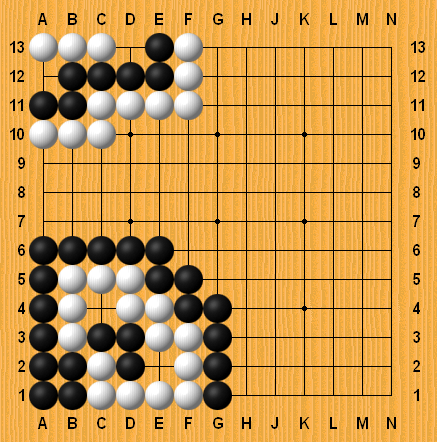
Image

Image

Image

Here, Black's top group is alive only if her bottom 3 stones die. Black sacrifices her seki in order to win the ko.

But if these shapes remain on the board after both players have passed, the 1949 rule lists the top shape as dead regardless of the state of the rest of the board, and the 1989 rule says that Black 8 is illegal : Black hasn't the right to recapture a ko during the confirmation phase.

Under chinese rules, if there is a disagreement between the players, then everything that remains on the board is considered to be alive.
In your example, if Black adds three stones in order to capture the white one, while White passes, at the end, Black has still 15 points (the 15 intersections on the right side), and White 10 (the 10 intersections on the left side).
So in practice, disagreements are settled by actually capturing (or failing to capture) the disputed group. Thanks to the aera scoring system, there is no need to remove the extra stones, they don't affect the score.

In the above figure Black's top group is alive and her bottom 3 stones are dead under chinese rules, while the top group is dead and the bottom stones alive in seki under japanese rules.
This is an extremely rare case where the japanese and chinese rules diverge completely.
User avatar
Cassandra
Lives in sente
Posts: 1326
Joined: Wed Apr 28, 2010 11:33 am
Rank: German 1 Kyu
GD Posts: 0
Has thanked: 14 times
Been thanked: 153 times

Re: Territory scoring confusion

Post by Cassandra »

Pio2001 wrote:In the above figure Black's top group is alive and her bottom 3 stones are dead under chinese rules, while the top group is dead and the bottom stones alive in seki under japanese rules.
This is an extremely rare case where the japanese and chinese rules diverge completely.
The effect depends on the relative size of Black's, and White's, large groups.
If Black's group were much larger, White might ignore Black's Ko-threat in the bottom left.

With Chinese rules, the status of "Bent-Four" depends on the entire rest of the board.
With Japanese rules, it depends on the circumstances in its direct environment only, which is bordered by "independently alive" groups.
The really most difficult Go problem ever: https://igohatsuyoron120.de/index.htm
Igo Hatsuyōron #120 (really solved by KataGo)
beginsA291
Beginner
Posts: 7
Joined: Tue May 19, 2015 2:22 am
Rank: kgs 30 kyu
GD Posts: 0

Re: Territory scoring confusion

Post by beginsA291 »

Regarding Bill's post 4564, ah of course I could kick myself I didn't see that. A tactic of fill them in, make them take, and repeat, to keep reducing their territory until I can take them.


Pio2001: I felt that there must be something making those after end game territories independent. Glad to see it spelled out. Also the example really also makes explicit that the area and territory methods are not the same, despite the best of intentions of rulesmakers trying to make them so. Awkward boundary cases like this exist.


Bill again quote: "Why did White pass? At the end of play neutral points should be filled. If the White stone is alive, why didn't White fill in a neutral point? White's pass is an indication that White thinks that the stone is dead."
Of course I only had white play there and pass because I thought it would force back to place 3 stones to capture it, leading to being up 2. This was based on not knowing the after end game confirmation of life/death procedure. Sorry to repeat.
yoyoma
Lives in gote
Posts: 653
Joined: Mon Apr 19, 2010 8:45 pm
GD Posts: 0
Location: Austin, Texas, USA
Has thanked: 54 times
Been thanked: 213 times

Re: Territory scoring confusion

Post by yoyoma »

Bill Spight wrote:Why did White pass? At the end of play neutral points should be filled. If the White stone is alive, why didn't White fill in a neutral point? White's pass is an indication that White thinks that the stone is dead.
White thinks it's a seki. :cool:
Bill Spight
Honinbo
Posts: 10905
Joined: Wed Apr 21, 2010 1:24 pm
Has thanked: 3651 times
Been thanked: 3373 times

Re: Territory scoring confusion

Post by Bill Spight »

beginsA291 wrote: Bill again quote: "Why did White pass? At the end of play neutral points should be filled. If the White stone is alive, why didn't White fill in a neutral point? White's pass is an indication that White thinks that the stone is dead."
Of course I only had white play there and pass because I thought it would force back to place 3 stones to capture it, leading to being up 2. This was based on not knowing the after end game confirmation of life/death procedure. Sorry to repeat.
That's helpful. As you have pointed out, experienced players tend to forget how beginners think. :)
The Adkins Principle:
At some point, doesn't thinking have to go on?
— Winona Adkins

Visualize whirled peas.

Everything with love. Stay safe.
Kirby
Honinbo
Posts: 9553
Joined: Wed Feb 24, 2010 6:04 pm
GD Posts: 0
KGS: Kirby
Tygem: 커비라고해
Has thanked: 1583 times
Been thanked: 1707 times

Re: Territory scoring confusion

Post by Kirby »

beginsA291 wrote:Looking back to page 2 again (and the issue in my OP), and quoting Kirby :

This thread has a lot of interesting discussion, but in my opinion, it has become more complicated than it needs to be*.

Let's go back to your original example:
Click Here To Show Diagram Code
[go]$$
$$ ------------
$$ | . . O X C C |
$$ | . . O X W C |
$$ | . . O X C C |
$$ | . . O X C C |
$$ | . . O X C C |
$$ | . . O X C C |
$$ | . . O X C C |
$$ -----------[/go]
If both players pass, the game is over. The marked white stone is within the black area, as shown above, and it counts as black's points. That's because both players passed, which means the stones within the bordered off areas are dead.

If white doesn't pass, and makes something happen (eg. captures stones, etc.), then the game's not over.

That's the big picture. End quote Kirby.


But Kirby this was exactly my issue. That "big picture" is not enough. That white invading stone has liberties and so is is plausibly alive. A simple two eye shape is certainly alive and can never be killed. It's not true that any whites inside blacks territory simply get swept away or captured. We also need to know the after game end testing rules that decides the issue of whether invaders are alive or dead.

Perhaps it's so ingrained and instinctive in non-beginers that you do find it hard to conceive that anyone could think differently.

I suppose that if you learn in a club you quickly pick up those rules. But I've just been playing at home.
Hi beginsA291,
In response to, "That white invading stone has liberties and so is is plausibly alive.", my point was that, in passing, white denied his right to try to live. So although the stone is plausibly alive, white did not take advantage of that opportunity.

If we leave it at that, I think you have enough understanding to play.

However, at the time I wrote this post, I did not realize that a "hot" position was an invalid endgame position. I thought that in such a case, if both players passed, the stone was just dead. It appears though, that some rulesets indicate that both players lose if the position is "hot". At higher levels of play, it probably doesn't make a difference, since both players will be able to see whether a position is still "hot".

But I personally feel that this type of detail makes things more confusing for beginners. That's because, in order to "truly score" the game, beginners have to understand whether a position is "hot" or not, which can be confusing.

In my opinion, in the aforementioned position, if both players pass and think that the marked stone is dead, why not let them have their way? :-)

(I suppose this gets confusing if two players pass and haven't even established borders yet, but usually that's not too much of an issue for beginners.)
be immersed
Post Reply