One of the best things about reading a problem completely is to look for failure modes after having found the solution. One possible effect is that you find "another solution" which leads to denouncing the first or the second, but the more beneficial effect is that you get many problems in one and an overall better comprehension of the problem and its topology:
$$B corner
$$ -----------------
$$ | . a . . . . . .
$$ | 1 . X . . . . .
$$ | . X O O . O . .
$$ | b X O , . . . .
$$ | . O . . . . . .
$$ | . . O . . . . .
$$ | . . . . . . . .
$$ | . . . . . . . .
- Click Here To Show Diagram Code
[go]$$B corner

$$  -----------------

$$ | . a . . . . . .

$$ | 1 . X . . . . .

$$ | . X O O . O . .

$$ | b X O , . . . .

$$ | . O . . . . . .

$$ | . . O . . . . .

$$ | . . . . . . . .

$$ | . . . . . . . .[/go]
For example, in this basic problem, it's almost trivial to see that

is the solution, making miai of a and b. This time, I went on to see why it is the *only* solution:
$$B corner
$$ ----------------
$$ | . b . . . . . .
$$ | a . X 1 2 . . .
$$ | . X O O . O . .
$$ | . X O , . . . .
$$ | . O . . . . . .
$$ | . . O . . . . .
$$ | . . . . . . . .
$$ | . . . . . . . .
- Click Here To Show Diagram Code
[go]$$B corner

$$  ----------------

$$ | . b . . . . . .

$$ | a . X 1 2 . . .

$$ | . X O O . O . .

$$ | . X O , . . . .

$$ | . O . . . . . .

$$ | . . O . . . . .

$$ | . . . . . . . .

$$ | . . . . . . . .[/go]
After exchanging
for

, which follows the principle of trying to expand eyespace first and then play the vital point, the original move doesn't work anymore. In fact the position has become symmetrical and this time around a and b have become miai for White to kill, due to shortage of liberties at both ends (exercise left to the reader).
This pattern is known to me from the tripod group but it was reinforced after investigating the failure, rather than leading me to the problem's solution, which was trivial to begin with.
At this stage of my intuition in problem solving, investigating failure modes still leads to (re)discoveries like these. After sufficient rounds of similar problems, the whole problem will eventually become trivial, not only the solution but also the failure modes, and full reading of the problem will no longer be required, in a more profound way.
As such, the discipline to read all variations not only improves the overall reading discipline but also and maybe more importantly, the overall understanding of shapes.

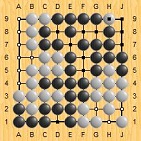
 is considered even.
 direction, I am unfamiliar with it.
 to be a mistake, at least after R13 (though I am unfamiliar with the joseki) because it strengthens white on top, weakens black and white seems a little hard to attack. (with that said I think white's
  approach was slightly questionable and that after Q17 black would be winning).
 a succesful net, using shortage of liberties, to connect all groups
 the wrong choice, resulting in a ko which the opponent didn't play

 -
-