Why are our instincts so bad?
-
Abyssinica

- Lives in gote
- Posts: 660
- Joined: Mon Jan 06, 2014 2:36 am
- Rank: Miserable 4k
- GD Posts: 0
- KGS: STOP STALKING ME
- Has thanked: 25 times
- Been thanked: 124 times
Re: Why are our instincts so bad?
My intuition: Q10 and let white figure out how he wants to consolidate this entire area.
-
Cassandra

- Gosei
- Posts: 1334
- Joined: Wed Apr 28, 2010 11:33 am
- Rank: German 1 Kyu
- GD Posts: 0
- Has thanked: 14 times
- Been thanked: 153 times
Re: Why are our instincts so bad?
There is a special "flow of stones" in games between very strong players.John Fairbairn wrote: But what we also found was that, when we did a game that included one or two amateurs - even good ones, e.g. at the World Ama - our speed fell dramatically. Close to double the time was needed. We talked about this many times and were quite clear about the explanation. When doing a pro game we had a reliable intuitive feel for where the next move would be. That meant finding the move on a dense diagram was not specially hard - we knew where to focus. The only real problems came when ko threats were scattered round the board (or, of course, as quite often happens, if moves are missing from the printed source). In amateur games, however, moves just followed each other without any rhyme or reason apparent to us, so we had to waste time laboriously scanning the whole board, over and over again.
My beloved wife might be 4 dan / 5 dan in Ikebana (they do not have these ranks in Ikebana, but this assumption will match the interval between her certificate, and the top), but is below 20 Kyu in Go. Accompanying me on Go tournaments, she always loved to follow the games of the top players, especially of professionals, 7 Dan Korean players, and similar.
She said that these boards would look like a good Ikebana.
Games between the other Dan players would show flaws on the board (as a matter of course, the more the lower the rank). No need to talk about games between Kyu players.
My wife had also a good feeling for the overall position on the board. When asking her sometimes, who would be ahead on the board in my games, according to her "feeling", she was right in the overwhelming majority of cases.John Fairbairn wrote: Our conclusion was that we had both developed a good feel for pro play. This does not mean, of course, that we could read like pros or explain exactly what the pro was thinking. In fact we didn't know ourselves what was enabling us to focus so often and almost unerringly on the next area of play. The only logical inference, supported by many other things such as the repeated advice of pros to play over pro games, was that we had played over enough games to train (but unwittingly, without any conscious study-type thoughts at the time) our sub-conscious into acting like a reasonably reliable machine. For pro games. Pro games only.
As a matter of course, she would have been unable to give an idea for the next best move.
The really most difficult Go problem ever: https://igohatsuyoron120.de/index.htm
Igo Hatsuyōron #120 (really solved by KataGo)
Igo Hatsuyōron #120 (really solved by KataGo)
-
longshanks
- Dies with sente
- Posts: 97
- Joined: Sat Nov 22, 2014 1:51 am
- GD Posts: 0
- Been thanked: 14 times
Re: Why are our instincts so bad?
intuition
ɪntjʊˈɪʃ(ə)
noun
I think when a person plays with instinct/intuition in Go it's just subconscious learned reasoning. With that in mind perhaps playing moves with more conscious thought rather than 'it feeling right' should work better if we can understand the knowledge or insight that comes to us subconsciously. Perhaps it's our inability to know/remember why this shape looks bad that leads us to just call it intuition.
Currently I'm studying and applying fundamentals to my play. I have jumped from 18k to 11k in months by doing this and I contribute not getting higher than this to a) not having more time to study the fundamentals fully b) not applying them always fully. The latter I can learn retrospectively by reviewing my games. I've also only played 100 games.
ɪntjʊˈɪʃ(ə)
noun
- the ability to understand something instinctively, without the need for conscious reasoning.
"we shall allow our intuition to guide us"
a thing that one knows or considers likely from instinctive feeling rather than conscious reasoning.
"your insights and intuitions as a native speaker are positively sought"
I think when a person plays with instinct/intuition in Go it's just subconscious learned reasoning. With that in mind perhaps playing moves with more conscious thought rather than 'it feeling right' should work better if we can understand the knowledge or insight that comes to us subconsciously. Perhaps it's our inability to know/remember why this shape looks bad that leads us to just call it intuition.
Currently I'm studying and applying fundamentals to my play. I have jumped from 18k to 11k in months by doing this and I contribute not getting higher than this to a) not having more time to study the fundamentals fully b) not applying them always fully. The latter I can learn retrospectively by reviewing my games. I've also only played 100 games.
-
daal

- Oza
- Posts: 2508
- Joined: Wed Apr 21, 2010 1:30 am
- GD Posts: 0
- Has thanked: 1304 times
- Been thanked: 1128 times
Re: Why are our instincts so bad?
I also doubt that people are born with an instinct to play go (well), but imagine a person who has just learned the rules and objective of the game, who for some reason understands eyes and ko, and is playing their first game. Where do they place their first stone? Some will play at tengen, some will play in a corner some on a side, some on an edge. What is their reason for playing that stone where they played it? They don't have any go experience to draw on, so they must follow either their intuition or their instinct (in contrast with intuition, instinct is not based on learned experience, but is just a natural tendency). Later in the game, other situations will arise that the player may recognize as similar to other experiences (being surrounded, being threatened, getting the short end of the stick etc.,) and must also choose how to respond. Is their response not necessarily intuitive/instinctive?longshanks wrote:intuition
ɪntjʊˈɪʃ(ə)
noun
I personally don't think that people are born with an instinct to play Go. I think they acquire knowledge to play Go either through study or lots of play (or both). This becomes second nature after repetition in the same way as playing a musical instrument or learning a foreign language. At some point it becomes natural and we no longer think of it.
- the ability to understand something instinctively, without the need for conscious reasoning.
"we shall allow our intuition to guide us"
a thing that one knows or considers likely from instinctive feeling rather than conscious reasoning.
"your insights and intuitions as a native speaker are positively sought"
I think when a person plays with instinct/intuition in Go it's just subconscious learned reasoning. With that in mind perhaps playing moves with more conscious thought rather than 'it feeling right' should work better if we can understand the knowledge or insight that comes to us subconsciously. Perhaps it's our inability to know/remember why this shape looks bad that leads us to just call it intuition.
One of my points is that these intuitive responses (fighting, running, hoarding etc.,) exist and that they can continue to influence one's decisions even after one has learned more about go, because often, one's knowledge is full of holes, and when in doubt we might find ourselves making our choices on instincts and intuition that have nothing to do with go.
Patience, grasshopper.
-
wineandgolover

- Lives in sente
- Posts: 867
- Joined: Sun Jul 25, 2010 6:05 am
- GD Posts: 0
- Has thanked: 318 times
- Been thanked: 346 times
Re: Why are our instincts so bad?
Q10 without much thought. The stones are moving and black just can't stop there. Besides, white can't secure the bottom in a single move. If white does secure fourth line territory there, it's not that huge and then the O8 for Q10 exchange will be terrible for him.
If black tenukies now, then he will be reduced from both sides, which is really annoying.
If black tenukies now, then he will be reduced from both sides, which is really annoying.
- Brady
-
wineandgolover
- Lives in sente
- Posts: 867
- Joined: Sun Jul 25, 2010 6:05 am
- GD Posts: 0
- Has thanked: 318 times
- Been thanked: 346 times
Re: Why are our instincts so bad?
This feels an awful lot like telling white, fine, you can have the bottom, and strengthening him, which really hurts your potential there. And, I thought you watched my last video about aji-keshi.daal wrote:
D. Re-read John's text. Surrounding territory. Oh, what about firming up that corner that can still easily be ruined? Also looks like sente, so I could come back and play one of the other moves afterwards. This is my choice.

Who knows, you might be right, and I might be completely wrong, but if your goal is surrounding territory, you have another direction you can move in, without helping white.
- Brady
-
Cassandra
- Gosei
- Posts: 1334
- Joined: Wed Apr 28, 2010 11:33 am
- Rank: German 1 Kyu
- GD Posts: 0
- Has thanked: 14 times
- Been thanked: 153 times
Re: Why are our instincts so bad?
Why do you exclude (implicitely) that "your goal is surrounding territory" might be applied to White ?wineandgolover wrote:daal wrote: Who knows, you might be right, and I might be completely wrong, but if your goal is surrounding territory, you have another direction you can move in, without helping white.
Just because it is "Black to play" ?
Probably one has to consider that (some of) White's three stones at right (may be after a correct sequence that is unknown to me) might not be optimally placed for surrounding an APPROPRIATE amount of White territory ?
The really most difficult Go problem ever: https://igohatsuyoron120.de/index.htm
Igo Hatsuyōron #120 (really solved by KataGo)
Igo Hatsuyōron #120 (really solved by KataGo)
-
wineandgolover
- Lives in sente
- Posts: 867
- Joined: Sun Jul 25, 2010 6:05 am
- GD Posts: 0
- Has thanked: 318 times
- Been thanked: 346 times
Re: Why are our instincts so bad?
Just to clarify, Daal said that was his goal, not me.Cassandra wrote:Why do you exclude (implicitely) that "your goal is surrounding territory" might be applied to White ?wineandgolover wrote:daal wrote: Who knows, you might be right, and I might be completely wrong, but if your goal is surrounding territory, you have another direction you can move in, without helping white.
Just because it is "Black to play" ?
Probably one has to consider that (some of) White's three stones at right (may be after a correct sequence that is unknown to me) might not be optimally placed for surrounding an APPROPRIATE amount of White territory ?
I was just pointing out that he may be able to play in another direction and accomplish that same goal, without helping white on the bottom. My answer, in the previous post, is more about the stones going walking. It seems to me that black has more to lose by abandoning the stroll first. White's bottom is just too vague for me.
- Brady
-
Calvin Clark
- Lives in gote
- Posts: 426
- Joined: Thu Aug 13, 2015 8:43 am
- GD Posts: 0
- Has thanked: 186 times
- Been thanked: 191 times
Re: Why are our instincts so bad?
To me, this is a moyo boundary battle and it's all about getting ahead. Therefore, I would play "A" (P10), consider a white invasion in the top right and a black one in the on the lower side to be miai and leave it at that. I should be pretty clear by now that I can't predict white's moves anyway. Perhaps this is hard to feel if intuition comes from pro games, because white has made the relatively uncommon O4 approach. Also, Q8 feels a bit forced and may therefore be a mistake. Instead of Q8, I may play "B" (P8) or O3. It is because of this feeling of already being forced that P10 looks so urgent to me. Is any case, it is intolerable to let white get there first. This is a game of chicken and black is already flinching slightly, but it's still a game.
-
Kirby
- Honinbo
- Posts: 9553
- Joined: Wed Feb 24, 2010 6:04 pm
- GD Posts: 0
- KGS: Kirby
- Tygem: 커비라고해
- Has thanked: 1583 times
- Been thanked: 1707 times
Re: Why are our instincts so bad?
Not following the conversation closely, but I like J3.
be immersed
-
Loons
- Gosei
- Posts: 1378
- Joined: Tue Apr 20, 2010 4:17 am
- GD Posts: 0
- Location: wHam!lton, Aotearoa
- Has thanked: 253 times
- Been thanked: 105 times
Re: Why are our instincts so bad?
Just for the board being analysed, my intuition is G4 but on reflection I want to play Q2.
-
Abyssinica
- Lives in gote
- Posts: 660
- Joined: Mon Jan 06, 2014 2:36 am
- Rank: Miserable 4k
- GD Posts: 0
- KGS: STOP STALKING ME
- Has thanked: 25 times
- Been thanked: 124 times
Re: Why are our instincts so bad?
As a followup to my intuition post, my thinking would want me to play Q2 so I can get a lot of potential 4th line points on the right. If white walks ahead of me I don't care and I can reduce the bottom which he's not making much of and if he tries to plop down a stone there it's still a pretty big, vague area that I didnt' care about in my instinct move.Loons wrote:Just for the board being analysed, my intuition is G4 but on reflection I want to play Q2.
-
John Fairbairn
- Oza
- Posts: 3725
- Joined: Wed Apr 21, 2010 3:09 am
- Has thanked: 20 times
- Been thanked: 4739 times
Re: Why are our instincts so bad?
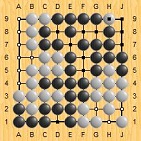
Here is a summary of Kim Sujun's opinion on the book position shown above, along with my own impressions when first looking at it. My framework is intuition and conscious thinking.
As a reminder, here is the position but now with the two options presented by Kim shown - A and B for Black.
As I've said, my initial impression of the position was that it was very odd. That intuition proved to be spot on. The whole-board position has never appeared in the GoGoD database. The lower-right quadrant has only appeared four times but in each case deep in the middle game with White strength to the left, making the three-stone White wall the last element in a surrounding tactic, not the building of thickness.
The bit I found odd was the White wall. It's hard to say whether it's thickness yet. It is peepable and, since it starts on the fourth line, it has no base. Rather than usual opening thickness, it resembles more the proto-thickness you get from erasing moves much deeper in the game. Black's area on the right is not territory yet - it's just a showcase for aji.
So, looking at B, it could be argued that it is sente, helping to firm up the right side and it prevents White from attaching at Q3, which could likewise be sente and would give White's wall a bit of a base. But my intuition told me pros just don't make those sorts of moves this early. The Black gain in the corner is outweighed by strengthening White over the whole board. My intuition proved to be right again.
Turning to A, I instantly assumed White would pincer it - intuition 100% right again, as it turned out.
But that left me with a choice of two moves I did not want to play. So I then switched to conscious reasoning. Part of that was assembling in my mind a group of factors likely to be relevant. I could easily rattle off concepts like sente, aji, pincers, thickness, as I have already done, and could add waffle about moyos, balance and a quite a few other things. I could even toss in stuff like what the Japanese call yakimochi moves - jealous or envious moves. In other words, I could look at the lower side and say, "Well, if I'm not going to get it, he sure as hell isn't either" and so I could play a disruptive move there. But at the same time I know that such moves lead to weak groups, weak groups require defensive moves that don't contribute to territory, and the biggest flaw in all amateur games is that they make far too many moves that don't contribute to territory. The upshot of all this conscious reasoning was that it didn't help. It just left me more confused.
The next step was conscious reasoning, too. What's this book about? Surrounding territory. Only B seems to do that, so B must be the answer. I chose it, but with great misgivings. It turned out conscious reasoning had let me down again.
Now it did occur to me (intuition again) that this problem may have been about White surrounding territory, but conscious thought dispelled that - the book's full title is "The four basics in surrounding territory efficiently." I'm a trusting soul and couldn't see how that would properly fit with giving White territory. As it turned out: yet again, intuition 1 - conscious reasoning 0.
The sequence Kim had in mind was initially 1 to 14 the following diagram.
In that final position, Black can also look forward to the sequence starting with A (A now, note - not B). The result is that he has forced White to surround territory but in an overconcentrated and small way. Obviously you are meant to take from this that this is a good strategic weapon to add to your armoury. It is reinforced by looking at the alternative - defending the lower-right corner in sente, i.e. B in the original diagram, and then switching to A there - next diagram.
This is the only time when my intuition let me down a little. I had sloppily assumed, without any thought, that White would then pincer. Perhaps he still can, but Kim's move for White is then a submarine attack. I have to confess, though, that while intuition let me down, I'm not sure I would have come up with the submarine attack even after conscious thought. My intuitions that pros don't play second-line moves this early and that Black has too much room to settle himself might have proven too strong. Of course I also have the intuition that these Black stones can easily become yakimochi, or even mochikomi, but the weighting on that element of my intuition is noticeably lower.
The next position in the book is the one that results where White does pincer in the above diagram, so we do get to see why the pincer is not White's best option. Several continuations are shown but I'll give one just to satisfy curiosity.
My conclusion from this little exercise is that my intuition was almost perfect and my conscious reasoning (or gullibility, if you prefer) scored zero, both in evaluating the position and choosing the next move. Although I can list a very large number of potentially relevant strategic elements consciously, I believe that conscious thought is not likely to be useful in such positions in actual games. Its main use would be in study, where it would help bolster my intuition. Although I am exaggerating, I think it's reasonable, for amateurs at least, to say that actual play is about intuition + reading and study is about conscious thought + examples. The only problem with that formula, if you are like me, is that usually reading = 0.
I also concluded, incidentally, that Kim (or his ghost writer) is not the best go writer in the business, but I still think this is a fascinating and very useful book, though almost certainly requiring a good reading knowledge of Japanese (and, as you have seen, it certainly requires knowledge of the causative!).
By way of a little extra review, therefore, the book will enable you to choose the correct option in the following positions also, and enable you to understand why - and in terms of surrounding territory rather than fighting (VERY useful). No options are offered for the second example. Black to play in both.
My intuition tells me that amateurs which find these sorts of positions rather familiar
As a reminder, here is the position but now with the two options presented by Kim shown - A and B for Black.
As I've said, my initial impression of the position was that it was very odd. That intuition proved to be spot on. The whole-board position has never appeared in the GoGoD database. The lower-right quadrant has only appeared four times but in each case deep in the middle game with White strength to the left, making the three-stone White wall the last element in a surrounding tactic, not the building of thickness.
The bit I found odd was the White wall. It's hard to say whether it's thickness yet. It is peepable and, since it starts on the fourth line, it has no base. Rather than usual opening thickness, it resembles more the proto-thickness you get from erasing moves much deeper in the game. Black's area on the right is not territory yet - it's just a showcase for aji.
So, looking at B, it could be argued that it is sente, helping to firm up the right side and it prevents White from attaching at Q3, which could likewise be sente and would give White's wall a bit of a base. But my intuition told me pros just don't make those sorts of moves this early. The Black gain in the corner is outweighed by strengthening White over the whole board. My intuition proved to be right again.
Turning to A, I instantly assumed White would pincer it - intuition 100% right again, as it turned out.
But that left me with a choice of two moves I did not want to play. So I then switched to conscious reasoning. Part of that was assembling in my mind a group of factors likely to be relevant. I could easily rattle off concepts like sente, aji, pincers, thickness, as I have already done, and could add waffle about moyos, balance and a quite a few other things. I could even toss in stuff like what the Japanese call yakimochi moves - jealous or envious moves. In other words, I could look at the lower side and say, "Well, if I'm not going to get it, he sure as hell isn't either" and so I could play a disruptive move there. But at the same time I know that such moves lead to weak groups, weak groups require defensive moves that don't contribute to territory, and the biggest flaw in all amateur games is that they make far too many moves that don't contribute to territory. The upshot of all this conscious reasoning was that it didn't help. It just left me more confused.
The next step was conscious reasoning, too. What's this book about? Surrounding territory. Only B seems to do that, so B must be the answer. I chose it, but with great misgivings. It turned out conscious reasoning had let me down again.
Now it did occur to me (intuition again) that this problem may have been about White surrounding territory, but conscious thought dispelled that - the book's full title is "The four basics in surrounding territory efficiently." I'm a trusting soul and couldn't see how that would properly fit with giving White territory. As it turned out: yet again, intuition 1 - conscious reasoning 0.
The sequence Kim had in mind was initially 1 to 14 the following diagram.
In that final position, Black can also look forward to the sequence starting with A (A now, note - not B). The result is that he has forced White to surround territory but in an overconcentrated and small way. Obviously you are meant to take from this that this is a good strategic weapon to add to your armoury. It is reinforced by looking at the alternative - defending the lower-right corner in sente, i.e. B in the original diagram, and then switching to A there - next diagram.
This is the only time when my intuition let me down a little. I had sloppily assumed, without any thought, that White would then pincer. Perhaps he still can, but Kim's move for White is then a submarine attack. I have to confess, though, that while intuition let me down, I'm not sure I would have come up with the submarine attack even after conscious thought. My intuitions that pros don't play second-line moves this early and that Black has too much room to settle himself might have proven too strong. Of course I also have the intuition that these Black stones can easily become yakimochi, or even mochikomi, but the weighting on that element of my intuition is noticeably lower.
The next position in the book is the one that results where White does pincer in the above diagram, so we do get to see why the pincer is not White's best option. Several continuations are shown but I'll give one just to satisfy curiosity.
My conclusion from this little exercise is that my intuition was almost perfect and my conscious reasoning (or gullibility, if you prefer) scored zero, both in evaluating the position and choosing the next move. Although I can list a very large number of potentially relevant strategic elements consciously, I believe that conscious thought is not likely to be useful in such positions in actual games. Its main use would be in study, where it would help bolster my intuition. Although I am exaggerating, I think it's reasonable, for amateurs at least, to say that actual play is about intuition + reading and study is about conscious thought + examples. The only problem with that formula, if you are like me, is that usually reading = 0.
I also concluded, incidentally, that Kim (or his ghost writer) is not the best go writer in the business, but I still think this is a fascinating and very useful book, though almost certainly requiring a good reading knowledge of Japanese (and, as you have seen, it certainly requires knowledge of the causative!).
By way of a little extra review, therefore, the book will enable you to choose the correct option in the following positions also, and enable you to understand why - and in terms of surrounding territory rather than fighting (VERY useful). No options are offered for the second example. Black to play in both.
My intuition tells me that amateurs which find these sorts of positions rather familiar
-
John Fairbairn
- Oza
- Posts: 3725
- Joined: Wed Apr 21, 2010 3:09 am
- Has thanked: 20 times
- Been thanked: 4739 times
Re: Why are our instincts so bad?
QUOTE from http://www.chess.com/news/long-lost-fis ... hours-2843
That site also mentions that the youngest US chess master is now 9. Both he and the previous holder have Chinese names. The top US chess player, Nakamura, is of Japanese ancestry. So it's not only in go that people with Oriental names seem to be moving top of the pile... A Chinese GM has recently moved into the chess Elo top ten by the way, and the best female player is Chinese, I gather.Forget Deep Blue; Deep Learning Became An IM In Three Days
You've heard the stats before about computations per second in man vs. machine matches -- millions and millions every time the carbon-based life form analyses two. Now programmers are upping their game by reducing the amount of "thought".
Throwing Moore's Law aside, this new computer program, "Giraffe", professes to analyse "much more like humans" according to the article and achieved IM strength in 72 hours. The secret? "Deep neural networks" that are also used in such processes as face and handwriting recognition.
-
wineandgolover
- Lives in sente
- Posts: 867
- Joined: Sun Jul 25, 2010 6:05 am
- GD Posts: 0
- Has thanked: 318 times
- Been thanked: 346 times
Re: Why are our instincts so bad?
Thanks for the problem and answer John. Daal may have had the wrong answer, but at least his, unlike mine, was one a pro would consider. 
- Brady