Hello all! I value this forum greatly, though my playing has never been strong enough for me to have anything cogent to contribute. Now, though, I have an odd puzzle regarding the infrastructure of the game, in particular a complete but somewhat odd set of stones, bowls, and board I have come across.
Between my half-remembered Japanese and Google Translate, I think that the labelling suggests that the stones are yuki grade, of clam and slate, and perhaps made in Hinata instead of the usual Hyuga?! (I usually hear Hinata as a name for people, but it seems to be a place on a bay near Tokyo as well.) The thickness is also far below current standards, a bit over 6mm so perhaps #22? The board measures just under 6cm thick, and appears to be one piece. Age is unknown, though my instinct looking at the boxes is that perhaps they're from the 80's.
Has anyone seen the like?
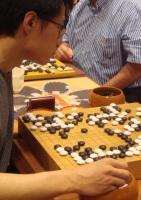
Any information is welcome, and in any case I thought people might find it curious to see what's out there in the world of go! (This is not, by the way, a subtle "for sale" post; odd or not I find it a very pleasant step up from my usual backpack-toted glass stones and folding goban.) Below are pictures, though capturing the grain in the white stones is frustratingly hard...
curiously thin stones from Japan, but perhaps not Hyuga?
-
amb
- Beginner
- Posts: 14
- Joined: Mon Mar 28, 2016 1:52 pm
- Rank: two-digit kyu
- GD Posts: 0
- KGS: amb
- Location: Boston (though highly variable!)
- Has thanked: 7 times
- Been thanked: 7 times
curiously thin stones from Japan, but perhaps not Hyuga?
- Attachments
-
- white stone detail
- white-stones.jpg (67.69 KiB) Viewed 14251 times
-
- labels
- boxes.jpg (61.66 KiB) Viewed 14251 times
-
- a bit of everything
- stones-bowls-board.jpg (93.79 KiB) Viewed 14251 times
-
Erythen
- Lives with ko
- Posts: 211
- Joined: Mon Jun 11, 2012 1:33 pm
- Rank: KGS 4K
- GD Posts: 0
- KGS: Erythen
- Wbaduk: Erythen
- OGS: Erythen
- Universal go server handle: Erythen
- Online playing schedule: Beijing Time: Usually between 20:00 - 22:00
- Has thanked: 55 times
- Been thanked: 179 times
- Contact:
Re: curiously thin stones from Japan, but perhaps not Hyuga?
Hello,
The box says snow grade though I can't tell for sure if the stones themselves are because I can't get a good look at the grain.
For reference, if it helps, here's an old photo from Mr. Kuroki's website showing snow grade stones.
From what little I see though, the stones appear to be of the Mexican variety. There's only two or three manufactures left in Japan, all located in Hyuga City. I've never heard of a city called "Hinata," but I've seen the word pop up from time to time when I use google translate. I suspect it's either an odd translation (like Kaya being translated as "mosquito net") or it's another word for the Mexican stones.
You'll see old sets like this pop up from time to time. New stones this thin aren't as common anymore, though I do believe some places will take special orders of size 20.
Size 20 = 5.5mm
Size 22 = 6.3mm
The bowls are chestnut.
I'd need to get a better look at the side grain of the board. From what little I can see of the surface, it looks to either be Kaya or Katsura. The brownish color makes me think Katsura, but that could just be the lighting in the photograph.
The box says snow grade though I can't tell for sure if the stones themselves are because I can't get a good look at the grain.
For reference, if it helps, here's an old photo from Mr. Kuroki's website showing snow grade stones.
You'll see old sets like this pop up from time to time. New stones this thin aren't as common anymore, though I do believe some places will take special orders of size 20.
Size 20 = 5.5mm
Size 22 = 6.3mm
The bowls are chestnut.
I'd need to get a better look at the side grain of the board. From what little I can see of the surface, it looks to either be Kaya or Katsura. The brownish color makes me think Katsura, but that could just be the lighting in the photograph.
-
John Fairbairn
- Oza
- Posts: 3725
- Joined: Wed Apr 21, 2010 3:09 am
- Has thanked: 20 times
- Been thanked: 4739 times
Re: curiously thin stones from Japan, but perhaps not Hyuga?
Hinata is just a reading for 日向 which is read Hyuga in the go sense in reference to Hyuga City, home of the famous hamaguri clams.
The reading Hinata is probably very common on Google at present because there is a Naruto character called Hinata Hyuga who may be two-faced in more senses than one (there's a play on the meaning of the characters in there). I know nothing about Naruto but my grandchildren have just discovered him so I may learn more as time goes on.
If the box is genuine then the stones are Japanese (real hamaguri and real nachi slate), though of Class 2. Being so thin means they are taken from young clams or the edge parts of older clams, and so will be a little weak. Don't try Kajiwaraing these!
The reading Hinata is probably very common on Google at present because there is a Naruto character called Hinata Hyuga who may be two-faced in more senses than one (there's a play on the meaning of the characters in there). I know nothing about Naruto but my grandchildren have just discovered him so I may learn more as time goes on.
If the box is genuine then the stones are Japanese (real hamaguri and real nachi slate), though of Class 2. Being so thin means they are taken from young clams or the edge parts of older clams, and so will be a little weak. Don't try Kajiwaraing these!
-
xed_over
- Oza
- Posts: 2264
- Joined: Mon Apr 19, 2010 11:51 am
- Has thanked: 1179 times
- Been thanked: 553 times
Re: curiously thin stones from Japan, but perhaps not Hyuga?
beautifulamb wrote: a complete but somewhat odd set of stones, bowls, and board I have come across.
-
amb
- Beginner
- Posts: 14
- Joined: Mon Mar 28, 2016 1:52 pm
- Rank: two-digit kyu
- GD Posts: 0
- KGS: amb
- Location: Boston (though highly variable!)
- Has thanked: 7 times
- Been thanked: 7 times
Re: curiously thin stones from Japan, but perhaps not Hyuga?
Thank you both! I tried to get a better picture of the grain of the stones and found it vexingly hard. (Erythen, the job you do for your sales listing is amazing!)
Thank you both for the answers! I have tried to find what information I could in English, but I think there's not much to find. (Aside from discussion here, Sensei's Library, Kiseido, and Erythen's ebay listings are where I have found the most!)
Ahh, thank you! I was wondering if this was the case, but hadn't yet pestered my Japanese instructor.John Fairbairn wrote:Hinata is just a reading for 日向 which is read Hyuga in the go sense in reference to Hyuga City, home of the famous hamaguri clams.
I'm curious, how do you make the hamaguri determination? Implied by some of the labelling? (I had wondered if they dated from a time when stones were still being made from hamaguri, but the thicker ones had become hard to find.) I believe the box is genuine; the seller said that they were indeed the boxes the stones were purcased in, and they were not trying to get a premium for any particular origin. I do read enough to understand the notation on the left side of the interior boxes as approximately "2nd class" (which I would naively think would be tsuki), though given that they're also marked as snow grade I wasn't sure how that worked.If the box is genuine then the stones are Japanese (real hamaguri and real nachi slate), though of Class 2. Being so thin means they are taken from young clams or the edge parts of older clams, and so will be a little weak. Don't try Kajiwaraing these!
Thank you both for the answers! I have tried to find what information I could in English, but I think there's not much to find. (Aside from discussion here, Sensei's Library, Kiseido, and Erythen's ebay listings are where I have found the most!)
-
gowan
- Gosei
- Posts: 1628
- Joined: Thu Apr 29, 2010 4:40 am
- Rank: senior player
- GD Posts: 1000
- Has thanked: 546 times
- Been thanked: 450 times
Re: curiously thin stones from Japan, but perhaps not Hyuga?
The characters to the right on the top of the box of the white stones and in the red label on the end of the box are yuki in, snow grade.
-
John Fairbairn
- Oza
- Posts: 3725
- Joined: Wed Apr 21, 2010 3:09 am
- Has thanked: 20 times
- Been thanked: 4739 times
Re: curiously thin stones from Japan, but perhaps not Hyuga?
It says so. The white stones are made of 蛤 (Meretrix meretrix lusoria) and the black stones are described as 那智 or Nachi slate.I'm curious, how do you make the hamaguri determination?
The other critical phrase on the box is 特選 or "specially selected" which usually implies Mexican clams or Taiwanese squilla. If native Hyuga clams are used the designation would have been 特産 of "special produce [of Hyuga]", and the cost would increase thirty-fold.
Mexican clams usually show the grain only on one side, which seems to be what the picture shows. Also, native Hyuga clams have a highly esteemed reddish tinge. As with kaya boards, the colouring subdues the harsh light of the glinting Japanese sun a little and so reduces eye strain. If your stones really are grained on both sides you might well have squilla, which is more durable than hamaguri.
The grade is 雪印 or yuki-jirushi. Being designated snow, moon or flower was traditionally meant to convey they came from Hyuga, but as Cheddar cheese is now made in places like the USA, I suppose we can no longer trust this 100%.
-
amb
- Beginner
- Posts: 14
- Joined: Mon Mar 28, 2016 1:52 pm
- Rank: two-digit kyu
- GD Posts: 0
- KGS: amb
- Location: Boston (though highly variable!)
- Has thanked: 7 times
- Been thanked: 7 times
Re: curiously thin stones from Japan, but perhaps not Hyuga?
My confusion here, perhaps based on bad assumptions, is that the box seems to say hamaguri (which could only be native Japanese clams) but the appearance of the stones suggests a Mexican origin for the clams. Perhaps the label does not match the reality?John Fairbairn wrote:It says so. The white stones are made of 蛤 (Meretrix meretrix lusoria) and the black stones are described as 那智 or Nachi slate.I'm curious, how do you make the hamaguri determination?
The other critical phrase on the box is 特選 or "specially selected" which usually implies Mexican clams or Taiwanese squilla. If native Hyuga clams are used the designation would have been 特産 of "special produce [of Hyuga]", and the cost would increase thirty-fold.
Per an early comment/request above, here is some detail on the stones and the edge grain of the board. For the stones, the grain is on both sides but is generally more intense on one than the other; some look nearly blank on both until closely examined. A fair amount of "personality" overall!
The edge grain of the board on two sides suggests that it's from close to the center of the tree, and is approximately straight on the other two. The last picture (with the white background) shows the color about right, at least to my eye on my laptop! It appears darker and more reddish than almost every board I have seen, though a few online pictures of kaya seem comparable.
Thank you all for the info, it is deeply appreciated.
- Attachments
-
- the curved-grain edge
- edge-grain-curved.jpg (63.71 KiB) Viewed 14049 times
-
- the straight-grain edge
- edge-grain-straight.jpg (63.78 KiB) Viewed 14049 times
-
- definitely more orangey than usual!
- board-colour.jpg (92.03 KiB) Viewed 14049 times
-
amb
- Beginner
- Posts: 14
- Joined: Mon Mar 28, 2016 1:52 pm
- Rank: two-digit kyu
- GD Posts: 0
- KGS: amb
- Location: Boston (though highly variable!)
- Has thanked: 7 times
- Been thanked: 7 times
Re: curiously thin stones from Japan, but perhaps not Hyuga?
...oops, and the stones. (The board color does not look true in this one, btw.)
- Attachments
-
- grain, finally!
- stone-colour.jpg (68.65 KiB) Viewed 14049 times
-
John Fairbairn
- Oza
- Posts: 3725
- Joined: Wed Apr 21, 2010 3:09 am
- Has thanked: 20 times
- Been thanked: 4739 times
Re: curiously thin stones from Japan, but perhaps not Hyuga?
No.hamaguri (which could only be native Japanese clams)
-
Erythen
- Lives with ko
- Posts: 211
- Joined: Mon Jun 11, 2012 1:33 pm
- Rank: KGS 4K
- GD Posts: 0
- KGS: Erythen
- Wbaduk: Erythen
- OGS: Erythen
- Universal go server handle: Erythen
- Online playing schedule: Beijing Time: Usually between 20:00 - 22:00
- Has thanked: 55 times
- Been thanked: 179 times
- Contact:
Re: curiously thin stones from Japan, but perhaps not Hyuga?
Thank you for the clarification.Hinata is just a reading for 日向 which is read Hyuga in the go sense in reference to Hyuga City, home of the famous hamaguri clams.

--------------
The stones look Mexican.
Mexican stones are graded mostly on grain fineness, while native Japanese (suwabute) stones are graded on color.
In the photo below is an example of the kinds of grain you can expect to see in all grades of suwabute stones. For reference, this is a sized 25 snow grade suwabute set. (Apologies for the size)
The board looks Katsura. It's a popular material for Go boards in Japan because of the pleasing color, durability of the wood and fast growth (compared with Kaya). The board is Itame - Kiura cut (irregular grain with the grain facing upward). Katsura boards are universally Itame because the trees do not grow as large as Kaya.
As a note: If by happenstance a masame (strait grain) Katsura board does happen to exist, I'd love to see photos.

Katsura (without the clay-like, color-diminishing covering I see plastered over some boards) will have a very slight brown-gold/red sheen to it, especially on the playing surface.
See the example photo below (again apologies for the size).
-
EdLee
- Honinbo
- Posts: 8859
- Joined: Sat Apr 24, 2010 6:49 pm
- GD Posts: 312
- Location: Santa Barbara, CA
- Has thanked: 349 times
- Been thanked: 2070 times
-
Erythen
- Lives with ko
- Posts: 211
- Joined: Mon Jun 11, 2012 1:33 pm
- Rank: KGS 4K
- GD Posts: 0
- KGS: Erythen
- Wbaduk: Erythen
- OGS: Erythen
- Universal go server handle: Erythen
- Online playing schedule: Beijing Time: Usually between 20:00 - 22:00
- Has thanked: 55 times
- Been thanked: 179 times
- Contact:
Re: curiously thin stones from Japan, but perhaps not Hyuga?
Native Japanese clamshell. Hyuga Tokusan "Special Product of Hyuga."Sorry, may I ask what is "suwabute" ?
Mexican clamshell left, Suwabute right.
-
LifeIn9x9
- Dies in gote
- Posts: 47
- Joined: Fri Mar 11, 2016 1:24 am
- Rank: JP 1d
- GD Posts: 0
- Has thanked: 7 times
- Been thanked: 5 times
Re: curiously thin stones from Japan, but perhaps not Hyuga?
Is it possible to find these "dual sided" stones these days, or are they unobtainable?John Fairbairn wrote:If your stones really are grained on both sides you might well have squilla, which is more durable than hamaguri.