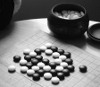
I guess for reading practice, it's best to consider every variation. Especially for such a small space. If I have found one working variation, I can usually reverse engineer the shape to return to the one that worked. Not always though. If white plays a, c or d, black can connect at b and make e and f miai.Bill Spight wrote:Putting yourself in your opponent's place is indeed important in a game. In fact, IMHO, you should do that before you think about your play. If it were your opponent's turn, where would they play? The saying is, The opponent's key point is my key point. How do you know the opponent's key point if you don't look at the board through their eyes?FinrodFelagund wrote:New plan!
Now the whole corner only has 1 eye. White should take the stone to save the corner, but will lose an extra two points if white wants to save everything.
White can only take at C1 , then black wins the capturing race with H1.
White would live in sente ifwas played at
, letting black connect.
I think I still suffer from a huge case of wishful reading. I need to develop the discipline to go back and consider white's best response with the same intensity that I considered black's first move.
But to solve a problem doing that is neither necessary nor sufficient.It's not necessary because you only need to find one move for yourself when it's your turn, regardless of where your opponent might play, and it's not sufficient because when it's your opponent's turn, you need to have a good reply to each of their moves. It's not a question of psychology, but of technique.
For instance,
You have shown replies for a and b, but what about c - f?
Maybe some of these plays are trivially obvious. But to me b and f stand out because they are where Black played in response to a. c is a point where Black played in response to b. And after e Black can still make a mistake.
I don't mean that you need to read every possibly reply by your opponent at every turn, but you certainly need to be prepared for every one of them.

If white plays f, black plays a, white d, black e. White is cut off again. (I probably should have just made this a diagram, because I hate when go books describe sequences like this.)
 Black has miai between cutting at a and taking the second eye away at f.