Superko rules and ko-cycles rules are BAD board game design

For discussing go rule sets and rule theory
User avatar
Cassandra
Lives in sente
Posts: 1326
Joined: Wed Apr 28, 2010 11:33 am
Rank: German 1 Kyu
GD Posts: 0
Has thanked: 14 times
Been thanked: 153 times

Re: Superko rules and ko-cycles rules are BAD board game des

Post by Cassandra »

CDavis7M wrote:
John Fairbairn wrote:1. Article 2's commentary 1 says "The making of moves in alternation is a right." That's it. It seems like a blunt, comes-out-of-nowhere statement. In fact, it reflects a huge debate in Japan going back to 1928 as to whether making a move was a right or an obligation. For a Japanese this comment 2.1 does not come out of nowhere - it has a huge context.
I read that but not having not seen the previous arguments, my understanding is that 着手 is an "allowance" or "right," but not an "obligation" because the player may choose 着手の放棄 instead. I appreciate your comments because I think there is a difference between 着手の放棄 and "passing your turn to your opponent." 着手の放棄 is not パス, even if it might commonly be called that.
In the commentaries, "着手放棄" (being "commonly called "パス") and "パス" are BOTH utilised for "abandoning a move".

However, it should be evident that "パス" as synonym for "着手放棄" is NOT the same as "パス" as synonym for "あなたの番" (= "your turn") in the MIDDLE of a MEANINGFUL sequence where one side does not have any suitable board point left for placing a stone (please refer e.g. to L&D example 7-2).

------------------------------------------

On the other hand, (pretended) mixing up BOTH usages of "パス" does have one decisive advantage:
J89's Article 2, Clause 2 explicitly states that there is no further move possible after the SECOND "パス" in succession (which followed a "着手放棄" (being "commonly called "パス")).

As can be seen from the L&D Examples, DOUBLE-KO is considered a relatively common formation.
The very strict ruling cited above prohibits the nonsensical double-ko cycle with two successive "パス" at its END, which would turn the whole board "chôsei".
The really most difficult Go problem ever: https://igohatsuyoron120.de/index.htm
Igo Hatsuyōron #120 (really solved by KataGo)
John Fairbairn
Oza
Posts: 3724
Joined: Wed Apr 21, 2010 3:09 am
Has thanked: 20 times
Been thanked: 4672 times

Re: Superko rules and ko-cycles rules are BAD board game des

Post by John Fairbairn »

Cassandra wrote:
CDavis7M wrote:
John Fairbairn wrote:
1. Article 2's commentary 1 says "The making of moves in alternation is a right." That's it. It seems like a blunt, comes-out-of-nowhere statement. In fact, it reflects a huge debate in Japan going back to 1928 as to whether making a move was a right or an obligation. For a Japanese this comment 2.1 does not come out of nowhere - it has a huge context.
I read that but not having not seen the previous arguments, my understanding is that 着手 is an "allowance" or "right," but not an "obligation" because the player may choose 着手の放棄 instead. I appreciate your comments because I think there is a difference between 着手の放棄 and "passing your turn to your opponent." 着手の放棄 is not パス, even if it might commonly be called that.

In the commentaries, "着手放棄" (being "commonly called "パス") and "パス" are BOTH utilised for "abandoning a move".

However, it should be evident that "パス" as synonym for "着手放棄" is NOT the same as "パス" as synonym for "あなたの番" (= "your turn") in the MIDDLE of a MEANINGFUL sequence where one side does not have any suitable board point left for placing a stone (please refer e.g. to L&D example 7-2).
This is making my head spin, not least because Davis and Cassandra are arguing with each other but seem to be saying the same thing.

I've said this already, but have been ignored, so I'll try again here: in the sequence of ordinary play White plays, Black plays, White passes, Black is now allowed to play at once. No shilly-shallying about two passes and resuming play.

Here is an example from Japanese pro play (Game 5 of the 2008 Kisei):
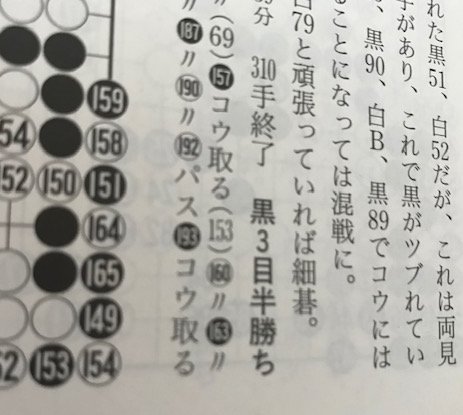
pass.jpg
pass.jpg (52.68 KiB) Viewed 23220 times
Move 192 (actually 292) is a pass (パス)and move 293 takes a ko (コウ取る). There is no reference to shilly-shallying and the exchange doesn't even merit a mention in the commentary. Everybody in Japan knows what transpired.

The 1949 rules spells it out (after telling us in Article 35 that the game ends when both players agree):

第36条 終局について双方意見が一致しないときは、終局したことを認める方は、自己の着手を放棄して、相手方に着手させることができる。
2 前項によって着手を放棄した後であっても、必要と認めるときは、着手放棄者は、随時交互着手を復活する自由を有する。

Article 36 If the two sides do not agree that game is over, the side that judges the game is over may relinquish his own move and allow the opposing side to play.
2 Even if it is after relinquishing a move in accordance with the preceding paragraph, if the relinquishing player deems it necessary, he has the freedom to resume alternate moves at any time.

After these rules were published there was considerable research into rules in Japan. This was not based so much on dissatisfaction with the 1949 rules as on increasing awareness of other rulesets, obviously Chinese rules most of all, but there was also the discovery of Tibetan rules, and a set called "Taiwan rules" in Japan attracted attention as a form of Chinese rules with Japanese element (this was not Ing rules: its main feature was the gote no tedomari). In 1960 the noted researcher Kaise Takaaki published a complete draft for the "Kaise Rules" which essentially are the current AGA rules - they include pass stones. Kaise was co-opted onto the Rules Committee that led to the 1989 (and was given space in Kido to voice his opinions), but none of his, or similar ideas, were adopted.

There were also occurrences of quadruple ko to excite the rules mavens in this period. The first was in the 1963 Oteai and a couple of others followed. These were handled as void games. They may have excited the mavens but did not excite controversy.

Thus, when the 1989 rules were published, the Preamble outlined four principles that had governed the committee's work. The first was (1) 日本の伝統的な対局方法を遵守する。(We shall adhere to the traditional way of play in Japan.). Principle 2 was to rationalise and clarify the latent principles of Japanese rules. Only in Principle 3 did the rest of the world get a look-in: We shall pursue go rules for common use throughout the world. And Principle 4 was a nod towards listening to proposals for revisions in future. But these four principles were immediately followed by a caveat: namely that ii has been determined that the basis will be the scope within which go is played in Japan.

In other words, the way of play described in 1949 applies unless specifically overridden.

A pass does hand the right to move to the opponent.

As I have said in another thread, amateurs may play under Marquis of Queensbury rules and let the passer resume play after pointing out necessary moves. But M of Q rules are not Japanese rules.
Pio2001
Lives in gote
Posts: 418
Joined: Mon Feb 16, 2015 12:13 pm
Rank: kgs 5 kyu
GD Posts: 0
KGS: Pio2001
Has thanked: 9 times
Been thanked: 83 times

Re: Superko rules and ko-cycles rules are BAD board game des

Post by Pio2001 »

CDavis7M wrote:On the whole, I think Area Scoring is a better design. But Stone Scoring is better design than Territory or Area because the scoring is directly related to the play mechanic. Area scoring needs additional rules for scoring.
That's right, stone scoring has fewer rules. The winner is the one with more stones (plus komi). While with area scoring, the winner is the one with more stones and empty space sourrounded.

But on the other hand, I find more complicated to evaluate the situation during the game with stone scoring : if I want to win, my goal is to get the widest area while not creating too many groups.
With area scoring, my goal is easier to understand. I just have to get the widest area. Everything inside will be mine, stones or empty space. I don't have to distinguish between the part that can be filled with stones and the part that should remain unfilled in order to get two eyes in the end.

What's more complicated in the rule (stones and empty spaces count, that's two things to think about) becomes less complicated in actual game (everything counts, no need to consider separately stones and empty spaces).
CDavis7M wrote:
Pio2001 wrote:Black could play "a" forever, starting and endless cycle.
The game is better if this is forbidden.
I disagree. White could decide to let black capture and give up the seki. If the game is so close that this would decide the result, then allowing for black to create this complex situation in a close game adds to the depth of strategy (gameplay is improved at the cost of no winner). I think that gameplay should have more weight than merely deciding the winner. Though I understand why this is not the case for tournament play.
I see your point of view. I agree that scoring this position as we usually do in not mandatory. It is indeed special, and I wouldn't mind it to have a special status.
But I don't like the "no result" option. That's bad game design. I am ok to rule this position as draw, or anything else, but something must be decided other than "nothing".
jann
Lives in gote
Posts: 445
Joined: Tue May 14, 2019 8:00 pm
GD Posts: 0
Been thanked: 37 times

Re: Superko rules and ko-cycles rules are BAD board game des

Post by jann »

Pio2001 wrote:
CDavis7M wrote:
Pio2001 wrote:{sending2-returning1}
Black could play "a" forever, starting and endless cycle.
The game is better if this is forbidden.
I disagree. White could decide to let black capture and give up the seki. If the game is so close that this would decide the result, then allowing for black to create this complex situation in a close game adds to the depth of strategy ...
I see your point of view. I agree that scoring this position as we usually do in not mandatory.
The duality/union of the area and territory game is a very important principle in Go. Rules cannot create so huge difference between them in so common shapes.
Gérard TAILLE
Gosei
Posts: 1346
Joined: Sun Aug 23, 2020 2:47 am
Rank: 1d
GD Posts: 0
Has thanked: 21 times
Been thanked: 57 times

Re: Superko rules and ko-cycles rules are BAD board game des

Post by Gérard TAILLE »

CDavis7M wrote:
Gérard TAILLE wrote:
Click Here To Show Diagram Code
[go]$$W
$$ -----------------------
$$ | O a X . O . O X . . .
$$ | X X X X O O O X . . .
$$ | O O O O X X X X . . .
$$ | . . . . . . . . . . .
$$ | . . . . . . . . . . .[/go]
We are still in normal play, it is white to play and I assume the last interesting move on all board is a black move at "a" to get a captured stone.
Black does not need to play at "a". The one white stone to the left of "a" is not a living stone 活き石? It does not meet the definition because it can be captured by a black play at "a", and white cannot then play a new stone that cannot be captured.
I agree CDavis7M but because it is not territory (article 8) the white dead stone in the corner is not taken into account for the score. That is the reason why this stone has to be captured during normal play.
User avatar
CDavis7M
Lives in sente
Posts: 716
Joined: Tue Jun 15, 2010 2:18 pm
Rank: Shokyu
GD Posts: 0
Universal go server handle: CDavis7M
Has thanked: 109 times
Been thanked: 140 times
Contact:

Re: Superko rules and ko-cycles rules are BAD board game des

Post by CDavis7M »

Cassandra wrote:However, it should be evident that "パス" as synonym for "着手放棄" is NOT the same as "パス" as synonym for "あなたの番" (= "your turn") in the MIDDLE of a MEANINGFUL sequence where one side does not have any suitable board point left for placing a stone (please refer e.g. to L&D example 7-2).
No, no, no. Article 7-2 explicitly allows for a ko to be retaken after a pass when confirming life and death. I have recognized this rule several times. This rule does not apply to any other situation. There is no possibility of playing after a pass during play itself (unless as the first [play when passing after resumption).
User avatar
CDavis7M
Lives in sente
Posts: 716
Joined: Tue Jun 15, 2010 2:18 pm
Rank: Shokyu
GD Posts: 0
Universal go server handle: CDavis7M
Has thanked: 109 times
Been thanked: 140 times
Contact:

Re: Superko rules and ko-cycles rules are BAD board game des

Post by CDavis7M »

John Fairbairn wrote:The 1949 rules spells it out (after telling us in Article 35 that the game ends when both players agree):
第36条 終局について双方意見が一致しないときは、終局したことを認める方は、自己の着手を放棄して、相手方に着手させることができる。
2 前項によって着手を放棄した後であっても、必要と認めるときは、着手放棄者は、随時交互着手を復活する自由を有する。
Article 36 If the two sides do not agree that game is over, the side that judges the game is over may relinquish his own move and allow the opposing side to play.
2 Even if it is after relinquishing a move in accordance with the preceding paragraph, if the relinquishing player deems it necessary, he has the freedom to resume alternate moves at any time.
Right. There is no disagreement that the rules allow the player to pass upon resumption. That is explicitly in the rules. The question is whether a player may pass their turn during the game to enable the other player to play during the game. As in, passing 9 times to give 9 moves, then continue playing.
====================
John Fairbairn wrote:Here is an example from Japanese pro play (Game 5 of the 2008 Kisei)...
Move 192 (actually 292) is a pass (パス)and move 293 takes a ko (コウ取る). There is no reference to shilly-shallying and the exchange doesn't even merit a mention in the commentary. Everybody in Japan knows what transpired.
I hate to question you, but is this game record really steeped in Japanese Go tradition? Is it Japanese tradition to play 1 or more dame points after your opponent passes (and passes again)?

Or is this Kisei game record showing a break with tradition (and the rules) for the convenience of modern Go computer software? Is it not the software that demands the pass? It is really the last move of the game or should it be the first dame filled?
Is there any evidence of a "pass" in a game record predating computers?

Here is my counter example. This is game between Tsuchiya Shuwa and and Yasui Shuntetsu. I don't have the original record but this record was published in a Sugiuchi's book copyright 1975. So, before Go record formatting software demanded that passes be input into game records. In this game record, the last play is move 239, which is retaking the ko. The game ends. There is no pass (move 240) and play (241) in the game otherwise it would be in the game record. The record notes that the ko was connected. My understanding of the Japanese Rules is that this point is a dame and it would be connected during dame filling. Since the current Japanese Rules are rooted in Japanese tradition, it does not surprise me that the record does not include "plays" after a pass. Connecting a dame is not a play in the game.

Image
John Fairbairn wrote:In other words, the way of play described in 1949 applies unless specifically overridden.A pass does hand the right to move to the opponent.
In the event that the game is resumed as described in the section your copied? I agree. However, in rule design, an allowance conditioned upon one circumstance is not also an allowance for any other circumstance.
Last edited by CDavis7M on Sun Oct 03, 2021 2:22 pm, edited 1 time in total.
Gérard TAILLE
Gosei
Posts: 1346
Joined: Sun Aug 23, 2020 2:47 am
Rank: 1d
GD Posts: 0
Has thanked: 21 times
Been thanked: 57 times

Re: Superko rules and ko-cycles rules are BAD board game des

Post by Gérard TAILLE »

CDavis7M wrote:
Cassandra wrote:However, it should be evident that "パス" as synonym for "着手放棄" is NOT the same as "パス" as synonym for "あなたの番" (= "your turn") in the MIDDLE of a MEANINGFUL sequence where one side does not have any suitable board point left for placing a stone (please refer e.g. to L&D example 7-2).
No, no, no. Article 7-2 explicitly allows for a ko to be retaken after a pass when confirming life and death. I have recognized this rule several times. This rule does not apply to any other situation. There is no possibility of playing after a pass during play itself (unless as the first [play when passing after resumption).
Let me try to understand
Click Here To Show Diagram Code
[go]$$B
$$ ---------------
$$ | . X O . . |
$$ | . X O O . |
$$ | X . 1 O . |
$$ | . X O O . |
$$ | . X O . . |
$$ ---------------[/go]
After :b1: white has no interesting move => white pass => black pass (black is not allowed to play a move after a pass) => game stops.
Now, because all black stones will be dead in confirmatiopn phase, black resume the game.
White starts in the resume game but is not allowed to retake the ko => white passes but now we are in a situation where black is allowed to play a move => black connects and then white passes and black passes.

Is it a good understanding CDavis7M ?
User avatar
CDavis7M
Lives in sente
Posts: 716
Joined: Tue Jun 15, 2010 2:18 pm
Rank: Shokyu
GD Posts: 0
Universal go server handle: CDavis7M
Has thanked: 109 times
Been thanked: 140 times
Contact:

Re: Superko rules and ko-cycles rules are BAD board game des

Post by CDavis7M »

Gérard TAILLE wrote:
Click Here To Show Diagram Code
[go]$$B
$$ ---------------
$$ | . X O . . |
$$ | . X O O . |
$$ | X . 1 O . |
$$ | . X O O . |
$$ | . X O . . |
$$ ---------------[/go]
After :b1: white has no interesting move => white pass => black pass (black is not allowed to play a move after a pass) => game stops.
Now, because all black stones will be dead in confirmation phase, black resume the game.
Why do you think the black stones are dead? This goes against my understanding of Life and Death confirmation in the Japanese Rules. The 6 black stones are alive. Dame filling and reinforcement are part of confirming life and death.
Gérard TAILLE wrote: White starts in the resume game but is not allowed to retake the ko => white passes but now we are in a situation where black is allowed to play a move => black connects and then white passes and black passes.
If white does not understanding life and death confirmation then this scenario could happen.
Pio2001
Lives in gote
Posts: 418
Joined: Mon Feb 16, 2015 12:13 pm
Rank: kgs 5 kyu
GD Posts: 0
KGS: Pio2001
Has thanked: 9 times
Been thanked: 83 times

Re: Superko rules and ko-cycles rules are BAD board game des

Post by Pio2001 »

CDavis7M wrote:Why do you think the black stones are dead? This goes against my understanding of Life and Death confirmation in the Japanese Rules. The 6 black stones are alive. Dame filling and reinforcement are part of confirming life and death.
If the 6 black stones were alive, then there would be no dame, and Black would have 5 points of territory.

Proof:
If the empty intersection in the ko is surrounded by living stones of the same colour, then it is an eye space.
Since all empty intersections are eye spaces, there is no dame.
Since there is no dame, no stones are in seki.
Since eye spaces are surrounded by living stones not in seki, all empty intersections are territory.

However, everyone knows that there is no point of territory inside this ko.
User avatar
CDavis7M
Lives in sente
Posts: 716
Joined: Tue Jun 15, 2010 2:18 pm
Rank: Shokyu
GD Posts: 0
Universal go server handle: CDavis7M
Has thanked: 109 times
Been thanked: 140 times
Contact:

Re: Superko rules and ko-cycles rules are BAD board game des

Post by CDavis7M »

Pio2001 wrote:If the 6 black stones were alive, then there would be no dame, and Black would have 5 points of territory.
I was a bit slack. This is not 駄目詰め, it is 手入れ. Both are carried out in life and death confirmation so there is no need to pass for the final ko to be filled.
John Fairbairn
Oza
Posts: 3724
Joined: Wed Apr 21, 2010 3:09 am
Has thanked: 20 times
Been thanked: 4672 times

Re: Superko rules and ko-cycles rules are BAD board game des

Post by John Fairbairn »

Right. There is no disagreement that the rules allow the player to pass upon resumption. That is explicitly in the rules. The question is whether a player may pass their turn during the game to enable the other player to play during the game. As in, passing 9 times to give 9 moves, then continue playing.
There is no resumption. Play has not ended because the two players have not both agreed it's over.
I hate to question you, but is this game record really steeped in Japanese Go tradition? Is it Japanese tradition to play 1 or more dame points after your opponent passes (and passes again)?
Games where one player is said to connect a ko at the end have not necessarily ended there. In real life, there are often many extra plays as all the ko threats are played out. The reader is spared this dross. But it's less to do with compassion for the reader than the fact that players in early rounds are supposed to record their games afterwards and file them in their pigeon holes at the Ki-in. Sometimes players are too lazy to do this and have to be chased up by the admin staff, with the result that games are reconstructed from memory quite a long time after the event. Such players can't be bothered with the ko trivia. Some players just don't bother filing games records at all. There are also cases where the two players remember the game differently, even producing different final point scores. It's WYSIWYG, not WYSIWWP (was played).
Is there any evidence of a "pass" in a game record predating computers?
Yes. The most famous is a wartime Oteai game in which Hashimoto and Hayashi played I think (from memory) five passes because they didn't know how to handle a 10,000 year ko. There was no game-end to resume from, simply because the whole point was that they didn't know how to end the game.

Relevant also, in an oblique way, is the tinnitus game in which (I think) Ryu Shikun grunted something that meant Pass and assumed from his opponent's mien that he passed also, but the opponent (O Rissei?) claimed he did not agree it was over because he had never heard the pass, because he has hearing problems. So Ryu started (as he thought) to fill in the dame in alternation but not in proper order, so he left a large group in atari, which O promptly captured.

There are lots of things in pro go that are not what they seem. One I like is byoyomi. Timekeepers are supposed to count out the last few seconds. But the youngsters soon learn to count VERY VERY slowly for certain senior players (and of course no sponsor wants to print a truncated lost-on-time title game). So the times taken as printed may be well short of what were really taken.

As to software making things easier, you might not rush to assume it makes so much difference if you'd seen a Japanese compositor put diagrams together using lead fonts - backwards, of course. Think Ginger Rogers, who pointed out that she danced every step Fred Astaire did, but had to do it backwards and in high heels - and got half the pay.

And just because something is called Japanese tradition doesn't mean it's full of wabi-sabi. It can be full of kye excrement as well.
jann
Lives in gote
Posts: 445
Joined: Tue May 14, 2019 8:00 pm
GD Posts: 0
Been thanked: 37 times

Re: Superko rules and ko-cycles rules are BAD board game des

Post by jann »

CDavis7M wrote:The question is whether a player may pass their turn during the game to enable the other player to play during the game. As in, passing 9 times to give 9 moves, then continue playing.
As these examples shown, this can actually be necessary for reaching a scorable position, when one side have more moves to play than the other. OC you can also imagine 9 resumptions for 9 extra moves. :)
Is there any evidence of a "pass" in a game record predating computers?
You cannot go back too far into the past, because these things changed significantly around the time of the first written rules. Your approach was present as a competing opinion before that - but not after.
User avatar
CDavis7M
Lives in sente
Posts: 716
Joined: Tue Jun 15, 2010 2:18 pm
Rank: Shokyu
GD Posts: 0
Universal go server handle: CDavis7M
Has thanked: 109 times
Been thanked: 140 times
Contact:

Re: Superko rules and ko-cycles rules are BAD board game des

Post by CDavis7M »

jann wrote:
CDavis7M wrote:The question is whether a player may pass their turn during the game to enable the other player to play during the game. As in, passing 9 times to give 9 moves, then continue playing.
As these examples shown, this can actually be necessary for reaching a scorable position, when one side have more moves to play than the other. OC you can also imagine 9 resumptions for 9 extra moves. :)
You know that I only take issue with passing during the game ("alternating play") and not during life and death confirmation, right? I might as well respond over there.
jann wrote:
Is there any evidence of a "pass" in a game record predating computers?
You cannot go back too far into the past, because these things changed significantly around the time of the first written rules. Your approach was present as a competing opinion before that - but not after.
I must not know my approach. What is it?
User avatar
CDavis7M
Lives in sente
Posts: 716
Joined: Tue Jun 15, 2010 2:18 pm
Rank: Shokyu
GD Posts: 0
Universal go server handle: CDavis7M
Has thanked: 109 times
Been thanked: 140 times
Contact:

Re: Superko rules and ko-cycles rules are BAD board game des

Post by CDavis7M »

John Fairbairn wrote:
Right. There is no disagreement that the rules allow the player to pass upon resumption. That is explicitly in the rules. The question is whether a player may pass their turn during the game to enable the other player to play during the game. As in, passing 9 times to give 9 moves, then continue playing.
There is no resumption. Play has not ended because the two players have not both agreed it's over.
Looking at the 2008 Kisei match again, maybe it was not a case of resumption. It seems to be even more weird than that. The "normal" game ends with W248 filling a ko. Then B249 starts "trying stuff" insides White's territory and this lasts for 60 moves. Black makes a ko, they play some real ko threats, but then black starts filling dame, white doesn't connect the ko but fills dame too, and then Black takes the ko again, and continues to fill dame to retake the ko. Cho must be wondering why Yamashita is not connecting the ko. Yamashita must be wondering why Cho's dead group keeps playing a ko that doesn't work that doesn't help while Cho is already winning.

So when Cho fills the dame a 4th time at B291, I think Yamashita is sick of this and he just passes. "Let's just end this thing!" So guess what, B293 takes the ko. :clap: This continues for a bit until dame and threats are all used, white takes the ko, doesn't connect, and the game ends. I don't know what was really going on between these two at the time, but it seems like the "normal" game ended back with W248 and I am not going to take White's pass at W292 as hard evidence for what the rules on passing actually are.
====================
John Fairbairn wrote:Games where one player is said to connect a ko at the end have not necessarily ended there. In real life, there are often many extra plays as all the ko threats are played out. The reader is spared this dross.
I wish Yomiuri spared me. Thanks for all the history tid-bits though.
====================
John Fairbairn wrote:Yes. The most famous is a wartime Oteai game in which Hashimoto and Hayashi played I think (from memory) five passes because they didn't know how to handle a 10,000 year ko. There was no game-end to resume from, simply because the whole point was that they didn't know how to end the game.
I guess I'll have to do more looking around but this also seems like an oddball case. For me, the bottom line is that the rules allow for alternating play and the only mention of using a pass before the game is stopped is the use of 2 passes to actually stop the game. There is no need to not take your turn or to give the opponent an extra turn during the game.
====================
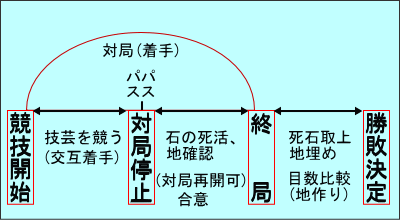
This chart is from the Japanese Rules
Image
It matches my understanding. The game uses alternating play. Passing mentioned only so far as 2 passes stop the game. But as shown in the diagram, the game may freely move between phases. So there is no issue with passes not being allowed during the game.
Post Reply