As hanekomi mentioned, Mainichi Communications have published several excellent go books in recent years - no doubt the result of having an excellent commissioning editor. The prices are also excellent.
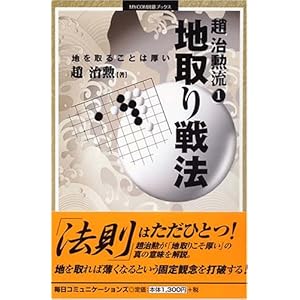
That prompted me to write a few notes about another of their books, one by His Excellency Cho Chikun. This is 趙治勲流地取り戦法 (Cho Chikun's territory-taking style), ISBN 4-8399-1700-0. 222 pages, about 1300 yen.
This too is an excellent book, though with perhaps not enough evidence of lucubration to claim the sense of 彫心鏤骨 and yet perhaps too novel to be labelled 重畳. Not quite refined enough perhaps to be 卓筆 but too good to be dismissed with a mere 凄い, and 逸物 might be too teasing. Maybe just 優良 will suffice.
It has three parts. Part 1 is an explanation, longish but not of the order of a disquisition, of the important notion that taking territory can be a thick and therefore good style of play. The bulk of this part is devoted to a definition of what thickness really means (i.e. not influence), with a couple of pages recommending that you try playing this way, and finally several pages on "The Structure of This Book". Apart from it being unexpected to see such a section on page 40 of a book, this is an unexpected treat in other ways. The rest of the book is a slew of examples, but this section on structure explains how to read those examples. It does so by giving an example. In brief, it tells you how to evaluate positions using Cho's approach. This is an excellent idea.
Part 2 is sixteen examples on "Attack and Defence round about the 3-3 point". As in the rest of the book, all the examples are full-board early games positions. Obviously the 3-3 point has been chosen as an exemplar for invasions in general, and at first sight some of the examples will look mundane: Black invades at the 3-3 point, which side does White block on? But the key difference is in the evaluation techniques. This is no mere "block on the side where you can develop most" sort of evaluation. It is more precise, more challenging and much more interesting than that. The real questions are, e.g. "Do I need sente or gote here?" or "Which side does White block, knowing that Black has gouged out his territory?" or "Is a solid position better here than a developmental one?" Other topics include weighing pros against cons, sabaki and consistency of style, but overall the message is - evaluate like this! Great stuff.
Part 3 takes Part 2 to another level. It is a series of nineteen examples showing how to fight Cho Chikun-style. Rather than evaluating a position, as in Part 2, you are now evaluating an attack or a strategy. This is when the budding surgeon gets to put his scalpel into live bodies instead of corpses. The examples do illustrate the differences: e.g. wanting to do something but not necessarily being able to do it. What then?
Yes, you do need to be able to read Japanese to get more than a whiff of value out of this book. But this book is 99% go text, with no reminsicences, soliloquies or other discursive text, so people who have done some basic Japanese should find it accessible. To those who don't have that background, please don't feel teased. I think there's value in simply knowing what exists out there.