balmung wrote:daal wrote:
But the problems remains the same: you are playing too fast, and you seem to believe that you should be winning games simply because you think you are better.
I only think I should win game is when the player plays alot weaker than I normally do, and I'm not losing from playing fast by it self I'm losing from
arrogance and tunnel vision. (...)
I remember I played a 5 kyu I lost to by like 10 points and I made two major flaws that
would have won me the game. One flaw was dealing with an
invasion properly, and that probably could of gone either way but it would of gave me the lead. The second flaw was
not playing the correct move to kill a large group of his that would have ended the game.
(...)
Wins truly have no meaning for the context of improving.
Some of your words are so true.
However, that is again ...
tunnel vision. It would
not have ended the game, as the opponent would
- objectively know that you both
could be wrong (e.g. the group is alive as it stands, connectible, has aji, is seki, too small, ko material, etc.),
- have no clue
*,
- being ignorant,
being arrogant and therefore
- simply play on.
With other words, as often said in post-game discussions: "
this would have been a different game".
Free yourself from this obsession, accept your whatever-status-quo-rank
OR
try to improve by self-study a/o learning with a teacher.
___________________________________________________________________________________________________________________
*In a team championship I played against s.o. about 3 stones weaker. From about the 50th move, I think I am winning.
With move 86 he allows me to attack his second group in ko for his life).
With move 106 the issue is settled, his group is technically dead with only remaining 3 liberties.
He chose his option to chase my cutting groups (into his prospects of moyo) - which I gladly accepted. I win both chases.
With move 152 I put his 26-stone group in atari, just for safety, as I wanted to exclude the distant imponderability of a kind of approach ko of him.
Quite late he plays a 'meaningless' ko involving one of my earlier cutting groups and two kos (he takes one, I can take the other and so on)
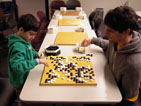
At move 261, Black made hastily his last move in byoyomi, I took a picture of the game situation, adjusted his clock,
replied (wrongly) to his move ... and realized my error


I should have taken out the 26-stone group, which is since 110 moves in atari, not 'make 1 extra point'.
During the whole tournament game (1h + byo) he played moves inferior to mine (my evaluation), was forced into byoyomi quite early
playing 1 hour in it,
while (different than usual) only entered it after the incident. Eventually, I lost by only 18.5 points.
He was ignorant enough not to realize that he'd lost otherwise.
Why do I tell this? It sounds similar to your story.
I do realize that this loss is entirely my responsibility, as Go is a marathon and with every single move we should be on guard,
as (with an overlooked atari) it can be over in an instance.
I even didn't bear a grudge against him, as I recognized a habit in his tenacity which is close to mine.
(Not just resigning 'because you committed an error' or 'are behind' in our own faulty evaluation.
Give the opponent opportunities to commit errors too.
If 50% of thos 'lost' games can be won, then the overall winning percentage has increased to 75%).
We, you, I have our playing strength
including these incidents and habits.