But you have also made what is previously thin and rather uneasy group for white completely solid. I think an important part of being strong is to leave variations unplayed, particularly when this is an area where your opponent has more to lose than you.
Agreed. Like I said, I wouldn't have played that way if it wasn't considered joseki. I'm bad at figuring out when provoking my opponent to solidify himself is worth it; it doesn't seem crazy to me that getting this wall in sente actually is worth losing whatever aji remained in his position, and since it was listed as an even sequence I assumed it was even. Should I take it from all of the comments about this that playing this way is very unusual?
Just to restate Shaddy's comment, the sequence doesn't seem particularly lossy to me (gain thickness facing a friendly 4-4), but this is a local follow-up, not part of the joseki proper- which your comments seem to suggest. Surely josekipedia or eidogo would elucidate this (unless I'm not current with this joseki , though bear in mind those are just wikis, I think). "Normal joseki" would end with 12... K17 (though it's by no means mandatory). White takes sente. Later, black normally will have the opportunity to add a variation of this (because it's slow for white to just remove this) and black might have changed his mind about what to do based on how the board evolved.
Just to restate Shaddy's comment, the sequence doesn't seem particularly lossy to me (gain thickness facing a friendly 4-4), but this is a local follow-up, not part of the joseki proper- which your comments seem to suggest. Surely josekipedia or eidogo would elucidate this (unless I'm not current with this joseki , though bear in mind those are just wikis, I think). "Normal joseki" would end with 12... K17 (though it's by no means mandatory). White takes sente. Later, black normally will have the opportunity to add a variation of this (because it's slow for white to just remove this) and black might have changed his mind about what to do based on how the board evolved.
Okay, I can see this now on josekipedia. It does say "continuation," not "joseki." I wasn't being very careful (which sort of defeats the purpose of being allowed to use dictionaries). Normally it will say something first like "black can tenuki," and since I didn't see that I got sloppy. That said, I accept all of the comments about how this continuation is premature without reservation.
Any further thoughts on how i might know these moves are really a "continuation", and not the joseki itself? Like I said, I know nothing about this joseki and I find it sort of intuitive that I get this wall to hem W in - and W didn't seem as thin to me as Aphelion suggested. He now looks a little overconcentrated, but what would I know.
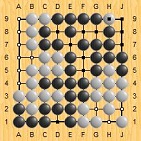
Not sure about my next move. I like J3. It seems to make the lower left side subtly more dangerous for W without getting over-concentrated. It also discourages W from playing a ladder breaker around K3. I want to sit down when I'm not exhausted and think about how I respond to the inevitable clamp at B9... what the board looks like after that effects the value of moves elsewhere.
(Someone - mw42? was suggesting that I was in "lose two stones" territory in this game. Maybe so. But situations like this are where I feel like I learn how to use joseki - I have successfully gotten the stones down on the board in the correct order, and now I get a chance to think about the weaknesses and strengths that I've saddled myself with. Once I understand that, each move in the joseki will make a lot more sense to me.)
Sorry I can't make the whole diagram, I'm on an iPad.
This is my sad, kyuish attempt at a probe. I can't decide between k4 and l17 . If I don't add a move at l17, all of my response to a white move there look cramped or risky. But it also looks like for me to move there would be over concentrated. So depending on his answer to this, I'll take one or the other.
After we finish this joseki, I'll make a keima enclosure in the upper right and any sort of invasion around l17 will be too cramped to be happy. If he decides to get cute and play the high variation without finishing up around r10, which is probably the most active line since our corners look the same, then I'll need to read out how precarious my group is.
He will probably play around K4, after which I will approach his upper right corner, but I haven't decided from which side. R14 would work well with my lower right, but since this is a handicap game, I will probably play O16/O17 instead.
I will also have to do something about his lower left moyo, but I will leave that till later.
My original plan was to play k3 or k4 (which was the point I wanted anyway) but a consultation with the dictionary reveals that when the opponent makes a high extension, 2space is the only joseki continuation. The logic seems to be that in a subsequent invasion, that high stone puts a little bit of extra pressure on my poor beleaguered stones.
Con: I am not making the beautiful double wing-ish formation in the lower left. Pro: assuming he finishes the joseki, I can add a move up top and I look very solid everywhere... He needs to think about one of two perilous invasions. If he plays h17, things will get messy and I'll be glad that this group is battened down.
I studied a lot of different variations, but I didn't like any of them too much. I'm clearly behind at this point, but this is a handicap game, and I must be patient (although I'm beginning to think that I shouldn't be giving a handicap). Let's try something a bit unorthodox (but not too much).
This is unusual, I know but (1) I'm experimenting, remember? And (2) the traditional responses (high extension or pincer) let him either finish the lower right or threaten the upper left in sente.
My hope here is that if we play the joseki (n15, p15, m16) I can play k17 in sente and then play somewhere painful for w on the lower-center right. I'll need to think more about how big a folowup I have to k17' though.
ps - I know there are also pincer variations that lead to a bloody mess ... I'm avoiding those because I'm afraid

 , though bear in mind those are just wikis, I think). "Normal joseki" would end with 12... K17 (though it's by no means mandatory). White takes sente. Later, black normally will have the opportunity to add a variation of this (because it's slow for white to just remove this) and black might have changed his mind about what to do based on how the board evolved.