doubling every 19 minutes would mean doubling 75 times in a day.
that's a 65,298,760,041,523,225,564,460.189164846 percent increase in size, per day. yeeeaaaahhhhh......
the expanding matter hypothesis
-
phillip1882
- Lives in gote
- Posts: 323
- Joined: Sat Jan 08, 2011 7:31 am
- Rank: 6k
- GD Posts: 25
- OGS: phillip1882
- Has thanked: 4 times
- Been thanked: 39 times
-
Loons
- Gosei
- Posts: 1378
- Joined: Tue Apr 20, 2010 4:17 am
- GD Posts: 0
- Location: wHam!lton, Aotearoa
- Has thanked: 253 times
- Been thanked: 105 times
Re: the expanding matter hypothesis
When you come up with a new model, it must explain or have an eye to explaining the preponderance of available data, make testable predictions that differentiate itself from the current model while respecting razors that belonged to German men or something.
Anyway, I would like to address the real travesty here; that in the fourth, fifth and sixth posts, when pulling for a popular layman-targeted book with an exciting name explaining an important but esoteric field in an interesting and accessible style, no one mentioned The Selfish Gene by Richard Dawkins. I guess it's not related to physics. Go, take it out of the library (or amazon it).
*Ignore Dawkins' subsequent works on his new topic when regarding this book.
Edit: It occurs to me that if you have a passing interest in physics and are not following http://backreaction.blogspot.com/ you are making a grave, grave error. One of the best things on the internet.
Anyway, I would like to address the real travesty here; that in the fourth, fifth and sixth posts, when pulling for a popular layman-targeted book with an exciting name explaining an important but esoteric field in an interesting and accessible style, no one mentioned The Selfish Gene by Richard Dawkins. I guess it's not related to physics. Go, take it out of the library (or amazon it).
*Ignore Dawkins' subsequent works on his new topic when regarding this book.
Edit: It occurs to me that if you have a passing interest in physics and are not following http://backreaction.blogspot.com/ you are making a grave, grave error. One of the best things on the internet.
Last edited by Loons on Thu Mar 31, 2011 4:04 am, edited 1 time in total.
-
Aphelion

- Lives in sente
- Posts: 766
- Joined: Thu Apr 22, 2010 12:14 pm
- Rank: KGS 4 kyu
- GD Posts: 227
- KGS: Aphelion02
- Has thanked: 24 times
- Been thanked: 59 times
Re: the expanding matter hypothesis
There sure are a lot of cranks out there...
Just a few things:
1. What does his theory explain that conventional physics does not? Does he have any data to support those claims? Do his claims even have a higher degree of accuracy than Newton's equations - which though old, are extremely impressive in their predictive strength under all but the most extreme scales.
2. What is the mathematical foundation his theory is built upon? Words and high level concepts are useless without this.
I wouldn't even bother looking at a theory that doesn't clearly state these two up front. This guy has the smell of a nutjob all over him.
Just a few things:
1. What does his theory explain that conventional physics does not? Does he have any data to support those claims? Do his claims even have a higher degree of accuracy than Newton's equations - which though old, are extremely impressive in their predictive strength under all but the most extreme scales.
2. What is the mathematical foundation his theory is built upon? Words and high level concepts are useless without this.
I wouldn't even bother looking at a theory that doesn't clearly state these two up front. This guy has the smell of a nutjob all over him.
-
phillip1882
- Lives in gote
- Posts: 323
- Joined: Sat Jan 08, 2011 7:31 am
- Rank: 6k
- GD Posts: 25
- OGS: phillip1882
- Has thanked: 4 times
- Been thanked: 39 times
Re: the expanding matter hypothesis
yeah, i agree for the most part that the expandimg matter hypothesis is broken and wrong primarly from the scaling problem. never the less i would like to address a few of the posts made here.
when holding a rock on a spring, the only force stretching it out is gravity. that being the case, the spring should continue to stay steached out during free fall because gravity is still forcefully pulling down on it. only wind resistance should allow it to collapse back in. but the spring collapses back in on itself even in an air free evironment.
in short the spring acts precicely as it would if you streached it out with the same force as gravity and let go in a zero gravity environment.
i can give a couple other examples as to why i suspect gravity to not be a force.
newtonain theory doesn't just say objects fall it says why they fall: that the earth is literally pulling down on them.If this is the best example the guy can find, he's a quack. Newtonian mechanics predicts the spring will collapse because the spring is subject to internal forces due to its extension. The gravitation force only predicts that the spring will fall.
when holding a rock on a spring, the only force stretching it out is gravity. that being the case, the spring should continue to stay steached out during free fall because gravity is still forcefully pulling down on it. only wind resistance should allow it to collapse back in. but the spring collapses back in on itself even in an air free evironment.
in short the spring acts precicely as it would if you streached it out with the same force as gravity and let go in a zero gravity environment.
i can give a couple other examples as to why i suspect gravity to not be a force.
you haven't really proven anything here, as you've applied a force outside the system. if you lift a rock, you're applying a force against gravity. however in no obvious way does this charge the atoms of the earth to prepare for you to let go and allow it to fall back to earth. gravity in of itself seems like a perpetual free energy device.By that logic: if you have a spring and pull on it, it is obviously stretched out. If you let go it collapses again AGAINST GRAVITY What have you proved now?
the fact that you have attraction and repulsion is magnetism. that it doesn't repel a compass needle doesn't make it not magnetism, just a diffent form of magnetism. there are a couple reasons why it might not deflect a compass needle a) monopole magnets may only affect eachother and not standard bi-pole magnets. b) the magentic force may not be strong enough to overcome the earth's magnetism.The experiment demonstrates static electricity, no magnets. You will find, for example, that neither the balloon nor the test tube will deflect a compass needle.
-
amnal
- Lives in gote
- Posts: 589
- Joined: Fri Apr 23, 2010 10:42 am
- Rank: 2 dan
- GD Posts: 0
- Been thanked: 114 times
Re: the expanding matter hypothesis
You are plain wrong, though the situation is perhaps designed to be unintuitive. As has already been explained, the internal physics of the system are such that its behaviour when dropped is unsurprising.phillip1882 wrote:yeah, i agree for the most part that the expandimg matter hypothesis is broken and wrong primarly from the scaling problem. never the less i would like to address a few of the posts made here.newtonain theory doesn't just say objects fall it says why they fall: that the earth is literally pulling down on them.If this is the best example the guy can find, he's a quack. Newtonian mechanics predicts the spring will collapse because the spring is subject to internal forces due to its extension. The gravitation force only predicts that the spring will fall.
when holding a rock on a spring, the only force stretching it out is gravity. that being the case, the spring should continue to stay steached out during free fall because gravity is still forcefully pulling down on it. only wind resistance should allow it to collapse back in. but the spring collapses back in on itself even in an air free evironment.
in short the spring acts precicely as it would if you streached it out with the same force as gravity and let go in a zero gravity environment.
i can give a couple other examples as to why i suspect gravity to not be a force.
When you say 'I suspect gravity to not be a force', well, I'm not sure what to say. Perhaps you should look up what a force is. I suppose you can say that gravity is not a force, but that it exerts a force (depending on how you define what), but I assume this kind of wordplay is not what you are representing as profound.
The lack of understanding here is frankly astounding. I recommend reading at least the wikipedia articles on electricity and magnetism before you start saying things like this, assuming your objective is to understand rather than to confuse.the fact that you have attraction and repulsion is magnetism. that it doesn't repel a compass needle doesn't make it not magnetism, just a diffent form of magnetism. there are a couple reasons why it might not deflect a compass needle a) monopole magnets may only affect eachother and not standard bi-pole magnets. b) the magentic force may not be strong enough to overcome the earth's magnetism.The experiment demonstrates static electricity, no magnets. You will find, for example, that neither the balloon nor the test tube will deflect a compass needle.
The fact that you have attraction and repulsion is because of the distribution of electric charges. Magnetism is not necessary in any way (except by its relation to electrical charges, which is not relevant here).
A monopole magnet would by necessity affect other magnets. It wouldn't be a magnet if it didn't...that's what magnetism is. If your monopole is powerful enough to deflect the balloon/test tubes system, I don't see why it wouldn't deflect a compass needle.
You actually appear to instead be postulating the existence of a new kind of charge which nobody has ever noticed before, which is observed when you rub balloons against things, and which interacts exactly the same way as electrical charges.
The balloons/tubes experiment is very well explained by conventional electromagnetism and the redistribution of electrons caused by your actions. What is your problem with the current theory that makes you think you have found a problem with it?
Edit: Just read your other comment, which is also flawed:
Saying 'charge the atoms of the earth' seems like a way of intentionally blurring what gravity is. Viewed as a contortion of spacetime, there isn't really a problem, and we know that this view seems to be correct.you haven't really proven anything here, as you've applied a force outside the system. if you lift a rock, you're applying a force against gravity. however in no obvious way does this charge the atoms of the earth to prepare for you to let go and allow it to fall back to earth. gravity in of itself seems like a perpetual free energy device.
Gravity is in no way a 'perpetual energy device'. What makes you think it is?
-
pwaldron
- Lives in gote
- Posts: 409
- Joined: Wed May 19, 2010 8:40 am
- GD Posts: 1072
- Has thanked: 29 times
- Been thanked: 182 times
Re: the expanding matter hypothesis
Um...no. In its steady state prior to falling, the gravitational force on the rock is balanced by the restoring force from the string. Once freefall begins, the restoring force is all that's left and the spring collapses. If you are lucky, you'll actually see the spring/rock combination oscillating.phillip1882 wrote: newtonain theory doesn't just say objects fall it says why they fall: that the earth is literally pulling down on them.
when holding a rock on a spring, the only force stretching it out is gravity. that being the case, the spring should continue to stay steached out during free fall because gravity is still forcefully pulling down on it. only wind resistance should allow it to collapse back in. but the spring collapses back in on itself even in an air free evironment.
in short the spring acts precicely as it would if you streached it out with the same force as gravity and let go in a zero gravity environment.
i can give a couple other examples as to why i suspect gravity to not be a force.
Um...no. There are several problems here. If it doesn't deflect a compass needle then it's not magnetism--it's static electricity. Magnetic forces add as vectors; they do not need to "overcome" the earth's magnetism. Magnetic monopoles have never been observed, and if they do they would certainly affect each other; see the difference between Maxwell's equations for electricity and magnetism to see what the effect of a magnetic monopole would be.phillip1882 wrote: the fact that you have attraction and repulsion is magnetism. that it doesn't repel a compass needle doesn't make it not magnetism, just a diffent form of magnetism. there are a couple reasons why it might not deflect a compass needle a) monopole magnets may only affect eachother and not standard bi-pole magnets. b) the magentic force may not be strong enough to overcome the earth's magnetism.
The explanations that you have put forward tell me that you have no training in even basic physics. You seem to put an awful lot of faith in the writings of someone who essentially claims that all of modern physics is incorrect. The burden of proof for such a claim is significant and is lacking in this case. Having glanced at the first chapter of his book (posted online), it's pretty clear that this writer is a quack who is trying to earn a few bucks bamboozling the public at the bookstand.
Speaking as someone who is a professional physicist, let me tell you that the examples you have presented are readily explained by modern physics and your alternate explanations are unphysical and incorrect.
-
fwiffo

- Gosei
- Posts: 1435
- Joined: Tue Apr 20, 2010 6:22 am
- Rank: Out of practice
- GD Posts: 1104
- KGS: fwiffo
- Location: California
- Has thanked: 49 times
- Been thanked: 168 times
Re: the expanding matter hypothesis
There are two forces being applied to the spring causing it to stretch. Gravity, and a force in opposition to gravity which keeps it from falling. Given that they're at opposite ends of the spring and in opposite directions, the spring stretches out. When you let go of the spring, one of the forces is removed, so the spring collapses.phillip1882 wrote:when holding a rock on a spring, the only force stretching it out is gravity. that being the case, the spring should continue to stay steached out during free fall because gravity is still forcefully pulling down on it.
You can try the same thing without involving gravity if you'd like. Lay a spring on a table and try to stretch it out by applying only a single force (i.e. tugging on one end). It won't work! The spring will slide across the table just the same as if gravity were causing it to fall. You have to pull at both ends to stretch it out. Let go with one hand, and it will spring back - and if you continue to pull with the other hand, it will resume sliding across the table at the same time.
Edit: D'oh! Ninja post.
-
phillip1882
- Lives in gote
- Posts: 323
- Joined: Sat Jan 08, 2011 7:31 am
- Rank: 6k
- GD Posts: 25
- OGS: phillip1882
- Has thanked: 4 times
- Been thanked: 39 times
Re: the expanding matter hypothesis
thank you! now this is the kind of thing i'm after! a reprocable experiment worth trying. i would very much like to try this to see if the spring does indeed collapse during the release.You can try the same thing without involving gravity if you'd like. Lay a spring on a table and try to stretch it out by applying only a single force (i.e. tugging on one end). It won't work! The spring will slide across the table just the same as if gravity were causing it to fall. You have to pull at both ends to stretch it out. Let go with one hand, and it will spring back - and if you continue to pull with the other hand, it will resume sliding across the table at the same time.
i have my doubts, i honestly don't know one way or the other. if it does then i'll drop this post if it doesn't then i'll persist.
-
phillip1882
- Lives in gote
- Posts: 323
- Joined: Sat Jan 08, 2011 7:31 am
- Rank: 6k
- GD Posts: 25
- OGS: phillip1882
- Has thanked: 4 times
- Been thanked: 39 times
Re: the expanding matter hypothesis
here's a bit further as to why i'm unsure.
suppose instead of pulling only one end of the spring at the rate of g, you swung it around yourself at the rate of g.
i'm confident, though not certain that the spring wouldn't just follow my motion but also stretch out.
but i agree that if you pull on a spring, the spring should follow the line of motion. (ie. if you pull on it at the rate of g along a straight line, will it stretch? hard for me to say, one way or the other.)
suppose instead of pulling only one end of the spring at the rate of g, you swung it around yourself at the rate of g.
i'm confident, though not certain that the spring wouldn't just follow my motion but also stretch out.
but i agree that if you pull on a spring, the spring should follow the line of motion. (ie. if you pull on it at the rate of g along a straight line, will it stretch? hard for me to say, one way or the other.)
-
topazg

- Tengen
- Posts: 4511
- Joined: Wed Apr 21, 2010 3:08 am
- Rank: Nebulous
- GD Posts: 918
- KGS: topazg
- Location: Chatteris, UK
- Has thanked: 1579 times
- Been thanked: 650 times
- Contact:

-
jts
- Oza
- Posts: 2670
- Joined: Sat Sep 18, 2010 4:17 pm
- Rank: kgs 6k
- GD Posts: 0
- Has thanked: 310 times
- Been thanked: 636 times
Re: the expanding matter hypothesis
I've always been troubled by general relativity because - while Einstein's curved space-time is clearly an improvement over the flawed Euclidean/Newtonian paradigm - it still cannot explain anomalies in spacetime at the mundane scales where relativity (falsely) predicts that space will conform to Euclidean "laws".
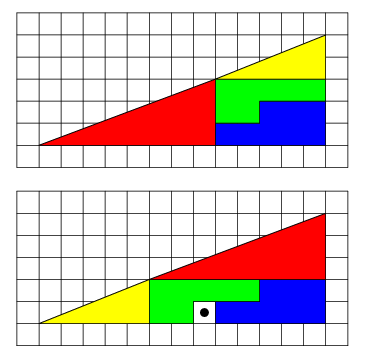
Can McCutcheon explain this well-known "triangle paradox"? I think that would definitely prove that his theory has more explanatory power than Einstein's.
Also, is it possible that, because washer-dryers are magnetic monopoles, they cause matter to expand at less than its normal rate? My sweatshirts normally don't fit quite so well after I've put them through the wash.
Can McCutcheon explain this well-known "triangle paradox"? I think that would definitely prove that his theory has more explanatory power than Einstein's.
Also, is it possible that, because washer-dryers are magnetic monopoles, they cause matter to expand at less than its normal rate? My sweatshirts normally don't fit quite so well after I've put them through the wash.
-
Violence
- Lives in sente
- Posts: 754
- Joined: Thu Apr 22, 2010 1:12 am
- Rank: Something Dan
- GD Posts: 720
- Has thanked: 9 times
- Been thanked: 144 times
Re: the expanding matter hypothesis
Well... you know... you could also just... draw a free body diagram... like any fledgling physics student.
When you hold the spring + ball system after the spring has stretched, the forces are as follows
Force of the hand exerting on the system = mg + kx, where m is the mass of the system, g is the gravitational accel, k is the spring constant, and x is the distance the spring has been stretched.
/
||
Hand holding spring.
|
|
|
|
| ||
| /
| Force of the system = mg + kx
|
O
Let's look what happens when we take away the hand.
Force of one end of the spring = kx
| ||
| /
|
|
| /
| ||
| Force of one end of the spring = kx
|
O
Because gravity affects the entire system equally, no net force is felt by any part of the system with respect to any other part of the system.
However, the force of the spring, given by kx, is no longer balanced by the hand, and as a result, both ends of the spring feel the kx force to return to its original, unstretched state. Perfectly normal behavior.
To further illustrate why this line of thought is false, let's simply turn the system upside down.
First, we assume that our spring has a relatively low mass and a high k, meaning, if we just hold the spring, it will not stretch significantly. It requires the mass of the ball to stretch. We perform the first experiment with easy success, and observe oscillation.
Now, we turn the entire setup upside down.
Force of the hand exerting on the system = mg.
/
||
Hand holding ball with spring attached.
|
|
|
|
| ||
| /
| Force of the system = mg
|
kx is so small here, it is negligible.
We let go. There is no oscillation in mid air, and there is no net difference of force felt within the system as it falls.
First scenario: kx internal force was large and significant. We observed oscillation in midair.
Second scenario: kx internal force was small and insignificant. We observed no significant oscillation in midair.
Therefore, the spring's internal force was the cause of the midair oscillation observed in our system.
It's been a while since I've taken physics, I suspect that I put the kx force in the wrong places, but I'm quite sure about where the forces are once the hand lets go of the system.
When you hold the spring + ball system after the spring has stretched, the forces are as follows
Force of the hand exerting on the system = mg + kx, where m is the mass of the system, g is the gravitational accel, k is the spring constant, and x is the distance the spring has been stretched.
/
||
Hand holding spring.
|
|
|
|
| ||
| /
| Force of the system = mg + kx
|
O
Let's look what happens when we take away the hand.
Force of one end of the spring = kx
| ||
| /
|
|
| /
| ||
| Force of one end of the spring = kx
|
O
Because gravity affects the entire system equally, no net force is felt by any part of the system with respect to any other part of the system.
However, the force of the spring, given by kx, is no longer balanced by the hand, and as a result, both ends of the spring feel the kx force to return to its original, unstretched state. Perfectly normal behavior.
To further illustrate why this line of thought is false, let's simply turn the system upside down.
First, we assume that our spring has a relatively low mass and a high k, meaning, if we just hold the spring, it will not stretch significantly. It requires the mass of the ball to stretch. We perform the first experiment with easy success, and observe oscillation.
Now, we turn the entire setup upside down.
Force of the hand exerting on the system = mg.
/
||
Hand holding ball with spring attached.
|
|
|
|
| ||
| /
| Force of the system = mg
|
kx is so small here, it is negligible.
We let go. There is no oscillation in mid air, and there is no net difference of force felt within the system as it falls.
First scenario: kx internal force was large and significant. We observed oscillation in midair.
Second scenario: kx internal force was small and insignificant. We observed no significant oscillation in midair.
Therefore, the spring's internal force was the cause of the midair oscillation observed in our system.
It's been a while since I've taken physics, I suspect that I put the kx force in the wrong places, but I'm quite sure about where the forces are once the hand lets go of the system.
-
amnal
- Lives in gote
- Posts: 589
- Joined: Fri Apr 23, 2010 10:42 am
- Rank: 2 dan
- GD Posts: 0
- Been thanked: 114 times
Re: the expanding matter hypothesis
Everyone knows the triangle thing is nonsense...but I think you're on to something with the washer-dryer thingjts wrote:I've always been troubled by general relativity because - while Einstein's curved space-time is clearly an improvement over the flawed Euclidean/Newtonian paradigm - it still cannot explain anomalies in spacetime at the mundane scales where relativity (falsely) predicts that space will conform to Euclidean "laws".
Can McCutcheon explain this well-known "triangle paradox"? I think that would definitely prove that his theory has more explanatory power than Einstein's.
Also, is it possible that, because washer-dryers are magnetic monopoles, they cause matter to expand at less than its normal rate? My sweatshirts normally don't fit quite so well after I've put them through the wash.

-
robinz
- Lives in gote
- Posts: 414
- Joined: Thu Sep 16, 2010 3:40 am
- Rank: KGS 9k
- GD Posts: 0
- KGS: robinz
- Location: Durham, UK
- Has thanked: 95 times
- Been thanked: 15 times
Re: the expanding matter hypothesis
@jts:
What does your "triangle paradox" (which I've seen before, and have attached a hint to the explanation below) have to do with general relativity, or indeed physics in general? It's a purely abstract construction - and basically an optical illusion, at that. No physical theories are required.
(It's possible you're joking, in which case I apologise, but if so it probably won't be obvious to everyone.)
Hint to the solution of the "paradox":
What does your "triangle paradox" (which I've seen before, and have attached a hint to the explanation below) have to do with general relativity, or indeed physics in general? It's a purely abstract construction - and basically an optical illusion, at that. No physical theories are required.
(It's possible you're joking, in which case I apologise, but if so it probably won't be obvious to everyone.)
Hint to the solution of the "paradox":
-
phillip1882
- Lives in gote
- Posts: 323
- Joined: Sat Jan 08, 2011 7:31 am
- Rank: 6k
- GD Posts: 25
- OGS: phillip1882
- Has thanked: 4 times
- Been thanked: 39 times
Re: the expanding matter hypothesis
violence, an excellent post, but agian i'd like to point out if you rotate a spring such that it's changing direction at the rate of g it streches out. if you let a spring hang freely even without wieght it streches. if you pull it at the rate of g along a striaght line i suspect though am in no way confident that it will stretch. therefore assuming these experiments are true, it should stay stretched during free fall, assuming gravity is a force. yet it doesn't, it collapses.