I looked at that download link. I'm not a computer nerd. I use Windows 7 and don't write code beyond relatively simple HTML. So I have no idea what the program looks like. But maybe I can help people visualize 4D Go, by referring to 4D tic-tac-toe.
2D tic-tac-toe 4x4:
Apart from using a 4x4 board instead of the usual 3x3 board, this is trivial to imagine. On paper, draw a square 4x4. Add the noughts and crosses, functionally equivalent to black and white stones placed alternately. Let's label the playing points on a 4x4 grid in a somewhat familiar fashion:
Top row: Aa Ab Ac Ad
2nd row: Ba Bb Bc Bd
3rd row: Ca Cb Cc Cd
4th row: Da Db Dc Dd
A winning line would be stones placed along any of the rows, any of the columns, either of the diagonals, 10 in all. Examples would be Aa Ab Ac Ad, Aa Ba Ca Da, and Aa Bb Cc Dd.
3D tic-tac-toe 4x4x4:
In three dimensions, this would look like a cube. But let's look at it in two dimensions, certainly easier to draw out on paper. On paper, draw out a lattice of four 4x4 grids. You then effectively play 16 simultaneous games of tic-tac-toe, as there are 16 different ways you can stack up a single 4x4 grid from a 4x4x4 cube (include the 4 "diagonals").
1Aa 1Ab 1Ac 1Ad | 2Aa 2Ab 2Ac 2Ad | 3Aa 3Ab 3Ac 3Ad | 4Aa 4Ab 4Ac 4Ad |
1Ba 1Bb 1Bc 1Bd | 2Ba 2Bb 2Bc 2Bd | 3Ba 3Bb 3Bc 3Bd | 4Ba 4Bb 4Bc 4Bd |
1Ca 1Cb 1Cc 1Cd | 2Ca 2Cb 2Cc 2Cd | 3Ca 3Cb 3Cc 3Cd | 4Ca 4Cb 4Cc 4Cd |
1Da 1Db 1Dc 1Dd | 2Da 2Db 2Dc 2Dd | 3Da 3Db 3Dc 3Dd | 4Da 4Db 4Dc 4Dd |
Examples of 4x4 grids would be:
1Aa 1Ab 1Ac 1Ad | 2Aa 2Ab 2Ac 2Ad | 3Aa 3Ab 3Ac 3Ad | 4Aa 4Ab 4Ac 4Ad |
1Aa 1Ab 1Ac 1Ad | 1Ba 1Bb 1Bc 1Bd | 1Ca 1Cb 1Cc 1Cd | 1Da 1Db 1Dc 1Dd |
1Aa 1Ba 1Ca 1Da | 2Aa 2Ba 2Ca 2Da | 3Aa 3Ba 3Ca 3Da | 4Aa 4Ba 4Ca 4Da |
1Aa 1Ba 1Ca 1Da | 2Ab 2Bb 2Cb 2Db | 3Ac 3Bc 3Cc 3Dc | 4Ad 4Bd 4Cd 4Dd |
4D tic-tac-toe 4x4x4x4:
This gets tricky to annotate similarly, as I don't have "upper case numbers". But the idea is just an extension of the 3D case, where instead of playing 16 simultaneous games of 4x4, you will be playing 16 simultaneous games of 4x4x4. Or 256 (?) simultaneous games of 4x4.
-----
I have no idea yet if this is a good game or trivial, but it would seem to me that turning all this into Go would result in playing 256 simultaneous games of "regular" Go. In tic-tac-toe, where the object of the game is to get four stones in a row before your opponent, that is a relatively simple goal, and the game is possible to play and see what is going on. Just! In a game where you surround territory, and capture, it gets more complex. Doh.
Let's take the question of liberties. Using the same reasoning as above, one single stone is playing on 256 (?) boards at once. If it's an edge stone, on any one board it has three liberties. So in those 256 games, it could be that on 32 boards it has 0 liberties, on 64 1 liberty, on 32 2 liberties, and on the remaining 128 boards it has 3 liberties. What are the criteria for it to be considered captured?
If we're talking about a board chalked up on the wall, one single stone either has to be on the board(s) or not on the board(s). It can't be in some quantum state of both at once. However, software could render it in both states simultaneously. Hmmm.
My thoughts right now are to formulate the rules for the game in three dimensions, so it makes sense to play 16 games simultaneously. Then merely jack it up a dimension. I think the hard questions would have been answered by that time.

Paul



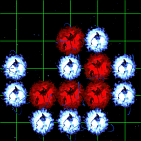

 ). I'll get a screenshot here soon, but it's not much to look at. I find the most interesting part to be the mental visualisation of the board, which still doesn't go all too well for me, seeing as just converting to 3D and then imagining that doesn't quite do the trick.
 . At school a couple of years earlier I made a little cardboard 3x3x3 tic-tac-toe board, in three dimensions. It was a trivial game. 4x4x4 would have been much better, but I didn't think of it. The 4x4x4x4 game is easily played in two dimensions — we chalked up a 4x4 lattice of 4x4 squares on the wall.