Hi everybody,
I'm 39, and have been about 1k KGS since 2007. However, I gained fresh hope of being able to improve recently, and so this is what I'm doing.
Frequent Things
Tsumego - challenging but not too difficult
It is like reading music or Japanese - the more you challenge yourself, the easier it becomes ("effortful study", keeping it in the "cognitive domain", etc.)
Study/Play Handicap Go - if I could turn the clock back, I would immerse myself in it!
Handicap go teaches you so much about strategy it's unbelievable. Honte, light play, connection, surrounding, breaking free, timing, shape, haengma, direction, attitude, it's all there, in black and white (!), because the handicap makes each player's task easy to understand
Study High-Level Games - little and often
To gain ideas, to learn about shape and flow
Play - always try my best, always seek challenging games (i.e., stronger opponents, or giving handicap to weaker players), reviewing objectively and with the help of stronger players wherever possible
Again, to keep myself in the cognitive domain, to encounter new situations and to learn how to handle them, to seek the opportunity to make mistakes and learn from them
Compass - this is my very own idea
To enact changes in thinking and procedure, to get rid of bad habits, to remind myself of important information
Occasional Things
Maintain a database of useful techniques and information, such as joseki and L&D patterns
This is portable and makes review easy
Mine online writings for ideas
If you read carefully, there are many interesting ideas and insights to be found
Study Habits
These are extremely important. I think the biggest causes of failure are trying too hard, and, conversely, failing to focus on the task in hand.
Do One Thing at A Time - You have to pay attention to what you are doing NOW, if you want to remember it and learn, and do it to your full ability. You cannot study tsumego while listening to music or watching TV (though listening to music, first, might put you in the right mood). You lose games when you start thinking about other things.
Short Bursts - Working memory can only deal with so much at any one time, and this often decreases as you get older. You get tired much more quickly if you continue trying after your WM becomes full, and this can result in neurotransmitter depletion.
Frequent Breaks - Breaks enable new ideas in the WM to begin to transfer to the long-term memory, and they enable the processes of Relational Memory to begin to work. They also replenish neurotransmitters, and keep you in best condition.
Spaced Review - This is known to strengthen recall greatly
Stay Out Of The Comfort Zone! - You get better at the guitar by learning new chords, scales and playing techniques. You learn a language by learning new vocabulary and grammar, and by taking on its unique difficulties of expression and register. I got much better at singing after joining a top choir in which I was one of the worst members. Why, then, would anybody think they could get better at go just by playing games at the same level for 20 years or more?
Expect It to Take Time - I studied Japanese intensively for a year, got off the plane and found I didn't understand a word of it. I kept trying, and after my second year here, I started to get the hang of it. You may be able to acquire a lot of information, but you have to allow time for the brain to make sense of it all. If you focus on your rank graph, and not your go itself, you'll only slow yourself down.
Avoid All-Or-Nothing Thinking - I don't have to play go only or play music only or study languages only. In fact, they support each other. When I get frustrated with songwriting or guitar practice, playing go gives me a welcome change. When I get frustrated with go, studying Japanese becomes fun and rewarding. When I get frustrated with studying Japanese, my guitar is waiting for me, and out comes a new song
Help Others - It gives you great perspective when you stop looking at yourself, and try to help other people. It's also much more fun, in general, to forget about your own feelings and to concentrate on other people and other subjects (do you know the saying "Pleasure to be got, has to be forgot?") Even if you couldn't get any better, wouldn't it be cool to play a part in helping another player to grow? Who, in the last analysis, makes the bigger contribution to any field - the King or Queen sitting alone at the top of the mountain, or the guide who helps others to climb it?
OUTCOMES SO FAR
19 August 2011
It's difficult to know whether KGS 1k is the same now as it was in 2007 or in 2009. I am confident, though, that Tami 2011 would defeat Tami 2007. Besides, I don't care what my rank is, anyway. What I do know is that I can take on stronger players (taking the appropriate handicaps) and win! Actually, I find it much harder to give handicap, but I think I'll learn from that challenge, too (up to now, I haved loved thick moves, but now I have to learn about light play) I get more pleasure out of the game, and when I lose, I no longer get angry, I get stronger. If I don't become stronger from this point, it won't be because I cannot, but because I let myself get distracted. But I will never stop believing in the possibility of becoming stronger, because I will never give up on myself!
It occurred to me that solving tsumego has changed my tactical thinking in a fundamental way. Up until now, I always thought of it in terms of finding the key move and reading out the forced moves until the situation became clear. Now, I have a better appreciation of what different suji actually do under different circumstances. To summarise, if you need to maximise your own liberties, then hane, kosumi, descent, and nobi will be your friends; if you need to reduce the partner's liberties, then hane, throw-in, slapping moves, butting moves, and sacrifices will be among your most useful tools. If it's about making eyes, kakatsugi will help, if it's about stealing eyes, placements, angle points and 2-1 points often become attractive. It's not so much pattern-matching, as learning to identify the situation and knowing what tools are normally appropriate for that particular job.
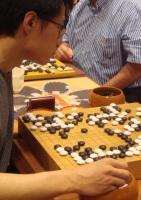
Also, the Nihon Kiin has a branch in Kure! And it's rather a nice place. There's a big crowd of players, free tea, a drinks dispenser, and a TV showing satellite coverage of go tournaments. Smokers use a sealed room at the back when it's time for a tobacco break. It's good to feel real stones and wood again, and to see my opponent. It's a good chance to get to know older Japanese people. The internet is proving wonderful for go fans, but playing in any kind of club gives you a sense of human connection and warmth that's missing from go servers.
I'm 39, and have been about 1k KGS since 2007. However, I gained fresh hope of being able to improve recently, and so this is what I'm doing.
Frequent Things
Tsumego - challenging but not too difficult
It is like reading music or Japanese - the more you challenge yourself, the easier it becomes ("effortful study", keeping it in the "cognitive domain", etc.)
Study/Play Handicap Go - if I could turn the clock back, I would immerse myself in it!
Handicap go teaches you so much about strategy it's unbelievable. Honte, light play, connection, surrounding, breaking free, timing, shape, haengma, direction, attitude, it's all there, in black and white (!), because the handicap makes each player's task easy to understand
Study High-Level Games - little and often
To gain ideas, to learn about shape and flow
Play - always try my best, always seek challenging games (i.e., stronger opponents, or giving handicap to weaker players), reviewing objectively and with the help of stronger players wherever possible
Again, to keep myself in the cognitive domain, to encounter new situations and to learn how to handle them, to seek the opportunity to make mistakes and learn from them
Compass - this is my very own idea
To enact changes in thinking and procedure, to get rid of bad habits, to remind myself of important information
Occasional Things
Maintain a database of useful techniques and information, such as joseki and L&D patterns
This is portable and makes review easy
Mine online writings for ideas
If you read carefully, there are many interesting ideas and insights to be found
Study Habits
These are extremely important. I think the biggest causes of failure are trying too hard, and, conversely, failing to focus on the task in hand.
Do One Thing at A Time - You have to pay attention to what you are doing NOW, if you want to remember it and learn, and do it to your full ability. You cannot study tsumego while listening to music or watching TV (though listening to music, first, might put you in the right mood). You lose games when you start thinking about other things.
Short Bursts - Working memory can only deal with so much at any one time, and this often decreases as you get older. You get tired much more quickly if you continue trying after your WM becomes full, and this can result in neurotransmitter depletion.
Frequent Breaks - Breaks enable new ideas in the WM to begin to transfer to the long-term memory, and they enable the processes of Relational Memory to begin to work. They also replenish neurotransmitters, and keep you in best condition.
Spaced Review - This is known to strengthen recall greatly
Stay Out Of The Comfort Zone! - You get better at the guitar by learning new chords, scales and playing techniques. You learn a language by learning new vocabulary and grammar, and by taking on its unique difficulties of expression and register. I got much better at singing after joining a top choir in which I was one of the worst members. Why, then, would anybody think they could get better at go just by playing games at the same level for 20 years or more?
Expect It to Take Time - I studied Japanese intensively for a year, got off the plane and found I didn't understand a word of it. I kept trying, and after my second year here, I started to get the hang of it. You may be able to acquire a lot of information, but you have to allow time for the brain to make sense of it all. If you focus on your rank graph, and not your go itself, you'll only slow yourself down.
Avoid All-Or-Nothing Thinking - I don't have to play go only or play music only or study languages only. In fact, they support each other. When I get frustrated with songwriting or guitar practice, playing go gives me a welcome change. When I get frustrated with go, studying Japanese becomes fun and rewarding. When I get frustrated with studying Japanese, my guitar is waiting for me, and out comes a new song
Help Others - It gives you great perspective when you stop looking at yourself, and try to help other people. It's also much more fun, in general, to forget about your own feelings and to concentrate on other people and other subjects (do you know the saying "Pleasure to be got, has to be forgot?") Even if you couldn't get any better, wouldn't it be cool to play a part in helping another player to grow? Who, in the last analysis, makes the bigger contribution to any field - the King or Queen sitting alone at the top of the mountain, or the guide who helps others to climb it?
OUTCOMES SO FAR
19 August 2011
It's difficult to know whether KGS 1k is the same now as it was in 2007 or in 2009. I am confident, though, that Tami 2011 would defeat Tami 2007. Besides, I don't care what my rank is, anyway. What I do know is that I can take on stronger players (taking the appropriate handicaps) and win! Actually, I find it much harder to give handicap, but I think I'll learn from that challenge, too (up to now, I haved loved thick moves, but now I have to learn about light play) I get more pleasure out of the game, and when I lose, I no longer get angry, I get stronger. If I don't become stronger from this point, it won't be because I cannot, but because I let myself get distracted. But I will never stop believing in the possibility of becoming stronger, because I will never give up on myself!
It occurred to me that solving tsumego has changed my tactical thinking in a fundamental way. Up until now, I always thought of it in terms of finding the key move and reading out the forced moves until the situation became clear. Now, I have a better appreciation of what different suji actually do under different circumstances. To summarise, if you need to maximise your own liberties, then hane, kosumi, descent, and nobi will be your friends; if you need to reduce the partner's liberties, then hane, throw-in, slapping moves, butting moves, and sacrifices will be among your most useful tools. If it's about making eyes, kakatsugi will help, if it's about stealing eyes, placements, angle points and 2-1 points often become attractive. It's not so much pattern-matching, as learning to identify the situation and knowing what tools are normally appropriate for that particular job.
Also, the Nihon Kiin has a branch in Kure! And it's rather a nice place. There's a big crowd of players, free tea, a drinks dispenser, and a TV showing satellite coverage of go tournaments. Smokers use a sealed room at the back when it's time for a tobacco break. It's good to feel real stones and wood again, and to see my opponent. It's a good chance to get to know older Japanese people. The internet is proving wonderful for go fans, but playing in any kind of club gives you a sense of human connection and warmth that's missing from go servers.
 But that's because I'm rethinking my whole approach to the game from top to bottom. It isn't exactly fun, but it is to be expected.