daal wrote:I don't know how to render it, but a spherical trihexagoal board would be pretty cool.

But I think I wouldn’t want to play this … no corners, no edges, this ain’t something for me lowly DDK

daal wrote:I don't know how to render it, but a spherical trihexagoal board would be pretty cool.
This is interesting; I wonder if there's an advantage in one or the other visualization. It does seem that Medusa has some additional rule variations that make it something different than "go on a different topology", which is what I was interested in


Mark Berger, who's real name is Richard Kramberger, got the idea to play Go on the triple contacts of a hexgrid, like this:emeraldemon wrote:This is interesting; I wonder if there's an advantage in one or the other visualization. It does seem that Medusa has some additional rule variations that make it something different than "go on a different topology", which is what I was interested in
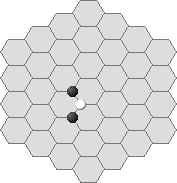
Mark called the game "Rosette" and published it in Games & Puzzles Magazine (issue 34)."His first idea was to simply apply the rules of Go and see how it worked out. As it turned out, regular concepts like 'ko' and 'seki' remained intact, but there was a big difference if a group was in 'atari', that is: if it had just one liberty left, like the white stone.
In Go a point has four liberties and extending from a group in atari may increase the number of its liberties by 2. In Rosette an extension increases that number at most by 1, and this one is consequently taken to keep the group in atari.
The attacker has the choice of direction and may lead the head of the 'escaping' group towards the edge or even around towards its own tail, to die.
Of course things were balanced by the fact that both players suffer or enjoy this to the same extent, but Mark concluded rightly that it gave rise to too much tactical involvement to leave much room for any long term strategy. So he invented a safety mechanism up and above the implicit safety mechanism of having two 'eyes', and called it a rosette.
A rosette is formed by six stones of one color, occupying a small hexagon. A group containing a rosette lives unconditionally."


You could have revealed that fact six posts back when you said "I don't want to spoil the fun, but this idea has been implemented long ago in Medusa," implying that Medusa was the first. Your claim of anteriority isn't just pointless in this circumstance. It's misleading and grossly misguided.christian freeling wrote: Mark Berger, who's real name is Richard Kramberger, got the idea to play Go on the triple contacts of a hexgrid,
That is the problem Mark Berger encountered:emeraldemon wrote:I intentionally chose a grid with 4 edges per vertex, to keep the tactics somewhat analogous. However, check out this "ladder":
And since the trihex tesselation has the same problem, as you rightly pointed out, it is also the reason Medusa and Lotus have the same additional safety mechanism."... In Rosette an extension increases that number at most by 1, and this one is consequently taken to keep the group in atari.
The attacker has the choice of direction and may lead the head of the 'escaping' group towards the edge or even around towards its own tail, to die.
...
So he invented a safety mechanism up and above the implicit safety mechanism of having two 'eyes', and called it a rosette.
A rosette is formed by six stones of one color, occupying a small hexagon. A group containing a rosette lives unconditionally."
I implied nothing. The Rosette is Mark Berger's idea and I've always acknowledged that. "Thanx Mark, wherever you are" it says in the introduction of Medusa. As for claiming anteriority regarding the trihex tesselation, I don't. Quite possibly the idea emerged somewhere before 1980, I'd be happy to acknowledge that too, if someone has some record of it.MarkSteere wrote:You could have revealed that fact six posts back when you said "I don't want to spoil the fun, but this idea has been implemented long ago in Medusa," implying that Medusa was the first.