what is "power go"?

General conversations about Go belong here.
Bill Spight
Honinbo
Posts: 10905
Joined: Wed Apr 21, 2010 1:24 pm
Has thanked: 3651 times
Been thanked: 3373 times

Re: what is "power go"?

Post by Bill Spight »

The closest Japanese term is 力碁 (chikara go), which means not being restricted by joseki, seeking fights, and relying upon reading.

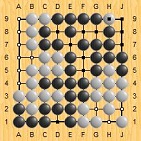
When I think of chikara go, this game comes to mind. Both players play chikara go. :)

The Adkins Principle:
At some point, doesn't thinking have to go on?
— Winona Adkins

Visualize whirled peas.

Everything with love. Stay safe.
SmoothOper
Lives in sente
Posts: 946
Joined: Thu Apr 19, 2012 9:38 am
Rank: IGS 5kyu
GD Posts: 0
KGS: KoDream
IGS: SmoothOper
Has thanked: 1 time
Been thanked: 41 times

Re: what is "power go"?

Post by SmoothOper »

Bill Spight wrote:The closest Japanese term is 力碁 (chikara go), which means not being restricted by joseki, seeking fights, and relying upon reading.


Thanks for the clarification. It seems people are confusing the concepts of style with that of strength or natural ability.
Bill Spight
Honinbo
Posts: 10905
Joined: Wed Apr 21, 2010 1:24 pm
Has thanked: 3651 times
Been thanked: 3373 times

Re: what is "power go"?

Post by Bill Spight »

jts wrote:
Bill Spight wrote:I do not understand why power go would have a negative connotation. :rambo:

Well, I think it depends on your perspective on what it is. If power go = "strongest at the middle game", then how could it have a negative connotation? But if power go = "intentionally creates confusing situations in the hopes of eliciting a dumb mistake," then who would want to play against such a style?


Actually, those are my favorite opponents. All I have to do is wait for the overplay. :mrgreen:
The Adkins Principle:
At some point, doesn't thinking have to go on?
— Winona Adkins

Visualize whirled peas.

Everything with love. Stay safe.
User avatar
shapenaji
Lives in sente
Posts: 1103
Joined: Tue Apr 20, 2010 10:58 pm
Rank: EGF 4d
GD Posts: 952
Location: Netherlands
Has thanked: 407 times
Been thanked: 422 times

Re: what is "power go"?

Post by shapenaji »

Bill Spight wrote:
jts wrote:
Bill Spight wrote:I do not understand why power go would have a negative connotation. :rambo:

Well, I think it depends on your perspective on what it is. If power go = "strongest at the middle game", then how could it have a negative connotation? But if power go = "intentionally creates confusing situations in the hopes of eliciting a dumb mistake," then who would want to play against such a style?


Actually, those are my favorite opponents. All I have to do is wait for the overplay. :mrgreen:


That was the dutch representative's response to seeing the above player play... what happens when the overplay never comes?

He was watching the Butcher smash one of my teammates, and as my teammate resigned, made a number of comments about how he could have won.

The Butcher merely directed him to the seat in front of him. Everything looked like overplay, and then none of it was... Running that razors edge.
Tactics yes, Tact no...
Mef
Lives in sente
Posts: 852
Joined: Fri Apr 23, 2010 8:34 am
Rank: KGS [-]
GD Posts: 428
Location: Central Coast
Has thanked: 201 times
Been thanked: 333 times

Re: what is "power go"?

Post by Mef »

shapenaji wrote:
jts wrote:
Bill Spight wrote:I do not understand why power go would have a negative connotation. :rambo:

Well, I think it depends on your perspective on what it is. If power go = "strongest at the middle game", then how could it have a negative connotation? But if power go = "intentionally creates confusing situations in the hopes of eliciting a dumb mistake," then who would want to play against such a style?


If we're dueling and I have very good balance, Forcing you onto a narrow raised platform is just controlling the ground. Controlling the ground and proper balance and footwork is part of the fight.


I don't know much about sword fighting, but the description of this style reminds me of some people I used to play tennis against. They wouldn't have proper form on their strokes, and they would stand in the wrong areas of the court....but they would always chase down the ball and return it no matter how you hit it. It would be incredibly frustrating to play against, because you see many of the things you have tried to train out of your own play on display in front of you, yet you have so much difficulty countering it. In the end it's so easy to try too hard to finish them off, but you're just as likely to miss as you are to put them away...
User avatar
shapenaji
Lives in sente
Posts: 1103
Joined: Tue Apr 20, 2010 10:58 pm
Rank: EGF 4d
GD Posts: 952
Location: Netherlands
Has thanked: 407 times
Been thanked: 422 times

Re: what is "power go"?

Post by shapenaji »

Mef wrote:

I don't know much about sword fighting, but the description of this style reminds me of some people I used to play tennis against. They wouldn't have proper form on their strokes, and they would stand in the wrong areas of the court....but they would always chase down the ball and return it no matter how you hit it. It would be incredibly frustrating to play against, because you see many of the things you have tried to train out of your own play on display in front of you, yet you have so much difficulty countering it. In the end it's so easy to try too hard to finish them off, but you're just as likely to miss as you are to put them away...


I used to play tennis too, Every weekend for 2 years I had a lesson with my trainer, practicing form,

"Pushers" is what they'd call them, as I recall. They win by virtue of just being able to endure.

Frustrating as hell to play, but you have to appreciate their sheer will. .
Tactics yes, Tact no...
Zombie
Dies with sente
Posts: 71
Joined: Mon Jul 25, 2011 11:53 am
GD Posts: 0
Has thanked: 71 times
Been thanked: 27 times

Re: what is "power go"?

Post by Zombie »

Apart from people who can play flawless basic or highly technical styles, I have enormous respect for people who play incredibly greedy and manage to make it work. Just something very exhilarating about managing to make something that shouldn't work work. A prime example from the Go world being the guy from the recent-ish Battousai lecture who opened Tengen all the time and was 7 dan on Tygem. I was grinning the whole lecture and the four space extension had me in fits.

It was mystifying to see people deride it as something you should not do. It may not be "proper play" but it is clearly strong, hard to counter (but still counterable and leads to an actual game) and fun as hell to play (for the guy who does tengen anyway). Why the hell would you not play that way? I mean, obviously you'd have to have a working knowledge of a "proper" game so you don't crumble after your stuff gets exposed, but it takes a professional to do that in the first place.

There's something similar in the Starcraft community, where people basically worship the idea of a long macro (=economy focused) game and have a marked dislike for "cheese" (all-in play that wins or loses on the spot, especially when done very early in the game) or very technical pushes which are generally regarded as gimmicks. Yet they work on a professional level, test different skills than the macro game and serve to keep the opponent honest over the course of the long set. You're just as much going to run into trouble when you meet foes with impeccable defense, but that doesn't mean they should not be played.

From what I've seen Go players seem even more averse to these kinds of things than players of Starcraft or some other games. Is it just the idea of there being one "proper" move and the opponent playing anything but his best guess as to what it is being insulting, even if he plays better in a very greedy or hyperaggressive style?
SmoothOper
Lives in sente
Posts: 946
Joined: Thu Apr 19, 2012 9:38 am
Rank: IGS 5kyu
GD Posts: 0
KGS: KoDream
IGS: SmoothOper
Has thanked: 1 time
Been thanked: 41 times

Re: what is "power go"?

Post by SmoothOper »

It seems the only player listed as a "power go" player in sensei's library list of professional styles is "Wimmer, Manfred: Grinding power go", though other players seem to be listed as "powerful"

http://senseis.xmp.net/?ProfessionalPlayersGoStyles

In the context of "Grinding power go.", I think it would mean something else perhaps a very thick mechanistic style. Evidently he invented a Joseki, so that is pretty cool.
Bill Spight
Honinbo
Posts: 10905
Joined: Wed Apr 21, 2010 1:24 pm
Has thanked: 3651 times
Been thanked: 3373 times

Re: what is "power go"?

Post by Bill Spight »

shapenaji wrote:
Bill Spight wrote:
jts wrote:Well, I think it depends on your perspective on what it is. . . . If power go = "intentionally creates confusing situations in the hopes of eliciting a dumb mistake," then who would want to play against such a style?


Actually, those are my favorite opponents. All I have to do is wait for the overplay. :mrgreen:


That was the dutch representative's response to seeing the above player play... what happens when the overplay never comes?


If a player plays hoping to elicit a dumb mistake, but never makes an overplay, then they are better than I am. ;)
The Adkins Principle:
At some point, doesn't thinking have to go on?
— Winona Adkins

Visualize whirled peas.

Everything with love. Stay safe.
SmoothOper
Lives in sente
Posts: 946
Joined: Thu Apr 19, 2012 9:38 am
Rank: IGS 5kyu
GD Posts: 0
KGS: KoDream
IGS: SmoothOper
Has thanked: 1 time
Been thanked: 41 times

Re: what is "power go"?

Post by SmoothOper »

Ah yes, not it is coming to me. Power Go = Large Scale Joseki :ugeek:
Suji
Lives in gote
Posts: 302
Joined: Wed May 19, 2010 2:25 pm
Rank: DDK
GD Posts: 0
KGS: Sujisan 12 kyu
OGS: Sujisan 13 kyu
Has thanked: 70 times
Been thanked: 8 times

Re: what is "power go"?

Post by Suji »

shapenaji wrote:That was the dutch representative's response to seeing the above player play... what happens when the overplay never comes?

He was watching the Butcher smash one of my teammates, and as my teammate resigned, made a number of comments about how he could have won.

The Butcher merely directed him to the seat in front of him. Everything looked like overplay, and then none of it was... Running that razors edge.


Reminds me a bit of Tal. These type of players are very, very dangerous to play against. Of course, I would relish the complexity of the game, and really not be sad if I lost.
My plan to become an SDK is here.
User avatar
Loons
Gosei
Posts: 1378
Joined: Tue Apr 20, 2010 4:17 am
GD Posts: 0
Location: wHam!lton, Aotearoa
Has thanked: 253 times
Been thanked: 105 times

Re: what is "power go"?

Post by Loons »

I admire tough play when it's being backed up by reading and good judgement.

However, I would never admire a player who eg unfavourably takes territory in exchange for too much thickness and then immediately plays too close to thickness, but sometimes wins anyway because other 2ds are also bad.

Also, in battousai's lecture that player plays conventionally badly against a random pro and gets annihilated beyond belief for it with no really interesting moves being played, even though he could often "make it work" against other amateurs to the tune of being c. 7d tygem.
Revisiting Go - Study Journal
My Programming Blog - About the evolution of my go bot.
RobertJasiek
Judan
Posts: 6273
Joined: Tue Apr 27, 2010 8:54 pm
GD Posts: 0
Been thanked: 797 times
Contact:

Re: what is "power go"?

Post by RobertJasiek »

SmoothOper wrote:Power Go = Large Scale Joseki


This style I used once, when I was 1d, in an H3 game as Black, where a big nadare joseki filled a quarter of the board. I suggested to repeat such in another corner, but my opponent woke up:(

In even games, usually I would not call using a large scale joseki "power go" just because of its scale.
RobertJasiek
Judan
Posts: 6273
Joined: Tue Apr 27, 2010 8:54 pm
GD Posts: 0
Been thanked: 797 times
Contact:

Re: what is "power go"?

Post by RobertJasiek »

hanekomu wrote:knowing, for example, why bad moves in joseki are in fact bad


Bad "joseki" moves can be detected, for example, by evaluation of the resulting position: consider difference of numbers of played stones, territory and influence and consider those strategic concepts in the positional context with significant impact, then use these values and facts to apply my general evaluation method. The detected value type would be "favourable for a player", here: the opponent of the bad moves.

Alternative 1: Only sometimes tewari or "local positional judgement" (see Joseki 2) can give the answer.

Alternative 2: Make global positonal judgements after the bad moves or after other (hopefully better) moves. Then compare. This, however, often is an overkill because 1) more than one positional judgement is necessary and 2) the differences of territory and influence need to be determined, too. Instead of simply forming their ratio and identifying the value type as in my method, also the whole rest of the board needs to be judged for territory and influence etc.
Post Reply