Page 8 of 27
Re: OCA's log
Posted: Mon Aug 04, 2014 8:25 am
by oca
Here is the first try with comments to nearly move 200
that funny, that take way more time than the actual game... but I think that can help me more to comments things than to play that same kind of game again and gain...
Re: OCA's log
Posted: Mon Aug 04, 2014 8:42 am
by skydyr
I got a general sense from the two handicap games that you might be afraid of white. As has been mentioned, there were numerous points when black could successfully cut, or otherwise harass white but chose to make an unnecessary protective move that cost momentum, or let white get strong where he was weak. Of course, there were also times when a protective move you played was necessary and proper.
I recommend, since a 9 stone game should be seen as a teaching game and not a real one, that you look at an area and read as deep as you can. If you see something, and it's more urgent to protect that than it is to continue the attack (sometimes a protection in itself) go ahead. If you don't see something, however, it is vital that you trust your reading and not protect. It's entirely possible that your reading is wrong, but you still need to trust it, or you will be wasting moves all over the place and lose. White may be able to read more, but can't make anything appear on the board that isn't there. If a corner is safe, for example, it's safe, and no amount of messing around by white will change that if you respond correctly. If your reading was wrong, or your judgement, your opponent will point it out in play and you will learn. This is why you were playing the game in the first place, after all.
Re: OCA's log
Posted: Mon Aug 04, 2014 9:16 am
by Knotwilg
Thanks, this self review is very helpful.
To me this shows that you are thinking a lot about territory and not about the primary goal of Go, which is to put as many alive stones on the board as possible. Terrritory is just a place where you can put alive stones anytime, so this is "yours". Hence the focus should be first on stabilizing your groups and harassing the opponent's. The primary strategy to achieve that is: connect & cut. Handicap games are a perfect way to exercise that because White is always fleeing into your arms, while your troops are always finding friends.
Surrounding the opponent should be your first thought. There's no need to kill him: if he lives small, you will win easily because you will connect on a large scale and territory will come naturally this way. Of course, unreasonable invasions of territory and grand opportunities should be killed.
Surround first, then kill eyes.
At

there is a perfect opportunity for you to surround, if you let go of your territorial focus. Any idea?
Next handicap game(s), forget about territory:
- connect your troops on a large scale
- cut the opponent on a large scale
- surround the opponent
- kill if necessary
- otherwise, enjoy the formation of spontaneous territory while doing the above
PS: Your analysis of

is wrong. It was a very good move, connecting your troops on a large scale and cutting off White's. If you allow White to capture here, all his troops are connected, which is his prime concern.
Re: OCA's log
Posted: Mon Aug 04, 2014 1:01 pm
by Charles Matthews
oca wrote:.
General comment: Black spends too much time playing very close to White.

I would prefer to play this one line lower, at M4.

If you want to play solidly, R6 would be better. It leaves the corner strong. White doesn't really have time to connect, and later R8 can be useful.

No good, makes no sense.

Just too close.

Extend to H2 rather than this 1-2-3.

Not needed. You can attack at G8.

Attacking from the other side at F8 makes territory, this doesn't.

Attack with F9.
Slow move. E9 seems to get White into big trouble.

Still too close. Play E11.
Re: OCA's log
Posted: Tue Aug 05, 2014 1:57 am
by oca
Knotwilg wrote:
To me this shows that you are thinking a lot about territory and not about the primary goal of Go, which is to put as many alive stones on the board as possible
...
...
Next handicap game(s), forget about territory:
- connect your troops on a large scale
- cut the opponent on a large scale
- surround the opponent
- kill if necessary
- otherwise, enjoy the formation of spontaneous territory while doing the above
...
Hi Knotwilg,
Thank you, in my next game, I will try to focus
first on connection. That's funny because I think this is the way I play on smaller board...
here is an example :
Re: OCA's log
Posted: Tue Aug 05, 2014 2:32 am
by Knotwilg
On a smaller board, connections are vital, while they're obviously small scale. On a large board, connectivity is important in the longer run and on a larger scale. The connectivity must also be purposeful: connecting two groups which are otherwise cut apart and/or surrounded, connecting because this simultaneously cuts/surrounds the opponent's group, etc ...
Re: OCA's log
Posted: Thu Aug 07, 2014 4:30 am
by oca
Here is a new hanicap game.
I played against Omusubi nearly one month ago, he gave me 8 stones and cruched me ! (
http://www.lifein19x19.com/forum/viewto ... 40#p168340)
But this time... well... I lose again

, but with 3 stones so I'm more happy with what I did.
Here is the game with comment to move 246
Any comments welcome !
Re: OCA's log
Posted: Thu Aug 07, 2014 6:37 am
by Knotwilg
You thought about G5 for connection but it looked fragile. Next

splits your forces without resistance.
If you had blocked and white cut, it's a crosscut, which is difficult for both, but more so for white because it is your sphere of influence.
Now White is connected and you are cut and this is no longer your sphere of influence.
To make matters worse,
and

are both played in contact with the strong group you allowed White to establish.
This little sequence violates two main principles of Go
1. strategy: connect & cut on a large scale
2. technique: pay careful attention to liberties
Forcing yourself to always block in such a situation, even when it feels bad, will improve your go. Later you can still decide, based on calculations, in which exceptional cases it is better not to block.
Re: OCA's log
Posted: Thu Aug 07, 2014 7:55 am
by Uberdude
How did you feel after 21? If it's not utterly crushed, destroyed and humiliated then your feeling for basic shapes is not developed enough.
http://senseis.xmp.net/?BasicInstinct#toc23. If such a result makes you want to vomit or gouge out your eyes with a fork, it should happen less in the future
. Just to put it even more simply than Knotwilg to make the point:
If you block and white cuts then black is cut and white is cut.
If you don't block then black is cut but white is connected.
Re: OCA's log
Posted: Thu Aug 07, 2014 8:10 am
by oca
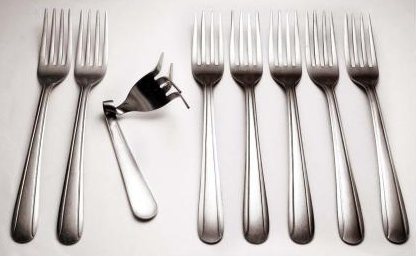
Uberdude wrote:... or gouge out your eyes with a fork...
tr y to gues wh ch one I us ed
- Capture.PNG (158.32 KiB) Viewed 9596 times
sor y fo the werd typin g bu t I als o cutted m e 3 fing ers so It's no t easy to typ e
Re: OCA's log
Posted: Thu Aug 07, 2014 8:17 am
by oca
Next game I will try the "Zero bad shape game"
I will ask myself on every move if that make a bad shape or not and see if I can avoid all of them...
Posted: Thu Aug 07, 2014 9:19 am
by EdLee
oca wrote:Next game I will try the "Zero bad shape game"
I will ask myself on every move if that make a bad shape or not and see if I can avoid all of them...
Good exercise.
Posted: Thu Aug 07, 2014 9:48 am
by EdLee
Hi oca, yes,

:
Example: basic broken shape for Black:
$$
$$ . . . . . . .
$$ . . . O . . .
$$ . . X O X . .
$$ . . . O . . .
$$ . . . O . . .
$$ . . . . . . .
- Click Here To Show Diagram Code
[go]$$

$$ . . . . . . .

$$ . . . O . . .

$$ . . X O X . .

$$ . . . O . . .

$$ . . . O . . .

$$ . . . . . . .[/go]
Post 114's comment is good: when you start to feel physically sick to the stomach about this shape for Black,
your understanding will have improved.
( If you have no feelings about this kind of shape, it's difficult to improve. )
Blocking at G5 is the only move for
-- if this fails, it means you've already
made earlier mistakes.
Re: OCA's log
Posted: Thu Aug 07, 2014 9:55 am
by Bill Spight
$$
$$ . . . . . . .
$$ . . . O . . .
$$ . . X X X . .
$$ . . . O . . .
$$ . . . O . . .
$$ . . . . . . .
- Click Here To Show Diagram Code
[go]$$

$$ . . . . . . .

$$ . . . O . . .

$$ . . X X X . .

$$ . . . O . . .

$$ . . . O . . .

$$ . . . . . . .[/go]
Comparison diagram.

Re:
Posted: Thu Aug 07, 2014 12:56 pm
by oca
EdLee wrote:oca wrote:Next game I will try the "Zero bad shape game"
I will ask myself on every move if that make a bad shape or not and see if I can avoid all of them...
Good exercise.
Here is my try, the game went really fine for me, I think there is no bad shape, but I got cut a few times...