could be the remains of eoman empire, it was possible that the the explorers from the great roman empire went as far as china and discovered the game then as they returned back to europe and recreated the board and stones.
If the age you mentioned (4th century) is accurate, this is likely to be Go. I count that the board has 17 lines. This is in line with the archaeological evidences that China also used 17x17 board around that time. For example, in 1975 archaeologists found a complete set of 289 Go stones from the tomb of a famous general from Jin dynasty. This guy was known to die in 301 AD [1].
macelee wrote:If the age you mentioned (4th century) is accurate, this is likely to be Go. I count that the board has 17 lines. This is in line with the archaeological evidences that China also used 17x17 board around that time. For example, in 1975 archaeologists found a complete set of 289 Go stones from the tomb of a famous general from Jin dynasty. This guy was known to die in 301 AD [1].
RBerenguel wrote:
There's a groove: this board seems designed for in-square playing.
A very plausible argument.
I'd love if it was a go board though pity many roman/norse games had very similar looking boards
It does seem entirely plausible that it could be a tafl board of some variety or another game altogether. The fact that there are black and white pieces and the board is a grid in no way confirms that this is go, unfortunately.
Could be relevant if the "where found" near a place involved with silk trade.
Does anybody know how far west in China go was played at roughly this time period? If played at the Chinese end of "The Silk Road" then people who would be traveling back to the Med could have learned it there.


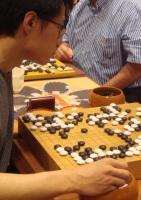

 pity many roman/norse games had very similar looking boards