One of the issues with heuristics for go, which are not so hard to generate, is sorting out those that don't require later unlearning.
This is a key point, but in the case of western go I think the problems are often of our own making.
I see two very common sources of the problem. One is an obsession with lists/flow charts/precision/comprehensiveness. The other is mistranslation.
To take the first first: lists or flow charts can be useful on paper; they are useless in the brain. In the present case the Japanese advice for the whole of the same topic would be boiled down to something like 弱い石から - (start) with weak group(s). This very, very common elliptical style might be called newspaper-headline style, their equivalent of our "Man bites dog." Perhaps the most distinctive feature of this style in Japanese, where articles and plurals are absent to start with, is omission of the verb. The reader is meant to supply it and he can (and will) supply a different verb according to circumstances, or even a range of verbs. This is so ingrained in Japanese that advertisers use the same style to trigger multile subconscious responses.
So, in the present case, the Japanese go player can start off thinking of 'defend' weak groups first, 'attack' them, 'think about' them, 'use' them, 'sacrifice' them. He is actively using his other go knowledge, for example that it is usually best to consider your own groups first. We might say that he is using a mindmap rather than a list, a neural network rather than a flow chart.
If a piece of advice can be encapsulated in this mindmap-friendly way, it doesn't really need to be unlearned. The brain will apply the necessary weightings as experience grows. The important point is that connections are made and then optimised.
It is not a case of the Japanese being cleverer than us at this. It is simply that in go they have been at it longer - heuristic pebbles have been polished smooth. The nuggets of wisdom have also become standardised, so that connections can be shared more easily. There is a wider range of associated material available, so that more connections can be generated. In contrast, in the west we tend to have several different versions of the same proverb, which tends to make the concept unravel. Some people try to put the threads back together by making lists, which actually makes the problem worse. And of course we lack much of the supporting bedrock.
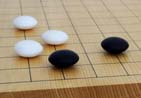
The second issue I mentioned - poor translations - is really just a sub-set of the first. To take another example involving what may be the most important trigger word, から (kara), we have the Japanese proverb サバキはツケから. I have seen various renderings of this in English. A typical one would be: "To make sabaki, attach!" In other words, play an attachment first. This is not exactly wrong, perhaps, but it is certainly inadequate. It leads western players robotically to play an attachment whenever they see the need to settle a weak group (and that tendency is exacerbated by a constant diet of blitz games where knee-jerk moves are prized). The Japanese player would instead be 'thinking about' an attachment first, 'probing' first, or a host of other things based on his experience. The end result on the board may often be the same, but the extra dimensions given by the mindmapping approach seem likley to result in a few stones extra strength over time.
Another aspect of translation is one I alluded to in another thread recently. 'Position' in 'positional judgement' doesn't really tell us much. The Japanese equivalent 形勢 comes pre-loaded with a host of useful connections going back even as the Art of War.
What we do to remedy our situation I'm not sure, since time is a big part of the answer. But I do think an early part of the answer is to stop making lists, and to stop pointing out that proverbs are contradictory and instead embrace their contrariness by setting up associations. Go is a game of co-existence in more than one sense.
 ).
).
 ) the point is that all these rules are to help/try adding some extra "full board thinking" before moving.