Hashimoto's Tsumego Saijiki 詰碁歳時記

Don't know what book to read next? Have a killer reading list for improving joseki knowledge? This is this place.
Post Reply
xela
Lives in gote
Posts: 652
Joined: Sun Feb 09, 2014 4:46 am
Rank: Australian 3 dan
GD Posts: 200
Location: Adelaide, South Australia
Has thanked: 219 times
Been thanked: 281 times

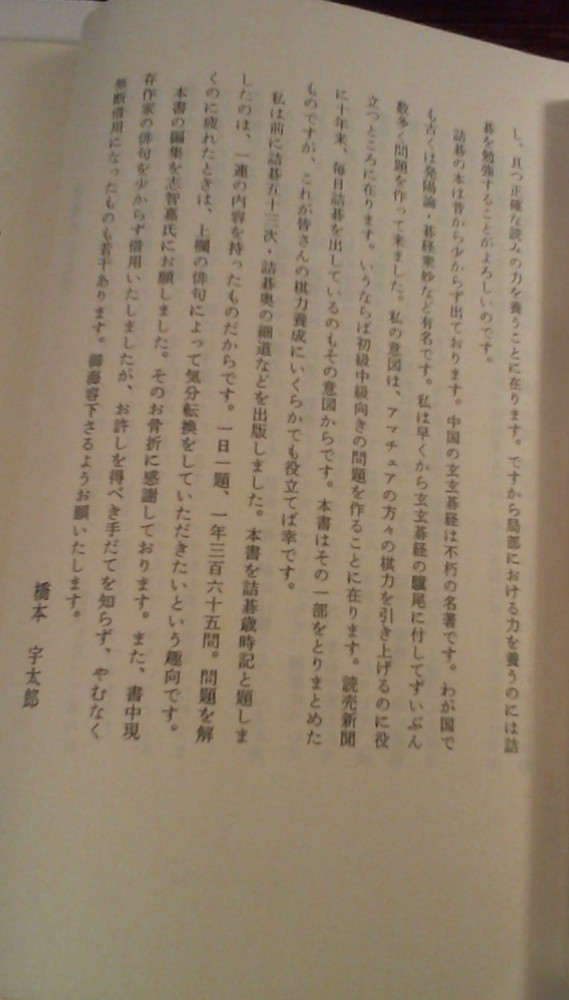
Hashimoto's Tsumego Saijiki 詰碁歳時記

Post by xela »

I discovered this at last year's US Go Congress. (Yes, I could have posted earlier! I got home, unpacked, and got distracted...) One morning I took a bus trip out of town to Portland's "other" bookshop, not the big famous one in the city centre, but a quirky second-hand place called Chaparral Books. As far as I could tell, they only had one go book, but it's a good one.
Hashimoto's Tsumego Saijiki, front cover
cover.jpg (190.51 KiB) Viewed 7428 times
It's a collection of 365 problems by Hashimoto Utaro, one for each day of the year beginning 1st January (I remember barely enough Japanese to read the date next to each problem). The difficulty level varies apparently at random: I'd say about half of them are low dan level, some are accessible to SDK players, some are way to hard for me, and they don't appear to be in any particular order. So it's a bit like Xuanxuan Qijing -- except that the difficult problems tend to be more the "obvious once you see it but hard to find" type, rather than very long variations.

If I'm interpreting Google translate correctly:
  • The title means something like "daily tsumego" or "seasonal tsumego". The word "saijiki" is hard to translate into a single English word: see https://en.wikipedia.org/wiki/Saijiki
  • The text at the top of each problem is a haiku and short commentary. As far as I can tell, the poems don't have a strong connection with the problems. Hashimoto just thinks it's nice to read poetry while you solve tsumego (or fail to solve them but just enjoy admiring them).
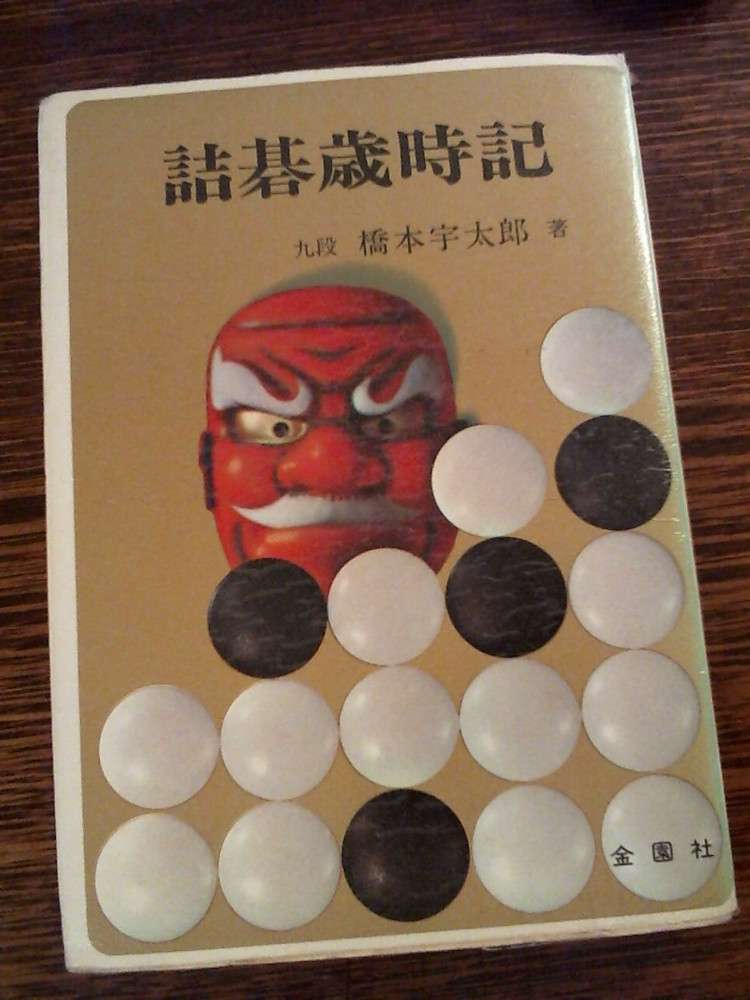
Here's the introduction for people who actually can read Japanese.
Hashimoto's Tsumego Saijiki, introduction, page 1 of 2
intro1.jpg (134.17 KiB) Viewed 7428 times
Hashimoto's Tsumego Saijiki, introduction, page 2 of 2
intro2.jpg (109.26 KiB) Viewed 7428 times
xela
Lives in gote
Posts: 652
Joined: Sun Feb 09, 2014 4:46 am
Rank: Australian 3 dan
GD Posts: 200
Location: Adelaide, South Australia
Has thanked: 219 times
Been thanked: 281 times

Re: Hashimoto's Tsumego Saijiki 詰碁歳時記

Post by xela »

And the first six problems for your entertainment. (No, I won't upload the whole book: I think it's still under copyright. This small extract is fair dealing for the purposes of review and study.)
Hashimoto's Tsumego Saijiki, problems 1 and 2
prob1+2.jpg (151.71 KiB) Viewed 7427 times
Hashimoto's Tsumego Saijiki, problems 3 and 4
prob3+4.jpg (139.34 KiB) Viewed 7427 times
Hashimoto's Tsumego Saijiki, problems 5 and 6
prob5+6.jpg (147.4 KiB) Viewed 7427 times
And here's Google's attempt at translating the text on the first page. I've noted before that Google isn't good at this sort of thing, so I'll stop here.
Ming Spring (January 1st)

The eagle is white, the island is black, the dawn of spring

Oemaru Taishomaru is a famous haiku poet from Osaka, but I don't think this poem is particularly well written. However, with the words "white," "thoughts," and "crows," it is impossible to overlook this poem as a book on go, regardless of whether the author wrote it with go in mind.

Now, regarding this White eye shape, if Black plays 2, White will play 14 6, and it will be both eyes. How can I play to get him to sleep?

First Bird (January 2)

Song Qingqing

In front of the teachings of the dream world, the first sparrow

The Kannon Bodhisattva that resides in Horyuji Temple is generally called the Savior Kannon. It is said that his face is filled with an ancient smile. What kind of smile is an ancient smile? The town of New Year is playing in front of this blessed Buddha. It looks very dangerous, but it is alive thanks to the merits of the Kannon Bodhisattva.

However, if you play 4-18 in a normal way, you will be hit with 2-16, and it will not be an unconditional survival move. Please consider sacrificing stones.

Ming Spring (text at top right of diagram, indicating problem 1)

first sparrow (text at bottom left of diagram)
Post Reply