I was reading a book on sabaki, which mentions that 'a' below is considered crude, and 1 is a better move (I've modified the diagram slightly from the book). I saw this sort of thing in a shape book before, too. The basic idea is a leaning attack turned trade, but I can't find anything that really examines this exact move/idea beyond calling it good (the shape book was especially frustrating in this regard).
I'm all gung ho to try this in a game (if I can remember in the heat of the moment), and I'm wondering if this has a name (in this case it's a 3-4 mid-high pincer joseki, but the pattern can happen on the sides of the board, too), and if there's any gotchas or variations to understand. As no doubt my opponents will not play calmly in response (1 looks too thin to be good at first glance).
A certain sabaki technique
-
RBerenguel
- Gosei
- Posts: 1585
- Joined: Fri Nov 18, 2011 11:44 am
- Rank: KGS 5k
- GD Posts: 0
- KGS: RBerenguel
- Tygem: rberenguel
- Wbaduk: JohnKeats
- Kaya handle: RBerenguel
- Online playing schedule: KGS on Saturday I use to be online, but I can be if needed from 20-23 GMT+1
- Location: Barcelona, Spain (GMT+1)
- Has thanked: 576 times
- Been thanked: 298 times
- Contact:
Re: A certain sabaki technique
I'm wondering, what do you think your rival would play in response to 1?
Geek of all trades, master of none: the motto for my blog mostlymaths.net
-
jts
- Oza
- Posts: 2672
- Joined: Sat Sep 18, 2010 4:17 pm
- Rank: kgs 6k
- GD Posts: 0
- Has thanked: 310 times
- Been thanked: 637 times
Re: A certain sabaki technique
Are you talking about the driving tesuji?
This way there's no driving tesuji, but it doesn't look great for B either:
Apologies if I've missed the point of your question.
This way there's no driving tesuji, but it doesn't look great for B either:
Apologies if I've missed the point of your question.
-
Bill Spight
- Honinbo
- Posts: 10905
- Joined: Wed Apr 21, 2010 1:24 pm
- Has thanked: 3651 times
- Been thanked: 3374 times
Re: A certain sabaki technique
I don't think thatNumsgil wrote:I was reading a book on sabaki, which mentions that 'a' below is considered crude, and 1 is a better move (I've modified the diagram slightly from the book). I saw this sort of thing in a shape book before, too. The basic idea is a leaning attack turned trade, but I can't find anything that really examines this exact move/idea beyond calling it good (the shape book was especially frustrating in this regard).
I'm all gung ho to try this in a game (if I can remember in the heat of the moment), and I'm wondering if this has a name (in this case it's a 3-4 mid-high pincer joseki, but the pattern can happen on the sides of the board, too), and if there's any gotchas or variations to understand. As no doubt my opponents will not play calmly in response (1 looks too thin to be good at first glance).
 has a special name, except, of course, for jump attachment. But White "a" has a name: Atari atari!.
The Adkins Principle:
At some point, doesn't thinking have to go on?
— Winona Adkins
Visualize whirled peas.
Everything with love. Stay safe.
At some point, doesn't thinking have to go on?
— Winona Adkins
Visualize whirled peas.
Everything with love. Stay safe.
-
Numsgil
- Lives in gote
- Posts: 614
- Joined: Wed Apr 21, 2010 10:07 am
- Rank: 1 Kyu KGS
- GD Posts: 0
- KGS: Numsgil
- Has thanked: 28 times
- Been thanked: 65 times
Re: A certain sabaki technique
@RBerenguel
The aggressive low SDK troll demon that lives in my head would try some of these (I don't think they really work, but it's a good starting point for conversation).
Or this, which I think isn't as easily dismissed as the others. As white I'd feel uncomfortable trying to decide how to respond (do I slide into the corner for base? Do I try to rescue the lone stone black didn't capture?)
@jts:
No, the driving tesuji is something different (though I think it's part of why 1 is a good move, as it sets up some driving tesuji aji for white).
Specifically, I have the demo chapter for "Vital Points and Skillful Finesse for Sabaki" from the "Go Books" app on iPhone. Chapter 1 talks about this. It says the atari 'a' in my original diagram is crude and 1 "is a fundamental skillful finesse for sabaki". Which I'm sure is true, as I've seen something similar in the "Making good shape" book. But in both cases it's just presented as good and not really explored.
The aggressive low SDK troll demon that lives in my head would try some of these (I don't think they really work, but it's a good starting point for conversation).
Or this, which I think isn't as easily dismissed as the others. As white I'd feel uncomfortable trying to decide how to respond (do I slide into the corner for base? Do I try to rescue the lone stone black didn't capture?)
@jts:
No, the driving tesuji is something different (though I think it's part of why 1 is a good move, as it sets up some driving tesuji aji for white).
Specifically, I have the demo chapter for "Vital Points and Skillful Finesse for Sabaki" from the "Go Books" app on iPhone. Chapter 1 talks about this. It says the atari 'a' in my original diagram is crude and 1 "is a fundamental skillful finesse for sabaki". Which I'm sure is true, as I've seen something similar in the "Making good shape" book. But in both cases it's just presented as good and not really explored.
-
Numsgil
- Lives in gote
- Posts: 614
- Joined: Wed Apr 21, 2010 10:07 am
- Rank: 1 Kyu KGS
- GD Posts: 0
- KGS: Numsgil
- Has thanked: 28 times
- Been thanked: 65 times
Re: A certain sabaki technique
It's one thing to know something is wrong. It's another to find the better moveBill Spight wrote:I don't think that
-
Loons
- Gosei
- Posts: 1378
- Joined: Tue Apr 20, 2010 4:17 am
- GD Posts: 0
- Location: wHam!lton, Aotearoa
- Has thanked: 253 times
- Been thanked: 105 times
Re: A certain sabaki technique
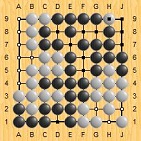
I'm just taking the Q10 stone off the board to answer specifically about the regular two space high pincer joseki, to make it clear why we don't play your 'a' *here* (who knows, it might generalise).
In this diagram, black 'x' looks crazy painful for white, right? But white at 'x' would push from behind/kill off the marked stone. Because of this move 'x' here, white does not have any time to use the marked stone.
If black still plays 2 (fine), white 3, it does look impractical for black to play 'b' now, right? So your given sequence gets played. But can't black still try something different with 4? - Yes. He can play 4 at 5, as noted; but it is not bad for white. Can't black also play a different 2 after this 1? Yes, but still ok for white.
...Hmm. Hope I helped.
Answer to your actual question:
IIRC jts is right and this is lumped in as driving tesuji by some people, including jts, myself, and James Davies, I think. (Even if proper play is for black to then prevent the drive happening).
Edit:
In this diagram, black 'x' looks crazy painful for white, right? But white at 'x' would push from behind/kill off the marked stone. Because of this move 'x' here, white does not have any time to use the marked stone.
If black still plays 2 (fine), white 3, it does look impractical for black to play 'b' now, right? So your given sequence gets played. But can't black still try something different with 4? - Yes. He can play 4 at 5, as noted; but it is not bad for white. Can't black also play a different 2 after this 1? Yes, but still ok for white.
...Hmm. Hope I helped.
Answer to your actual question:
IIRC jts is right and this is lumped in as driving tesuji by some people, including jts, myself, and James Davies, I think. (Even if proper play is for black to then prevent the drive happening).
Edit:
-Yes. This can degenerate into a family of super-perilous avalanche joseki.Heavily paraphrased Numsgil wrote:It looks like there could be really hard variations
-
tchan001
- Gosei
- Posts: 1582
- Joined: Wed Apr 21, 2010 6:44 pm
- GD Posts: 1292
- Location: Hong Kong
- Has thanked: 54 times
- Been thanked: 534 times
- Contact:
Re: A certain sabaki technique
I really don't think it's a matter of the driving tesuji.
The reason the second is better than the first is that it seems to allow establishing a base for the group while maintaining the option to run out to the center. Whereas the first seems to be a choice between the two options.
The reason the second is better than the first is that it seems to allow establishing a base for the group while maintaining the option to run out to the center. Whereas the first seems to be a choice between the two options.
http://tchan001.wordpress.com
A blog on Asian go books, go sightings, and interesting tidbits
Go is such a beautiful game.
A blog on Asian go books, go sightings, and interesting tidbits
Go is such a beautiful game.
-
Loons
- Gosei
- Posts: 1378
- Joined: Tue Apr 20, 2010 4:17 am
- GD Posts: 0
- Location: wHam!lton, Aotearoa
- Has thanked: 253 times
- Been thanked: 105 times
Re: A certain sabaki technique
Tapping Driving Tesuji into Sensei's gives our move as an illustration (I have never edited that sensei's page or even looked at it before), so if we wanted to name the move, it seems like at least some people will say driving tesuji, though clearly this is just a matter of semantics.
Edit:
Idly clicking around on sensei's yields "Flying Off Orthogonally" as a name for that attachment, in a page that seems specifically about your book's treatment of it.
Edit:
Idly clicking around on sensei's yields "Flying Off Orthogonally" as a name for that attachment, in a page that seems specifically about your book's treatment of it.
-
Bill Spight
- Honinbo
- Posts: 10905
- Joined: Wed Apr 21, 2010 1:24 pm
- Has thanked: 3651 times
- Been thanked: 3374 times
Re: A certain sabaki technique
I do not know about "flying off orthogonally"Loons wrote:Tapping Driving Tesuji into Sensei's gives our move as an illustration (I have never edited that sensei's page or even looked at it before), so if we wanted to name the move, it seems like at least some people will say driving tesuji, though clearly this is just a matter of semantics.
Edit:
Idly clicking around on sensei's yields "Flying Off Orthogonally" as a name for that attachment, in a page that seems specifically about your book's treatment of it.
, but the Driving Tesuji page on Sensei's is right about this joseki. Note that the jump attachment is not called a driving tesuji, but the follow-up in this variation. -
-  is the driving tesuji.
 The Adkins Principle:
At some point, doesn't thinking have to go on?
— Winona Adkins
Visualize whirled peas.
Everything with love. Stay safe.
At some point, doesn't thinking have to go on?
— Winona Adkins
Visualize whirled peas.
Everything with love. Stay safe.
-
Loons
- Gosei
- Posts: 1378
- Joined: Tue Apr 20, 2010 4:17 am
- GD Posts: 0
- Location: wHam!lton, Aotearoa
- Has thanked: 253 times
- Been thanked: 105 times
Re: A certain sabaki technique
Well, at least my explanation as to why 'a' is bad in that joseki there was textbook (Ishida's, Takao's will give you the same), you can trust that, if not my semantics 
Is there a rule of thumb for what name to ultimately give a tesuji?
Perhaps best is
(Jump-) Attachment tesuji -- The jump-attachment is a tesuji here
Sensei's calls it
Double-threat-tesuji -- It's a tesuji because it threatens two-ish followups
Jts & I's
Driving-tesuji -- It's a tesuji because it threatens driving tesuji (as well as the double-threat of its jump-attachment's followup ....) albeit driving-tesuji-proper will not be played.
Is there a rule of thumb for what name to ultimately give a tesuji?
Perhaps best is
(Jump-) Attachment tesuji -- The jump-attachment is a tesuji here
Sensei's calls it
Double-threat-tesuji -- It's a tesuji because it threatens two-ish followups
Jts & I's
Driving-tesuji -- It's a tesuji because it threatens driving tesuji (as well as the double-threat of its jump-attachment's followup ....) albeit driving-tesuji-proper will not be played.
-
EdLee
- Honinbo
- Posts: 8859
- Joined: Sat Apr 24, 2010 6:49 pm
- GD Posts: 312
- Location: Santa Barbara, CA
- Has thanked: 349 times
- Been thanked: 2070 times
 (a) atari to
  atari in the above Malkovich 104,
 there.)
-
Uberdude
- Judan
- Posts: 6727
- Joined: Thu Nov 24, 2011 11:35 am
- Rank: UK 4 dan
- GD Posts: 0
- KGS: Uberdude 4d
- OGS: Uberdude 7d
- Location: Cambridge, UK
- Has thanked: 436 times
- Been thanked: 3720 times
Re: A certain sabaki technique
I thinkNumsgil wrote:
Or this, which I think isn't as easily dismissed as the others. As white I'd feel uncomfortable trying to decide how to respond (do I slide into the corner for base? Do I try to rescue the lone stone black didn't capture?)
 is a strong move for black, especially given the support at q10. To play honte at a seems to me like a classic example of the dangers of "following joseki" without thinking about the actual position on the board. Even without q10 in place this descent is a powerful move, thought it does have a tinge of overplay: it will result in violent fighting. If white answers by blocking at c that's a nice exchange for black (though I have seen it in pro games) The idea of blocking is white still has miai of saving the cutting stone, or pincering the 2 stones on the right; that's why q10 in place makes a huge difference as that miai disappears. Fighting spirit calls for white to save the cutting stone: b is a tesuji for doing so in good shape. But then black will probably get to push at c in sente at some point which is pleasing. Here's a game of mine where I tried the descent (without q10 already) due to an unfinished joseki in an adjacent corner. http://www.online-go.com/games/board.php?boardID=178771
P.S. as for what that technique is called, I've not heard a particular name but it does crop up a lot. It is an example of miai: the crude atari gives black an obvious good answer and then white is without a good move, the attachment creates 2 good moves for white, only 1 of which black can deal with.
-
gogameguru
- Lives in gote
- Posts: 477
- Joined: Sun Jan 09, 2011 9:18 pm
- Rank: 5d
- GD Posts: 0
- Has thanked: 192 times
- Been thanked: 357 times
- Contact:
Re: A certain sabaki technique
The stone you added at z makes the whole position unusual (and also makes me wonder why on earth the push and cut was played...) so I've removed it to hopefully provide some more useful general advice.
First to answer your questions:
As for the name, I don't have one either. Lots of moves I just think of as 'tesuji building', haengma or 'making shape'. Is it important enough to have its own name (apart from jumping attachment)? It's a useful technique, but it's derivative of the driving tesuji.
I'll briefly go through the moves you were considering. This is just what I think...
An interesting comment on this variation:
I'm pretty sure older joseki books say that 1 here is bad for black because of this driving tesuji. I seem to remember learning that at some point.
However, I was flicking through a newer book at Younggil's Go club and it said that this is now considered slightly better for black. Since Younggil was there, I asked him about it. He said that some pros think black is better now, but he doesn't agree... I guess that's Go for you.
From a shape perspective, black is bad because white drove straight through again, damaging the two stones. However, Younggil pointed out that if you view those stones as a sacrifice, both players have given up two stones, so it's fairly even from that perspective.
Personally, I think it's a lot more important to just know enough technique to manage your shape properly when black tries different things. It's often hard to say whether black or white are better and, as you can see, even pros don't agree on this one.
I'm a bit embarrassed to say that when I was a weaker player (maybe around 5k) I used to believe too much stuff that books told me and then I'd get kind of self-righteous when the other player did something that was 'bad'. I'd feel like I had this big advantage and I'd usually overplay or play slackly later. Thinking like this actually makes you weaker, in my opinion. It's a bit like a recent thread I saw here about something to do with the 3-3 invasion and people were getting upset.
My advice to others is don't worry about stuff like that. Just aim to manage the position without giving too much away and if you're satisfied, then that's the most important thing. You can think about it more when you review your game. There's lots of stuff in Go books that's dogmatic and some which is just wrong. The books are still very useful for helping you get stronger (even the dogmatic books helped me a lot), but keep an open mind.
First to answer your questions:
I'll briefly go through the moves you were considering. This is just what I think...
An interesting comment on this variation:
I'm pretty sure older joseki books say that 1 here is bad for black because of this driving tesuji. I seem to remember learning that at some point.
However, I was flicking through a newer book at Younggil's Go club and it said that this is now considered slightly better for black. Since Younggil was there, I asked him about it. He said that some pros think black is better now, but he doesn't agree... I guess that's Go for you
.From a shape perspective, black is bad because white drove straight through again, damaging the two stones. However, Younggil pointed out that if you view those stones as a sacrifice, both players have given up two stones, so it's fairly even from that perspective.
Personally, I think it's a lot more important to just know enough technique to manage your shape properly when black tries different things. It's often hard to say whether black or white are better and, as you can see, even pros don't agree on this one.
I'm a bit embarrassed to say that when I was a weaker player (maybe around 5k) I used to believe too much stuff that books told me and then I'd get kind of self-righteous when the other player did something that was 'bad'. I'd feel like I had this big advantage and I'd usually overplay or play slackly later. Thinking like this actually makes you weaker, in my opinion. It's a bit like a recent thread I saw here about something to do with the 3-3 invasion and people were getting upset.
My advice to others is don't worry about stuff like that. Just aim to manage the position without giving too much away and if you're satisfied, then that's the most important thing. You can think about it more when you review your game. There's lots of stuff in Go books that's dogmatic and some which is just wrong. The books are still very useful for helping you get stronger (even the dogmatic books helped me a lot), but keep an open mind.
Last edited by gogameguru on Mon Dec 05, 2011 12:26 am, edited 1 time in total.