Let's study a game... I've got a copy of a commented sgf that was adapted from Ohira Shuzo's book Appreciating Famous Games (translated by John Fairbairn)
I don't know the author of the abridged commentary. A record on gobase.org has the initials UC for the comments, but none of the variations.
The sgf record I have has many, if not most of the variations from the book, but none of the mentioned markup. Since it differed from the book slightly from time to time, I did my best to guess at the markup referred to in UC's comments.
The commentator says his comments and variations were adapted from commentaries by both Ohira Shuzo and Go Seigen. I only have Ohira's book (in English) as my original source, and am unfamiliar with Go Seigen's commentary on the game. (I don't yet see that he participated with Ohira on his book, though I haven't read it all yet, so I may have missed a notation).
Dosaku's Masterpiece was a 2 stone Castle game played between a member of the Yasui house, Shunchi and the head of the Honinbo house, Dosaku. It was played on the Japanese date of Tenna 3-XI-19 which most people read as Nov 19th 1683. But it should actually be read as Jan 5th 1684.
Naturally, GoGod has it listed as 1684-01-05, as does the Japanese site Momoyama. But most English language sources that I could find use the November date, including Ohira's Appreciating Famous Games that John Fairbairn translated.
And even worse, Googling for "Dosaku's Masterpiece" will find many YouTube and other sources (such as Baduk Legends) with also the wrong name of Dosaku's opponent -- likely both a misspelling and confusion of Yasui Shunchi with the then head of the Yasui house, Yasui Sanchi.
Dosaku's Masterpiece
2 stones: Yasui Shunchi
White: Honinbo Dosaku
Date: 5th Jan 1684
277 moves.
Black wins by 1 point.
Commentary adapted from commentaries by Ohira Shuzo and Go Seigen.
This is the first game I played in my new board Since I don't remember most of it, all comments and moves will feel anew.
I feel that white is developing very quickly all around the board. My gut feeling is that the space between 3 and 5 has to be exploited, but of course Dosaku is a masterful fighter and can get away with that... Probably.
For me feels oddly out of place. Works neater with 10 in place, but... Doesn't need to be answered? Isn't the hane-tiger mouth shape in that area just too strong (btw, why there are no coordinates in the board?
Geek of all trades, master of none: the motto for my blog mostlymaths.net
RBerenguel wrote: My gut feeling is that the space between 3 and 5 has to be exploited, but of course Dosaku is a masterful fighter and can get away with that... Probably.
Ohira says that Black 4 could have pincered @ k3, but then White would probably play 5 at c6.
Otherwise, I think the timing is off for Black to play in there now. It would be to White's advantage for Black to start a bunch of separate fights.
This pincer now works well with Black's formation at the bottom. However, the joseki following this move were not known in the 17th century.
I feel like this is a good case for actively using C7: I find I often make the mistake of just playing C6ish passively because white approached, instead of actively planning around it.
RBerenguel wrote:
Doesn't need to be answered? Isn't the hane-tiger mouth shape in that area just too strong
My 2 cents: B is outnumbered 3-1. Now is not a good time to start a fight there.
My idea is that if W plays there another time, he already invested 4 stones into the bottom right at this early point, which is 3 more than B. Taking into account that B started with 2 handicap, B would have 4-5 stones more on the rest of the board. Besides there would be still aji in and/or sabaki possibilities with attaching to
I'm always playing when I shouldn't.
And my opponents always seem to be able to successfully cut me at a right away (often instead of 5, or maybe later, I can't remember).
But when the tables are turned and I'm playing white and try to cut, I still never can get it quite right and again find myself on the losing end of the deal.
Maybe its the presence of the marked stone (in the game) that makes the difference here. Without that stone, what should white do when black plays ? Cut right away, or wait for a later opportunity to take advantage of the weakness?
 The ogeima used to be the standard response to the kogeima kakari against hoshi. (a few too many Japanese terms for my taste
  )
) is in the wrong direction
 is an old style move. These days the extension to a is preferred.
 feels oddly out of place. Works neater with 10 in place, but... Doesn't
  need to be answered? Isn't the hane-tiger mouth shape in that area just too strong (btw, why there are no coordinates in the board?

 . What do you mean this joseki was unknown in the 17th century?
  Sure, they tenukied a lot, but that is not the same thing.
 @ k3, but then White would probably play 5 at c6.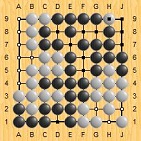
 is a suspect move
 if White hanes at a, pulling back at b is sufficient.
  This result is bad for Black. White can expose his weak points with a or b.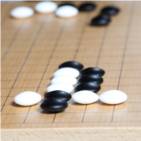
 and/or sabaki possibilities with attaching to
 is effectively sente
 is too small-scale and low
 here, aiming at a follow-up at "a", and achieving better balance with "T"
 is an aggressive move
 )
)
 at (a),
  at (b)) This exchange clearly favors White
 is slightly dubious
 Black gets a large moyo.