Bill Spight wrote:I do not profess the doctrine of immaculate transfer. That is obviously a pejorative term.

F = ma
may be taken as a definition of force.
So what? (For those unfamiliar with physics, that says that force equal mass times acceleration.)
First of all, it's a bit unfair to physicists to imply that force laws and conservation laws are similar to economic accounting identities. I think understanding that F is simply the name we give to m*a is important, and too little understood; but physicists have developed a number of formulas, like Gm_1m_2/r^2, -kx, mF_n, kq_1q_2/r^2, etc., that flesh out what m*a we predict in a given situation.
But anyway, even if we were all still Cartesians in physics, you can't rescue your style of economic argument this way.
Bill Spight wrote:MV = PQ.
Assuming that increasing everybody's bitcoin (M) proportionally does not affect the velocity of bitcoin (V),
That's the big assumption. Huge assumption. If people are inclined to hoard their money rather than to spend it, by definition the velocity of money immediately drops. If the Fed decided to double the money supply but keep half of it locked up in their vaults, they would have, by definition, cut the velocity of money in two. Purely as an artifact of the accounting identity. If they decide to double the money supply but skittish bankers, or CEOs, or households, decide to keep the cash locked up in
their vaults, ditto.
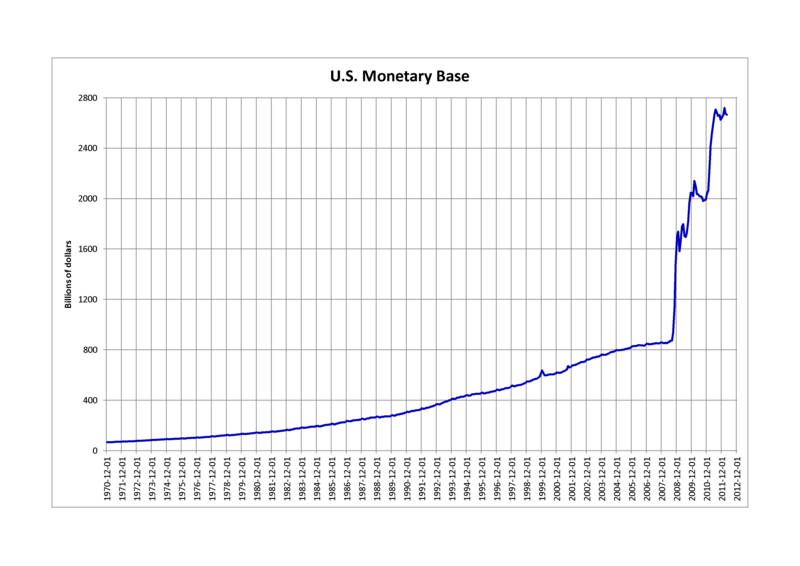
By the way, the Fed was printing a huge amount of money in a pretty severe recession a few years ago. Here's what happened to V in the real world (in green):
nor the production of real goods and services (Q),
Also a big assumption. The reason we want constant, low-level inflation, after all, is the connection between unused workers/capital goods and a shortage of money. So if people don't just hoard their newly printed money, we expect Q to rise until the economy is at full employment.
then prices denominated in bitcoins (P) will increase at the same proportion.
Voila. You have transferred something from one end of an accounting identity to another, while protecting the chastity of all the other variables.