Bitcoin adoption

All non-Go discussions should go here.
User avatar
jts
Oza
Posts: 2664
Joined: Sat Sep 18, 2010 4:17 pm
Rank: kgs 6k
GD Posts: 0
Has thanked: 310 times
Been thanked: 634 times

Re: Bitcoin adoption

Post by jts »

Bill Spight wrote:Look. You are a merchant who accepts bitcoins and you know that, come Tuesday, everybody's bitcoin holdings will increase by 1%. You know this, perhaps, because you hold a few bitcoins yourself. In any event, it is your business to know it. Do you keep your prices in bitcoins the same, or do you raise them by 1%?


I might do either! You can't just speculate about these things. It depends on whether people are going to try to buy more goods as a result, or not. If consumer confidence is high, then if everyone gets an extra 1% of their holdings, then I will expect them to spend most of it, so if I can increase my stock easily I'll raise prices a little, and if not I'll absorb the whole extra demand by hiking my prices. On the other hand, if I think everyone is worried about losing their jobs and is going to save the money for a rainy day - and as a result I'm already dealing with an inventory overhang, then all that's going to happen if I raise my prices is my rivals will get all of the business.

Bill Spight wrote:Also, the "doctrine of immaculate transfer" argument does not cut it with me. In a collision of billiard balls, both momentum (mv) and energy (mv^2) are conserved. (A conservation law is an identity.) Without going into details, typically the kinetic energy in the motion of the balls after the collision is less than before the collision. What happens to it? On earth typically most of it is dissipated in sound waves, which is why we hear the click of the balls. On the moon, with no atmosphere to carry sound waves, my guess is that the balls would heat up. Even on earth, when billiard balls were made of celluloid, sometimes they would explode. ;)

Now, it is true that the conservation of energy identity does not tell us exactly what will happen with the extra energy. But what would you think of a physicist who claimed that it did not express a causal relationship?

This is a great example. I could, by assuming that two billiard balls have the same mass and velocity before and after their collision (albeit in opposite directions), prove to you that in my thought-experiment the collision is silent. However, that would be a very poor guide to what actually happens when the balls collide. If we want to use the accounting identity to make a causal prediction, we actually need a causal theory about how we get the energy from one side of the equation to the other side of the equation (at minimum, a theory of whether billiard ball collisions are elastic or inelastic).
User avatar
jts
Oza
Posts: 2664
Joined: Sat Sep 18, 2010 4:17 pm
Rank: kgs 6k
GD Posts: 0
Has thanked: 310 times
Been thanked: 634 times

Re: Bitcoin adoption

Post by jts »

Bill Spight wrote:Look. You are a merchant who accepts bitcoins and you know that, come Tuesday, everybody's bitcoin holdings will increase by 1%. You know this, perhaps, because you hold a few bitcoins yourself. In any event, it is your business to know it. Do you keep your prices in bitcoins the same, or do you raise them by 1%?


I might do either! You can't just speculate about these things. It depends on whether people are going to try to buy more goods as a result, or not. If consumer confidence is high, then if everyone gets an extra 1% of their holdings, then I will expect them to spend most of it, so if I can increase my stock easily I'll raise prices a little, and if not I'll absorb the whole extra demand by hiking my prices. On the other hand, if I think everyone is worried about losing their jobs and is going to save the money for a rainy day - and as a result I'm already dealing with an inventory overhang, then all that's going to happen if I raise my prices is my rivals will get all of the business.

In a real economy, it's the process of actually selling things (money changing hands), and realizing that they can't easily expand their stock fast enough to keep up with rising demand, that induces firms to raise prices.

Bill Spight wrote:Also, the "doctrine of immaculate transfer" argument does not cut it with me. In a collision of billiard balls, both momentum (mv) and energy (mv^2) are conserved. (A conservation law is an identity.) Without going into details, typically the kinetic energy in the motion of the balls after the collision is less than before the collision. What happens to it? On earth typically most of it is dissipated in sound waves, which is why we hear the click of the balls. On the moon, with no atmosphere to carry sound waves, my guess is that the balls would heat up. Even on earth, when billiard balls were made of celluloid, sometimes they would explode. ;)

Now, it is true that the conservation of energy identity does not tell us exactly what will happen with the extra energy. But what would you think of a physicist who claimed that it did not express a causal relationship?

This is a great example. I could, by assuming that two billiard balls have the same mass and velocity before and after their collision (albeit in opposite directions), prove to you that in my thought-experiment the collision is silent. However, that would be a very poor guide to what actually happens when the balls collide. If we want to use the accounting identity to make a causal prediction, we actually need a causal theory about how we get the energy from one side of the equation to the other side of the equation (at minimum, a theory of whether billiard ball collisions are elastic or inelastic).
Bill Spight
Honinbo
Posts: 10905
Joined: Wed Apr 21, 2010 1:24 pm
Has thanked: 3651 times
Been thanked: 3373 times

Re: Bitcoin adoption

Post by Bill Spight »

jts wrote:In a real economy, it's the process of actually selling things (money changing hands), and realizing that they can't easily expand their stock fast enough to keep up with rising demand, that induces firms to raise prices.


Contracts matter, as well. But if everybody knows the rate and schedule for increasing bitcoins for everybody, those changes should be reflected in the contracts.

Bill Spight wrote:Also, the "doctrine of immaculate transfer" argument does not cut it with me. In a collision of billiard balls, both momentum (mv) and energy (mv^2) are conserved. (A conservation law is an identity.) Without going into details, typically the kinetic energy in the motion of the balls after the collision is less than before the collision. What happens to it? On earth typically most of it is dissipated in sound waves, which is why we hear the click of the balls. On the moon, with no atmosphere to carry sound waves, my guess is that the balls would heat up. Even on earth, when billiard balls were made of celluloid, sometimes they would explode. ;)

Now, it is true that the conservation of energy identity does not tell us exactly what will happen with the extra energy. But what would you think of a physicist who claimed that it did not express a causal relationship?

This is a great example. I could, by assuming that two billiard balls have the same mass and velocity before and after their collision (albeit in opposite directions), prove to you that in my thought-experiment the collision is silent. However, that would be a very poor guide to what actually happens when the balls collide. If we want to use the accounting identity to make a causal prediction, we actually need a causal theory about how we get the energy from one side of the equation to the other side of the equation (at minimum, a theory of whether billiard ball collisions are elastic or inelastic).


Predictability is not the same as causality. Consider the butterfly effect. :)
The Adkins Principle:
At some point, doesn't thinking have to go on?
— Winona Adkins

Visualize whirled peas.

Everything with love. Stay safe.
User avatar
jts
Oza
Posts: 2664
Joined: Sat Sep 18, 2010 4:17 pm
Rank: kgs 6k
GD Posts: 0
Has thanked: 310 times
Been thanked: 634 times

Re: Bitcoin adoption

Post by jts »

Bill Spight wrote:Contracts matter, as well. But if everybody knows the rate and schedule for increasing bitcoins for everybody, those changes should be reflected in the contracts.


This would be true as true can be, so long as you crossed out "increasing bitcoins" and substituted "increasing prices". Once inflation has been high and predictable for a number of years, people begin to expect a certain rate and build it into their contracts (the main cause of accelerating inflation). But inflation doesn't proceed either directly with the size of the monetary base, or even with the size of the money supply (there's V and Q to consider, remember), so merely knowing the size of the supply of bitcoins (or of dollars, or of gold discs) doesn't necessarily tell people what inflation expectations to build into their contracts.

(Now, if you had a central bank that said "7% inflation for the next five years!" and backed itself up with appropriate actions, people might take that seriously.)

Predictability is not the same as causality. Consider the butterfly effect. :)


When you can refine the definition of the velocity of money to account for butterflies, I will let you profess the doctrine of immaculate transfer. :)
Bill Spight
Honinbo
Posts: 10905
Joined: Wed Apr 21, 2010 1:24 pm
Has thanked: 3651 times
Been thanked: 3373 times

Re: Bitcoin adoption

Post by Bill Spight »

jts wrote:
Bill Spight wrote:Predictability is not the same as causality. Consider the butterfly effect. :)


When you can refine the definition of the velocity of money to account for butterflies, I will let you profess the doctrine of immaculate transfer. :)


I do not profess the doctrine of immaculate transfer. That is obviously a pejorative term. ;)

F = ma

may be taken as a definition of force. ;) So what? (For those unfamiliar with physics, that says that force equal mass times acceleration.)
The Adkins Principle:
At some point, doesn't thinking have to go on?
— Winona Adkins

Visualize whirled peas.

Everything with love. Stay safe.
User avatar
jts
Oza
Posts: 2664
Joined: Sat Sep 18, 2010 4:17 pm
Rank: kgs 6k
GD Posts: 0
Has thanked: 310 times
Been thanked: 634 times

Re: Bitcoin adoption

Post by jts »

Bill Spight wrote:I do not profess the doctrine of immaculate transfer. That is obviously a pejorative term. ;)

F = ma

may be taken as a definition of force. ;) So what? (For those unfamiliar with physics, that says that force equal mass times acceleration.)
First of all, it's a bit unfair to physicists to imply that force laws and conservation laws are similar to economic accounting identities. I think understanding that F is simply the name we give to m*a is important, and too little understood; but physicists have developed a number of formulas, like Gm_1m_2/r^2, -kx, mF_n, kq_1q_2/r^2, etc., that flesh out what m*a we predict in a given situation.

But anyway, even if we were all still Cartesians in physics, you can't rescue your style of economic argument this way.
Bill Spight wrote:MV = PQ.

Assuming that increasing everybody's bitcoin (M) proportionally does not affect the velocity of bitcoin (V),

That's the big assumption. Huge assumption. If people are inclined to hoard their money rather than to spend it, by definition the velocity of money immediately drops. If the Fed decided to double the money supply but keep half of it locked up in their vaults, they would have, by definition, cut the velocity of money in two. Purely as an artifact of the accounting identity. If they decide to double the money supply but skittish bankers, or CEOs, or households, decide to keep the cash locked up in their vaults, ditto.

By the way, the Fed was printing a huge amount of money in a pretty severe recession a few years ago. Here's what happened to V in the real world (in green):
Image

nor the production of real goods and services (Q),

Also a big assumption. The reason we want constant, low-level inflation, after all, is the connection between unused workers/capital goods and a shortage of money. So if people don't just hoard their newly printed money, we expect Q to rise until the economy is at full employment.
then prices denominated in bitcoins (P) will increase at the same proportion.
Voila. You have transferred something from one end of an accounting identity to another, while protecting the chastity of all the other variables. ;-)

Mike Novack
Lives in sente
Posts: 1045
Joined: Mon Aug 09, 2010 9:36 am
GD Posts: 0
Been thanked: 182 times

Re: Bitcoin adoption

Post by Mike Novack »

jts wrote:[....... Now, they don't print the money and bring it in big duffel bags onto the trading floor, but whenever anyone wants to draw on the money they have "deposited" with the Federal Reserve, the Fed is ready to greet them with warm, crisp sheets of money.

The second resort, when the Fed keeps printing money and no one is spending or investing it, is to have the national government spend more. ("Fiscal policy." ........


You are fixated on those physical pieces of paper. I hate to break it to you but the total amount of these in existence is far less than the amount of "money" in circulation.

Are you paid in greenbacks? Do you pay your bills using greenbacks? Yes, this does still exist to a small extent but for most of use transactions involving physical pieces of paper make up only a small fraction.

They don't simply "print money". First of all, no physical pieces of paper involved but secondly, they are issuing as much debt (bonds) as money. Under normal circumstances. Trust me, runaway inflation will indicate when they are simply "printing money".
badukJr
Lives with ko
Posts: 289
Joined: Sat Jan 07, 2012 1:00 pm
Rank: 100
GD Posts: 100
Has thanked: 7 times
Been thanked: 42 times

Re: Bitcoin adoption

Post by badukJr »

Mike Novack wrote:
jts wrote:[....... Now, they don't print the money and bring it in big duffel bags onto the trading floor, but whenever anyone wants to draw on the money they have "deposited" with the Federal Reserve, the Fed is ready to greet them with warm, crisp sheets of money.

The second resort, when the Fed keeps printing money and no one is spending or investing it, is to have the national government spend more. ("Fiscal policy." ........


You are fixated on those physical pieces of paper. I hate to break it to you but the total amount of these in existence is far less than the amount of "money" in circulation.

Are you paid in greenbacks? Do you pay your bills using greenbacks? Yes, this does still exist to a small extent but for most of use transactions involving physical pieces of paper make up only a small fraction.

They don't simply "print money". First of all, no physical pieces of paper involved but secondly, they are issuing as much debt (bonds) as money. Under normal circumstances. Trust me, runaway inflation will indicate when they are simply "printing money".


I think you're being overly literal in the interpretation of the comment, but printing the actual money does really matter. If I go to withdraw it, but there is no paper money to back it up because enough hasn't been printed, it is a terrible situation.
User avatar
jts
Oza
Posts: 2664
Joined: Sat Sep 18, 2010 4:17 pm
Rank: kgs 6k
GD Posts: 0
Has thanked: 310 times
Been thanked: 634 times

Re: Bitcoin adoption

Post by jts »

Mike Novack wrote:
jts wrote:[....... Now, they don't print the money and bring it in big duffel bags onto the trading floor, but whenever anyone wants to draw on the money they have "deposited" with the Federal Reserve, the Fed is ready to greet them with warm, crisp sheets of money.
The second resort, when the Fed keeps printing money and no one is spending or investing it, is to have the national government spend more. ("Fiscal policy." ........

You are fixated on those physical pieces of paper. I hate to break it to you but the total amount of these in existence is far less than the amount of "money" in circulation.

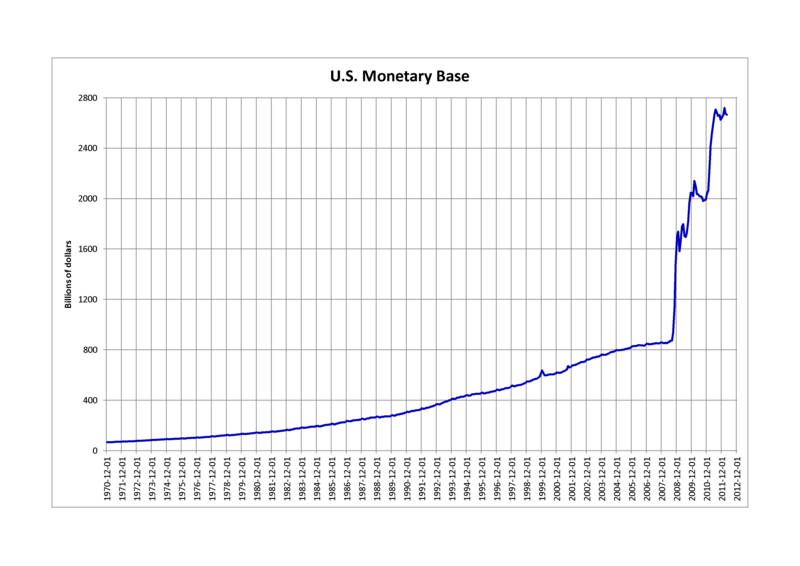
You've tried to bring up the distinction between physical paper and money several times. If you re-read what I've written, you'll see that I think this is a very important distinction too. You may not realize that "monetary base" and "the money supply" refer to this distinction. However, when the Fed buys bonds, they do not pay for them by fiddling with the fractional reserve banking system; they pay for them by printing money.
They don't simply "print money". First of all, no physical pieces of paper involved but

I assure you, they do. Even when they're not trying to alter the money supply, the Fed is always printing a huge amount of monetary base. When banks want to increase the size of their deposits with the Federal Reserve, actual trucks filled with money drive to the Fed; much of that money is shredded because it's getting old, and when the banks need to draw down their deposits, trucks roll out with freshly printed bills. When the banks have suddenly acquired vast amounts of new money from selling bonds to the Fed, their deposits with the Fed are correspondingly large and (unless monetary policy is wholly ineffective and the banks hoard the money, never taking it out of the Fed) the volume of trucks rolling out stuffed with freshly printed currency increases accordingly.

The normal way of thinking about it is that the monetary base serves as a base on which various people can make promises to others about payment, such that a broader measure of the money supply like M2 is a multiple of the monetary base. You seem to believe that the Fed affects the money supply primarily by fiddling with the multiplier, but I assure you they are adding to the base.
secondly, they are issuing as much debt (bonds) as money. Under normal circumstances.

Under normal circumstances, indeed! First, so far as I know, the modern Fed does not issue its own debt. I believe the NY Fed handles the sale of new bonds when the US Treasury issues debt; is this what you're referring to? Regardless, there are periods when the Fed is buying bonds, periods when it's selling, and periods when it has a neutral position. All of this is determined by how much monetary base they think they need to add to reach their inflation/unemployment targets.
Trust me, runaway inflation will indicate when they are simply "printing money".
People who share your understanding of the monetary system, but are keeping closer track of what the Fed is doing, have been predicting runaway inflation since 2008. A chart:
Image
User avatar
daniel_the_smith
Gosei
Posts: 2116
Joined: Wed Apr 21, 2010 8:51 am
Rank: 2d AGA
GD Posts: 1193
KGS: lavalamp
Tygem: imapenguin
IGS: lavalamp
OGS: daniel_the_smith
Location: Silicon Valley
Has thanked: 152 times
Been thanked: 330 times
Contact:

Re: Bitcoin adoption

Post by daniel_the_smith »

This has certainly been an educational thread!

I really wish economics was a harder science (I.e., more like physics). It's just too difficult to do real experiments. IMO, if you can't do what Bill wants to with an identity, then it's not a very good identity... :) I'm sure there are good reasons it is the way it is, but it seems weird from the outside.

Anyway, from my perspective, it seems likely that those who want to return to the gold standard (or solely use bitcoin) probably are not correctly predicting the outcome of their desired course of action. But it also seems like there is room in the economy for a limited asset like bitcoin, and there'd be room for something like bitcoin that wasn't limited, too.
That which can be destroyed by the truth should be.
--
My (sadly neglected, but not forgotten) project: http://dailyjoseki.com
User avatar
jts
Oza
Posts: 2664
Joined: Sat Sep 18, 2010 4:17 pm
Rank: kgs 6k
GD Posts: 0
Has thanked: 310 times
Been thanked: 634 times

Re: Bitcoin adoption

Post by jts »

daniel_the_smith wrote:I really wish economics was a harder science (I.e., more like physics). It's just too difficult to do real experiments. IMO, if you can't do what Bill wants to with an identity, then it's not a very good identity... :) I'm sure there are good reasons it is the way it is, but it seems weird from the outside.


It's a thought-provoking topic. In a way, we can't be too hard on social scientists. The phenomena that physicists, chemists, and biologists study have been with us since before civilization, but those sciences didn't achieve the sort of progress that makes us say "I wish X was rigorous, like physics" for 57 centuries. Meanwhile, if a political scientist is studying "political parties" or an economist is studying "monetary policy", they're studying something that has only been in existence for a century or two, tops. (I mean, we would hope that insights about modern society would clarify the "political parties" of Peisistratid Athens, or the "monetary policy" of the Hapsburgs, but the past is a different country.) Indeed, social scientists are often in the awkward position of studying something (like market economies, or constitutional democracies, or normal psychological development) that their own discipline first invented, and then disseminated. A laboratory without walls, if you will.

It's also worth remembering that people have pretty good instincts about physical objects, so the parts of physics that they're likely to come into contact with in their lives don't seem strange to them, and the parts that they wouldn't, don't. When otherwise smart people become fixated on some dumb physics problem (airplanes on conveyor belts, anyone?) you can see how deep respect for the rigor of physics has actually seeped into our common culture. Our lives don't give us any special insights into magnets, or quarks, or inertial frames of reference. Our lives also don't give us special insights into society as a whole. The questions that get raised in the social sciences intersect with our lives in more and more interesting ways (or perhaps I should say, more interested ways), so we get to see the poor fit between people's intuitions and the world on a more regular basis.
User avatar
Joaz Banbeck
Judan
Posts: 5546
Joined: Sun Dec 06, 2009 11:30 am
Rank: 1D AGA
GD Posts: 1512
Kaya handle: Test
Location: Banbeck Vale
Has thanked: 1080 times
Been thanked: 1434 times

Re: Bitcoin adoption

Post by Joaz Banbeck »

jts wrote:...
It's also worth remembering that people have pretty good instincts about physical objects, so the parts of physics that they're likely to come into contact with in their lives don't seem strange to them, and the parts that they wouldn't, don't. When otherwise smart people become fixated on some dumb physics problem (airplanes on conveyor belts, anyone?) you can see how deep respect for the rigor of physics has actually seeped into our common culture...


I disagree 100%. The airplane on a conveyor belt problem is actually an example of how little intellectual rigor has seeped into common culture. To me, it is a no-brainer. When I first encountered it, I didn't understand what the issue was. It was obvious: the plane takes off. I had to read other's comments to even appreciate how it could be misunderstood. I read them, and I was appalled. People are trying to solve the problem with anything but intellectual rigor.

And that was a simple problem. Take that set of people and ask them to understand money supply, Gresham's law, and other economic issues, and it is an intellectual train wreck.
Help make L19 more organized. Make an index: https://lifein19x19.com/viewtopic.php?f=14&t=5207
Bill Spight
Honinbo
Posts: 10905
Joined: Wed Apr 21, 2010 1:24 pm
Has thanked: 3651 times
Been thanked: 3373 times

Re: Bitcoin adoption

Post by Bill Spight »

Joaz Banbeck wrote:
jts wrote:...
It's also worth remembering that people have pretty good instincts about physical objects, so the parts of physics that they're likely to come into contact with in their lives don't seem strange to them, and the parts that they wouldn't, don't. When otherwise smart people become fixated on some dumb physics problem (airplanes on conveyor belts, anyone?) you can see how deep respect for the rigor of physics has actually seeped into our common culture...


I disagree 100%. The airplane on a conveyor belt problem is actually an example of how little intellectual rigor has seeped into common culture. To me, it is a no-brainer. When I first encountered it, I didn't understand what the issue was. It was obvious: the plane takes off. I had to read other's comments to even appreciate how it could be misunderstood. I read them, and I was appalled. People are trying to solve the problem with anything but intellectual rigor.

And that was a simple problem. Take that set of people and ask them to understand money supply, Gresham's law, and other economic issues, and it is an intellectual train wreck.


That's nothing. A majority of graduating Harvard seniors, as of a few years ago, thought that the reason that summer is hotter than winter is because the earth is closer to the sun. :shock:
The Adkins Principle:
At some point, doesn't thinking have to go on?
— Winona Adkins

Visualize whirled peas.

Everything with love. Stay safe.
User avatar
jts
Oza
Posts: 2664
Joined: Sat Sep 18, 2010 4:17 pm
Rank: kgs 6k
GD Posts: 0
Has thanked: 310 times
Been thanked: 634 times

Re: Bitcoin adoption

Post by jts »

Joaz Banbeck wrote:I disagree 100%.

What I said was perhaps ambiguous.
jts wrote:...you can see how deep respect for the rigor of physics has actually seeped into our common culture...

To wit: not very.
User avatar
jts
Oza
Posts: 2664
Joined: Sat Sep 18, 2010 4:17 pm
Rank: kgs 6k
GD Posts: 0
Has thanked: 310 times
Been thanked: 634 times

Re: Bitcoin adoption

Post by jts »

Bill Spight wrote:That's nothing. A majority of graduating Harvard seniors, as of a few years ago, thought that the reason that summer is hotter than winter is because the earth is closer to the sun. :shock:


Perhaps you mean "a majority of graduating Harvard seniors in a (edited) video clip from 1988"? Or do you have a more recent source?
Post Reply