jts takes notes
-
Joaz Banbeck
- Judan
- Posts: 5546
- Joined: Sun Dec 06, 2009 11:30 am
- Rank: 1D AGA
- GD Posts: 1512
- Kaya handle: Test
- Location: Banbeck Vale
- Has thanked: 1080 times
- Been thanked: 1434 times
Re: jts takes notes
Good luck with the move. I look forward to reading more here.
Help make L19 more organized. Make an index: https://lifein19x19.com/viewtopic.php?f=14&t=5207
-
thirdfogie
- Lives with ko
- Posts: 131
- Joined: Tue May 15, 2012 10:08 am
- Rank: British 3 kyu
- GD Posts: 0
- KGS: thirdfogie
- Has thanked: 151 times
- Been thanked: 30 times
Re: jts takes notes
I remember one case where a professional played a four-point pincer. The diagram is taken from The 1971 Honinbo Tournament. This is my first attempt to post a diagram, so anything could happen...
Black then invades at the top-right 3-3 point. The book does explain why such a wide pincer is good in this case, but the explanation is way above my level, and reproducing it here might be a copyright violation.
Black then invades at the top-right 3-3 point. The book does explain why such a wide pincer is good in this case, but the explanation is way above my level, and reproducing it here might be a copyright violation.
-
SoDesuNe
- Gosei
- Posts: 1810
- Joined: Wed Apr 21, 2010 1:57 am
- Rank: KGS 1-dan
- GD Posts: 0
- Has thanked: 490 times
- Been thanked: 365 times
Re: jts takes notes
I don't think that summarizing this one explanation will be a copyright violation (mere marketing - it's a very good book! ; ) ), so:
It's important to note that the right side is not that big for White. Preventing a Black framework on the top is, well, not urgent but somewhat handier. If White just answers with an one-point-jump, all of White's stones will be on the right side but will not surround territory as this area is wide open. Black will make a perfect extension from his Shimari then and achieve good form on top. It's a bit too easy on Black but playable.
Then: Ishida played according to Hosai's stlye, which was to take territory. Thus Ishida expected the 3*3-invasion. If he had played the "normal" of the widest pincers - the three-point -, Black coud have made a good checking extension from his Shimari after the 3*3-Invasion. White would like to negate this "good" checking extension and make more "territory" himself - therefore the four-point-pincer.
The four-point-pincer invites a fight at the top but this is not bad for either side. If Black makes a two-point-extension towards the four-point-pincer, White will defend the corner, make Black somewhat overconcentrated and then just hop out. Both groups will live but White successfully broke up Black's top-side-prospects.
On a somewhat related note:
This is - as far as I know - a kroean development. I hope I got it right. Somewhere in this forum, there is a discussion about this four-point-pincer, but sadly I don't know where.
So, what to learn from this? Maybe: Chose your move according to the global position (and style) and not according to Joseki? ; )
It's important to note that the right side is not that big for White. Preventing a Black framework on the top is, well, not urgent but somewhat handier. If White just answers with an one-point-jump, all of White's stones will be on the right side but will not surround territory as this area is wide open. Black will make a perfect extension from his Shimari then and achieve good form on top. It's a bit too easy on Black but playable.
Then: Ishida played according to Hosai's stlye, which was to take territory. Thus Ishida expected the 3*3-invasion. If he had played the "normal" of the widest pincers - the three-point -, Black coud have made a good checking extension from his Shimari after the 3*3-Invasion. White would like to negate this "good" checking extension and make more "territory" himself - therefore the four-point-pincer.
The four-point-pincer invites a fight at the top but this is not bad for either side. If Black makes a two-point-extension towards the four-point-pincer, White will defend the corner, make Black somewhat overconcentrated and then just hop out. Both groups will live but White successfully broke up Black's top-side-prospects.
On a somewhat related note:
This is - as far as I know - a kroean development. I hope I got it right. Somewhere in this forum, there is a discussion about this four-point-pincer, but sadly I don't know where.
So, what to learn from this? Maybe: Chose your move according to the global position (and style) and not according to Joseki? ; )
-
jts
- Oza
- Posts: 2672
- Joined: Sat Sep 18, 2010 4:17 pm
- Rank: kgs 6k
- GD Posts: 0
- Has thanked: 310 times
- Been thanked: 637 times
Re: jts takes notes
Hmm, I have internet so I might as well update my journal.
So far all is going well with my new internet-lite lifestyle - although all the drudgery that goes with changing one's address has seen me at internet cafes more than I would like. I have had time to play both of my tournament games and three ranked games on top of that. I should zap them off to the KTL once I've had a chance to look at them myself.
Recently I noticed, when illuck translated a commented game that someone else had posted in Chinese, that I had remembered substantial sections of the game. As a result I shifted gears towards and unanticipated but welcome direction - looking over pro games. So far I've mostly focused on poring over three games that were posted on L19 recently, and a fourth game that I've always rather liked. I'm getting much more familiar with them, although not familiar enough to attempt serious analysis yet. (E.g., in the long term I'd like to study all of the L&D issues that arise in each game, do a count and figure out what the endgame issues are, look at the joseki variations and alternative, study the connections, pose questions to stronger players...) Once I'm satisfied with those four games I think I will start looking at some games from the classical era.
I also reread Lessons in the Fundamentals of Go right after I moved, which was fruitful. It's odd how you can keep understanding such a simple book better and better. I took notes which I'll put up here eventually.
In a remarkable stroke of luck, I went to a local cafe to log on to KGS and stumbled over a local go club. I didn't get to play anyone that day because everyone was already playing, but I'll be back on Thursday.
So far all is going well with my new internet-lite lifestyle - although all the drudgery that goes with changing one's address has seen me at internet cafes more than I would like. I have had time to play both of my tournament games and three ranked games on top of that. I should zap them off to the KTL once I've had a chance to look at them myself.
Recently I noticed, when illuck translated a commented game that someone else had posted in Chinese, that I had remembered substantial sections of the game. As a result I shifted gears towards and unanticipated but welcome direction - looking over pro games. So far I've mostly focused on poring over three games that were posted on L19 recently, and a fourth game that I've always rather liked. I'm getting much more familiar with them, although not familiar enough to attempt serious analysis yet. (E.g., in the long term I'd like to study all of the L&D issues that arise in each game, do a count and figure out what the endgame issues are, look at the joseki variations and alternative, study the connections, pose questions to stronger players...) Once I'm satisfied with those four games I think I will start looking at some games from the classical era.
I also reread Lessons in the Fundamentals of Go right after I moved, which was fruitful. It's odd how you can keep understanding such a simple book better and better. I took notes which I'll put up here eventually.
In a remarkable stroke of luck, I went to a local cafe to log on to KGS and stumbled over a local go club. I didn't get to play anyone that day because everyone was already playing, but I'll be back on Thursday.
-
ez4u
- Oza
- Posts: 2419
- Joined: Wed Feb 23, 2011 10:15 pm
- Rank: Jp 6 dan
- GD Posts: 0
- KGS: ez4u
- Location: Tokyo, Japan
- Has thanked: 2354 times
- Been thanked: 1337 times
Re: jts takes notes
Congratulations!jts wrote:...
In a remarkable stroke of luck, I went to a local cafe to log on to KGS and stumbled over a local go club. I didn't get to play anyone that day because everyone was already playing, but I'll be back on Thursday.


Dave Sigaty
"Short-lived are both the praiser and the praised, and rememberer and the remembered..."
- Marcus Aurelius; Meditations, VIII 21
"Short-lived are both the praiser and the praised, and rememberer and the remembered..."
- Marcus Aurelius; Meditations, VIII 21
-
jts
- Oza
- Posts: 2672
- Joined: Sat Sep 18, 2010 4:17 pm
- Rank: kgs 6k
- GD Posts: 0
- Has thanked: 310 times
- Been thanked: 637 times
Re: jts takes notes
Thank you! Three of us met in a bar tonight and I played both of them. Not as impressive as the go players you drink with, but it will do quite nicely for now.ez4u wrote:Congratulations!jts wrote:...
In a remarkable stroke of luck, I went to a local cafe to log on to KGS and stumbled over a local go club. I didn't get to play anyone that day because everyone was already playing, but I'll be back on Thursday.
-
jts
- Oza
- Posts: 2672
- Joined: Sat Sep 18, 2010 4:17 pm
- Rank: kgs 6k
- GD Posts: 0
- Has thanked: 310 times
- Been thanked: 637 times
Re: jts takes notes
So as you might guess from the journal, progress has been slowish. I did finish taking notes on ky, but typing them up for the perusal of my adoring public is a low priority. I play 2-5 games a week, face to face, which is certainly more go than I was playing before I moved, but somehow it feels like less because I'm never on kgs. The no-internet project worked brilliantly for a while, but ultimately failed; my roommate needed it to check on patients when she's on call. If you notice me making more silly posts on here, that's because I'm spending less of my down time running and replaying pro games.
I currently have eight games that I can replay some part of:
A gl/cch game that illuck translated: I know this one down to the bitter end. At a good point I think I'm ready to transition to intensively studying it. (That was my plan to keep myself occupied until the rescuers came, but unfortunately Sandy was a bit of a let down and now i dont know what to do with my two cases of pellegrino, either.) I know the moves, but I'd doubt I see whats on the board.
Two Sakata games that bill posted for shape examples; I know about 80 to 120 moves of these. (with more of the longer one coming back when I replay it frequently.) That means I'm nearly done with one of them.
The killing game; I know it through the big fight. The sequence is deceptively simple; to retain it I really needed to come to an understanding of what the fight was about. Exhausting.
The first four shusaku castle games; I know the first hundred or so moves of the first two, and the fuseki of the second two. I've been adding these ones at a faster clip than the first four games. Partly because I've been trying to keep myself to a schedule which I havent had time for, partly because I recognize in principal that if I'm mostly just memorizing moves, the fuseki is most salutary. (In practice, I'm far too impulsive to stop at the fuseki. I can't be satisfied with knowing one move without having some sense of the local follow-up.)
The long term plan is to learn the Shusaku castle games, then a 9x9 or five, then either the sanjubango with Ota or perhaps something totally different. This will undoubtedly take a very long time, since I have looked at eight games in four months, studied none of them, and have been getting rather busy in the last month.
Other go-related activities and aspirations: I keep thinking that some day I'll have a day when I can just play a bunch of games on kgs, but sadly I've been too busy. (Partly this is because I recognize that games are probably far more important, and fun, than any other aspect of go. Partly because I tend to forget my games before I can make an sgf, so it's hard to ask for reviews. Partly because I miss the tension of the clock.) I have occasionally set up tsumego from cho chikun advanced set on the board, but I haven't gotten back into serious tsumego-cranking - largely because I no longer spend any time in public transit or on planes. I occasionally look at other go literature, but I can't help thinking that at this point tsumego would mean more to me than (literary) reading.
I currently have eight games that I can replay some part of:
A gl/cch game that illuck translated: I know this one down to the bitter end. At a good point I think I'm ready to transition to intensively studying it. (That was my plan to keep myself occupied until the rescuers came, but unfortunately Sandy was a bit of a let down and now i dont know what to do with my two cases of pellegrino, either.) I know the moves, but I'd doubt I see whats on the board.
Two Sakata games that bill posted for shape examples; I know about 80 to 120 moves of these. (with more of the longer one coming back when I replay it frequently.) That means I'm nearly done with one of them.
The killing game; I know it through the big fight. The sequence is deceptively simple; to retain it I really needed to come to an understanding of what the fight was about. Exhausting.
The first four shusaku castle games; I know the first hundred or so moves of the first two, and the fuseki of the second two. I've been adding these ones at a faster clip than the first four games. Partly because I've been trying to keep myself to a schedule which I havent had time for, partly because I recognize in principal that if I'm mostly just memorizing moves, the fuseki is most salutary. (In practice, I'm far too impulsive to stop at the fuseki. I can't be satisfied with knowing one move without having some sense of the local follow-up.)
The long term plan is to learn the Shusaku castle games, then a 9x9 or five, then either the sanjubango with Ota or perhaps something totally different. This will undoubtedly take a very long time, since I have looked at eight games in four months, studied none of them, and have been getting rather busy in the last month.
Other go-related activities and aspirations: I keep thinking that some day I'll have a day when I can just play a bunch of games on kgs, but sadly I've been too busy. (Partly this is because I recognize that games are probably far more important, and fun, than any other aspect of go. Partly because I tend to forget my games before I can make an sgf, so it's hard to ask for reviews. Partly because I miss the tension of the clock.) I have occasionally set up tsumego from cho chikun advanced set on the board, but I haven't gotten back into serious tsumego-cranking - largely because I no longer spend any time in public transit or on planes. I occasionally look at other go literature, but I can't help thinking that at this point tsumego would mean more to me than (literary) reading.
-
xed_over
- Oza
- Posts: 2264
- Joined: Mon Apr 19, 2010 11:51 am
- Has thanked: 1179 times
- Been thanked: 553 times
Re: jts takes notes
I think I have the same problem with Davies' L&D book that you describe in your earlier posts. In fact, I learned how to solve L&D problems better from reading his Tesuji book than from his L&D book.
-
Loons
- Gosei
- Posts: 1378
- Joined: Tue Apr 20, 2010 4:17 am
- GD Posts: 0
- Location: wHam!lton, Aotearoa
- Has thanked: 253 times
- Been thanked: 105 times
Re: jts takes notes
Hey jts, can you post the sgf of that game we were looking at on kaya? I had a flash of insight into my mediocre attempt at explaining that ko, but I don't remember the whole game.
Edit: Fortunately, I remembered enough of and about the game to find it easily on gokifu.com.
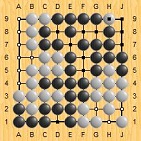
The question being about how this ko resolved:
White is thick to the right, so I guess black didn't want a risky fight by trying to play normally and instead played the usual ko.
Later, white plays the following "threat" and black seemingly wins the ko in sente. I think the key point is more or less what I said at the time, that black's central threat caused an exchange rather than a continuation of the ko fight.
With this threat, they have created a volatile, unsettled position. Locally speaking, black now owes starting the ko at 'a'. His threat was a gote, so to speak. But if he continues locally he won't have time to fight top left.
I would view white's threats not so much fighting the ko (which was black's option to create), as accepting this exchange. Coming back to 166. White removes the massive ko fight for life in the centre, living with points there in gote.
In exchange, black also lives (in sente) top left letting him come back to cover his weakness bottom left.
Also viewing it as an exchange from white's perspective rather than a ko proper, all of white's threats are marked. He never played a bad ko threat.
Edit: Maybe one should say top left and centre were miai.
Edit 3, hidden bonus question edition:
Edit: Fortunately, I remembered enough of and about the game to find it easily on gokifu.com.
The question being about how this ko resolved:
White is thick to the right, so I guess black didn't want a risky fight by trying to play normally and instead played the usual ko.
Later, white plays the following "threat" and black seemingly wins the ko in sente. I think the key point is more or less what I said at the time, that black's central threat caused an exchange rather than a continuation of the ko fight.
With this threat, they have created a volatile, unsettled position. Locally speaking, black now owes starting the ko at 'a'. His threat was a gote, so to speak. But if he continues locally he won't have time to fight top left.
I would view white's threats not so much fighting the ko (which was black's option to create), as accepting this exchange. Coming back to 166. White removes the massive ko fight for life in the centre, living with points there in gote.
In exchange, black also lives (in sente) top left letting him come back to cover his weakness bottom left.
Also viewing it as an exchange from white's perspective rather than a ko proper, all of white's threats are marked. He never played a bad ko threat.
Edit: Maybe one should say top left and centre were miai.
Edit 3, hidden bonus question edition:
-
jts
- Oza
- Posts: 2672
- Joined: Sat Sep 18, 2010 4:17 pm
- Rank: kgs 6k
- GD Posts: 0
- Has thanked: 310 times
- Been thanked: 637 times
Re: jts takes notes
Okay, this post is just a scratchpad to keep track of a few posts where I took the time to explain some beginner issues. It's getting surprisingly hard to remember where they are!
Size of moves n stuff
http://www.lifein19x19.com/forum/viewto ... 366#p73366
Fuseki - miai
http://www.lifein19x19.com/forum/viewto ... 26#p102626
Fuseki - long, w diagrams n stuff
http://www.lifein19x19.com/forum/viewto ... 88#p101488
What counting is
http://www.lifein19x19.com/forum/viewto ... 35#p108735
Memorization vs familiarity with L&d
http://www.lifein19x19.com/forum/viewto ... 56#p109356
Historical Connection between territory and area scoring
http://www.lifein19x19.com/forum/viewto ... 274#p95274
More on area/territory being the same
http://www.lifein19x19.com/forum/viewto ... 814#p75814
What counts as territory?
http://www.lifein19x19.com/forum/viewto ... 343#p91343
What's an invasion / what counts as territory?
http://www.lifein19x19.com/forum/viewto ... 294#p79294
When connecting is/isn't important
http://www.lifein19x19.com/forum/viewto ... 001#p69001
List of things beginners can ask themselves
http://www.lifein19x19.com/forum/viewto ... 815#p78815
Okay, that was actually the one I was looking for, this should be good for now.
Size of moves n stuff
http://www.lifein19x19.com/forum/viewto ... 366#p73366
Fuseki - miai
http://www.lifein19x19.com/forum/viewto ... 26#p102626
Fuseki - long, w diagrams n stuff
http://www.lifein19x19.com/forum/viewto ... 88#p101488
What counting is
http://www.lifein19x19.com/forum/viewto ... 35#p108735
Memorization vs familiarity with L&d
http://www.lifein19x19.com/forum/viewto ... 56#p109356
Historical Connection between territory and area scoring
http://www.lifein19x19.com/forum/viewto ... 274#p95274
More on area/territory being the same
http://www.lifein19x19.com/forum/viewto ... 814#p75814
What counts as territory?
http://www.lifein19x19.com/forum/viewto ... 343#p91343
What's an invasion / what counts as territory?
http://www.lifein19x19.com/forum/viewto ... 294#p79294
When connecting is/isn't important
http://www.lifein19x19.com/forum/viewto ... 001#p69001
List of things beginners can ask themselves
http://www.lifein19x19.com/forum/viewto ... 815#p78815
Okay, that was actually the one I was looking for, this should be good for now.
-
jts
- Oza
- Posts: 2672
- Joined: Sat Sep 18, 2010 4:17 pm
- Rank: kgs 6k
- GD Posts: 0
- Has thanked: 310 times
- Been thanked: 637 times
Re: jts takes notes
I haven't had a real problem playing out my games during an immediate review in over a year, so I always assume that it won't be a problem to record them and start keeping records of my games (especially important now that 90%+ of my games are face-to-face). But when I really want to ask for advice here or on KGS, I'm always chagrined to find that I can't actually remember the most important sequences.
So today I thought I would try recording a game that I had just reviewed extensively, just to get in practice, but lo and behold, 30 minutes later I couldn't remember it. I continued to try to hack away at it after dinner, but I'm giving up. I couldn't tell you where W found a ko threat to save my life.
Edit: okay, posting it revealed the problem - I had W play a ko threat (112) without taking the ko first.
So today I thought I would try recording a game that I had just reviewed extensively, just to get in practice, but lo and behold, 30 minutes later I couldn't remember it. I continued to try to hack away at it after dinner, but I'm giving up. I couldn't tell you where W found a ko threat to save my life.
Edit: okay, posting it revealed the problem - I had W play a ko threat (112) without taking the ko first.
- Attachments
-
- 130223vsalex.sgf
- (985 Bytes) Downloaded 1241 times
-
jts
- Oza
- Posts: 2672
- Joined: Sat Sep 18, 2010 4:17 pm
- Rank: kgs 6k
- GD Posts: 0
- Has thanked: 310 times
- Been thanked: 637 times
Re: jts takes notes
It always takes me a half an hour or so to figure out how to fix CGoban after I try logging in to KGS on a guest network by mistake; hopefully I'll remember that I've posted it in my journal.
Code: Select all
javaws -updateVersions -Xclearcache-
jts
- Oza
- Posts: 2672
- Joined: Sat Sep 18, 2010 4:17 pm
- Rank: kgs 6k
- GD Posts: 0
- Has thanked: 310 times
- Been thanked: 637 times
Re: jts takes notes
It has been nearly two months since my last update - I suppose I should include some information on my Go activities. I have played, oh, I would guess somewhere between 8-20 games. I was beaten soundly by a Korean 7d on the internet - during the fuseki. I re-read "In the Beginning" (funny how many of the reference positions are recognizable fuseki/joseki) and also "38 Basic Joseki". (I must admit that 38 Basic Joseki is not as bad as I had thought from the first two times I tried to read it. However, it isn't as accessible to multiple levels as the other books. You really need to be familiar with the joseki already, and then use "38" to systematize what you know. I've heard that Go players were much more obsessed with joseki thirty years ago; perhaps this is an artifact of that.) I taught one little girl to play using stone counting. (I even discovered a great way to teach the Ko rule - capture/recapture the ko until your student starts giggling.) I haven't been doing problems or playing through pro games.
***
Anyway, I'm adding an entry to make a record of two notes for later reference:
"Der Mensch soll mit der Schoenheit nur spielen, und er soll nur mit der Schoenheit spielen."
Style dichotomies that people sometimes conflate: high variance versus soba go, influence versus points, fighting versus peaceful, crazy versus solid, thin versus thick.
***
Anyway, I'm adding an entry to make a record of two notes for later reference:
"Der Mensch soll mit der Schoenheit nur spielen, und er soll nur mit der Schoenheit spielen."
Style dichotomies that people sometimes conflate: high variance versus soba go, influence versus points, fighting versus peaceful, crazy versus solid, thin versus thick.
-
jts
- Oza
- Posts: 2672
- Joined: Sat Sep 18, 2010 4:17 pm
- Rank: kgs 6k
- GD Posts: 0
- Has thanked: 310 times
- Been thanked: 637 times
Re: jts takes notes
What a silly journal.
The original premise of this journal has been more or less abandoned. I never typed up my notes on Kageyama from a year ago, and I didn't bother to make notes when I reread a few go books earlier this year.
Overall, a big part of the original motivation for taking notes on books I had already read was that I felt I wasn't applying the fascinating things I had read about in my games, and figured that I had not read the books carefully enough or retained/digested what I had learned. In retrospect that seems off-base. I wasn't applying what I had read correctly because I couldn't read very well, couldn't count at all, and couldn't come up with an intelligent plan to save my life.
(I still can't read or count, but my stones do live occasionally.)
It's also worth recalling that the reason why I had read so many books that I barely understood was that I was travelling for about four months at around 6k, and only had books I lugged around with me to keep my new obsession alive. It makes perfect sense now that at the end of those three months I had, if anything, declined as a player. I imagine I'll still benefit from re-reading some of them for as long as I'm playing Go. I guess I should say - reading books might help me live up to some potential I've gained by playing oodles of games, but I shouldn't have expected that I would be able to apply the material in those books more faithfully by reading them more carefully.
I've also stopped studying Go games. Actually, I never really started studying the games. The idea was to memorize games and, as I became comfortable with the games, start to analyze them in depth from different angles. In my defense, this was a plan that was adapted for a period in my life when I had just moved, was winging it without internet, and didn't realize there was a club that met twice a week, four blocks from my home. Now that I am back on the grid and getting six games a week at my club, I could claim that I don't want to study games anymore. But really, I do - I didn't stop on purpose. I had selected my next game back in November or so, and it had a very difficult ko that started early and went on into the endgame. I can't say why, exactly, but this threw my plans into disarray; I never finished or discarded that game, I never made progress on the games whose openings I knew, and I never progressed to the analysis of the games I knew by heart.
I do hope I return to playing through professional games, but in the foreseeable future I won't be trying to improve. That is, I don't have any special intention of gaining stones. So the journal will mainly serve as a scratchpad, if it serves as anything at all.
The original premise of this journal has been more or less abandoned. I never typed up my notes on Kageyama from a year ago, and I didn't bother to make notes when I reread a few go books earlier this year.
Overall, a big part of the original motivation for taking notes on books I had already read was that I felt I wasn't applying the fascinating things I had read about in my games, and figured that I had not read the books carefully enough or retained/digested what I had learned. In retrospect that seems off-base. I wasn't applying what I had read correctly because I couldn't read very well, couldn't count at all, and couldn't come up with an intelligent plan to save my life.
(I still can't read or count, but my stones do live occasionally.)
It's also worth recalling that the reason why I had read so many books that I barely understood was that I was travelling for about four months at around 6k, and only had books I lugged around with me to keep my new obsession alive. It makes perfect sense now that at the end of those three months I had, if anything, declined as a player. I imagine I'll still benefit from re-reading some of them for as long as I'm playing Go. I guess I should say - reading books might help me live up to some potential I've gained by playing oodles of games, but I shouldn't have expected that I would be able to apply the material in those books more faithfully by reading them more carefully.
I've also stopped studying Go games. Actually, I never really started studying the games. The idea was to memorize games and, as I became comfortable with the games, start to analyze them in depth from different angles. In my defense, this was a plan that was adapted for a period in my life when I had just moved, was winging it without internet, and didn't realize there was a club that met twice a week, four blocks from my home. Now that I am back on the grid and getting six games a week at my club, I could claim that I don't want to study games anymore. But really, I do - I didn't stop on purpose. I had selected my next game back in November or so, and it had a very difficult ko that started early and went on into the endgame. I can't say why, exactly, but this threw my plans into disarray; I never finished or discarded that game, I never made progress on the games whose openings I knew, and I never progressed to the analysis of the games I knew by heart.
I do hope I return to playing through professional games, but in the foreseeable future I won't be trying to improve. That is, I don't have any special intention of gaining stones. So the journal will mainly serve as a scratchpad, if it serves as anything at all.
-
jts
- Oza
- Posts: 2672
- Joined: Sat Sep 18, 2010 4:17 pm
- Rank: kgs 6k
- GD Posts: 0
- Has thanked: 310 times
- Been thanked: 637 times
Re: jts takes notes
Eventually.I also reread Lessons in the Fundamentals of Go right after I moved, which was fruitful. It's odd how you can keep understanding such a simple book better and better. I took notes which I'll put up here eventually.
Current thoughts