I think we will find that our experience leads us to the proverbs rather than to independence from them. It makes me think of these few lines from a T.S. Eliot poem:Kirby wrote:That's probably a good analogy. Maybe it is less limiting when you get to the point where you can make your own hypotheses from experience, independently of proverbs...Numsgil wrote:I think rather proverbs help formulate a plan (hypothesis), and reading shows if it'll work or not (experimentation). Sort of like a scientific method (hypothesis before experiment).Uberdude wrote:Proverbs are all just shortcuts to avoid reading, and for positions like this reading truly is king.
If you're at a point where you can form plans ex nihilo, you don't need proverbs.
We shall not cease from exploration
And the end of all our exploring
Will be to arrive where we started
And know the place for the first time.
I think all of our experience, exploration, and ideas gleaned from others, will lead us to arrive again at a proverb and see it in a new light. My experience in my own games so far is minimal. All my ideas on where and how to play have been taken from others for the most part - mostly from books and stronger players. All of the great players stand on the shoulders of many others who have come before them. Look at how much Shusaku's games have been studied by those who came after him. I think the proverbs are a distillation of all this experience and act as sign posts to guide us in finding the best play.
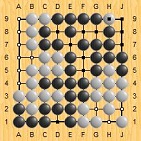
 which irritated me but it doesn't seem so bad now. I guess going after pure opening theory 'a' would be the move to do. However, I decided that it's time to invade the black framework and choose
  Playing at 'b' seemed like walking into B's trap for me. However, I'm sure there would have been other moves which are much better
  And I'm sure even the timing of the invasion is wrong but it seems like a nice position to search a good move to invade lightly.